
Politics
14:04, 25-Nov-2017
Egypt attack: What do we know?
 ["china"]
Share







Copied
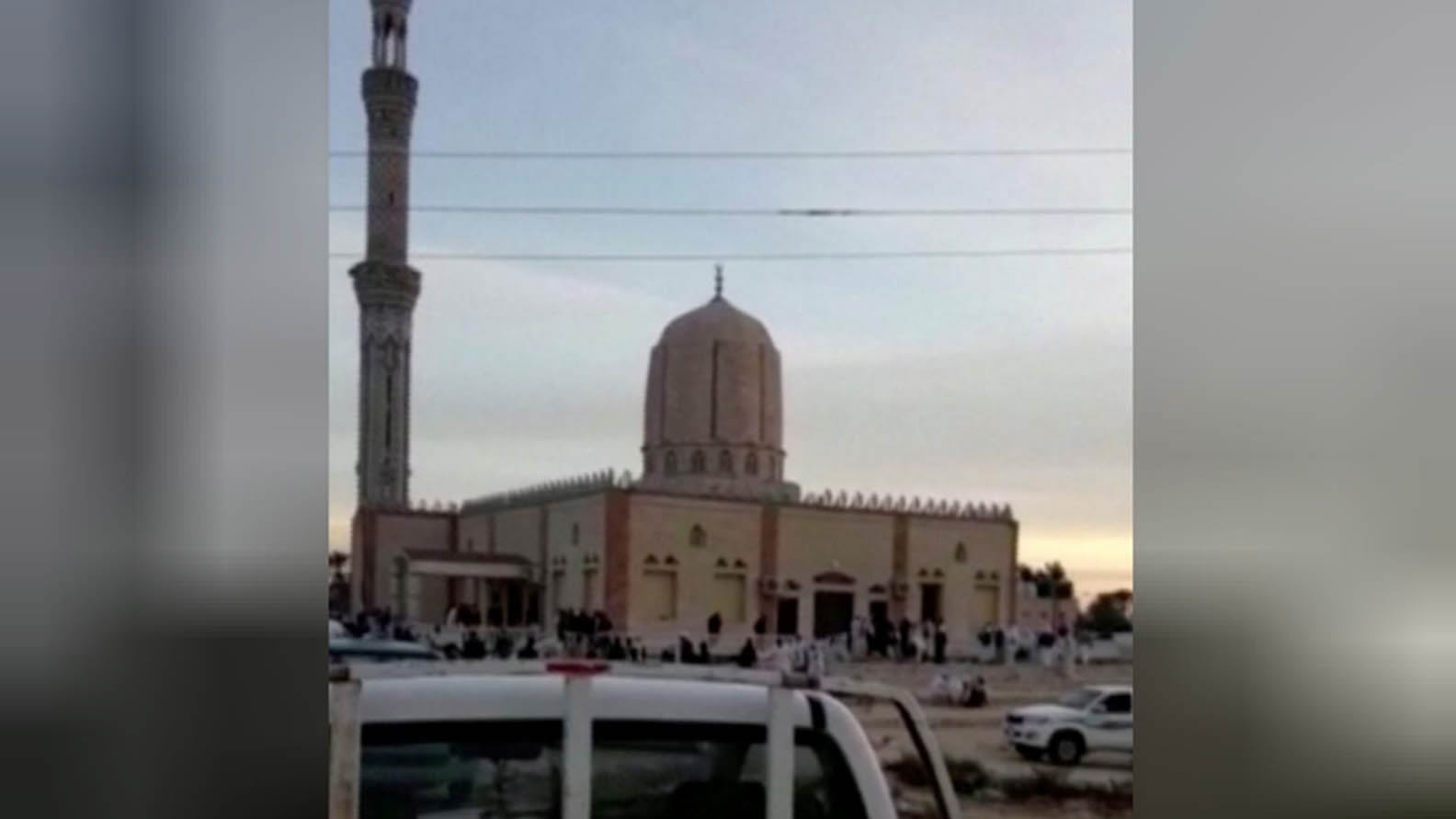
In the deadliest-ever attack in Egypt, militants assaulted a crowded mosque Friday during prayers, blasting helpless worshipers with gunfire and rocket-propelled grenades and blocking their escape routes. At least 305 people, including 27 children, were killed before the assailants got away.
What happened?
State media showed images of bloodied victims and bodies covered in blankets inside the Al Rawdah mosque in Bir al-Abed, west of El Arish, the main city in North Sinai.
Worshipers were finishing Friday prayers at the mosque when a bomb exploded, witnesses said. Around 40 gunmen set up positions outside the mosque with jeeps and opened fire from different directions as people tried to escape.
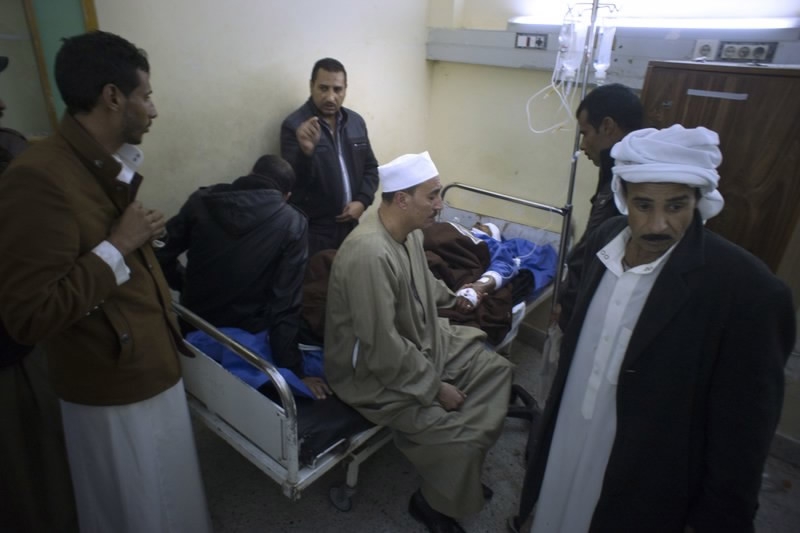
The victims receive medical treatment at Suez Canal University hospital in Ismailia, Egypt, November 24, 2017. /AP Photo
The victims receive medical treatment at Suez Canal University hospital in Ismailia, Egypt, November 24, 2017. /AP Photo
"Four groups of armed men attacked the worshipers inside the mosque after Friday noon prayers. Two groups were firing at ambulances to deter them," said Mohamed, a witness.
'Will avenge our martyrs'
No group immediately claimed responsibility, but since 2013 Egyptian security forces have battled an ISIL affiliate in the mainly desert region, and militants have killed hundreds of police and soldiers.
In a televised statement, Egyptian President Abdel Fattah al-Sisi sent a message of condolence to the families affected by the deadly attack, saying that the "vile and treacherous" act would not pass without a decisive punishment, and that the perpetrators will be brought to justice.
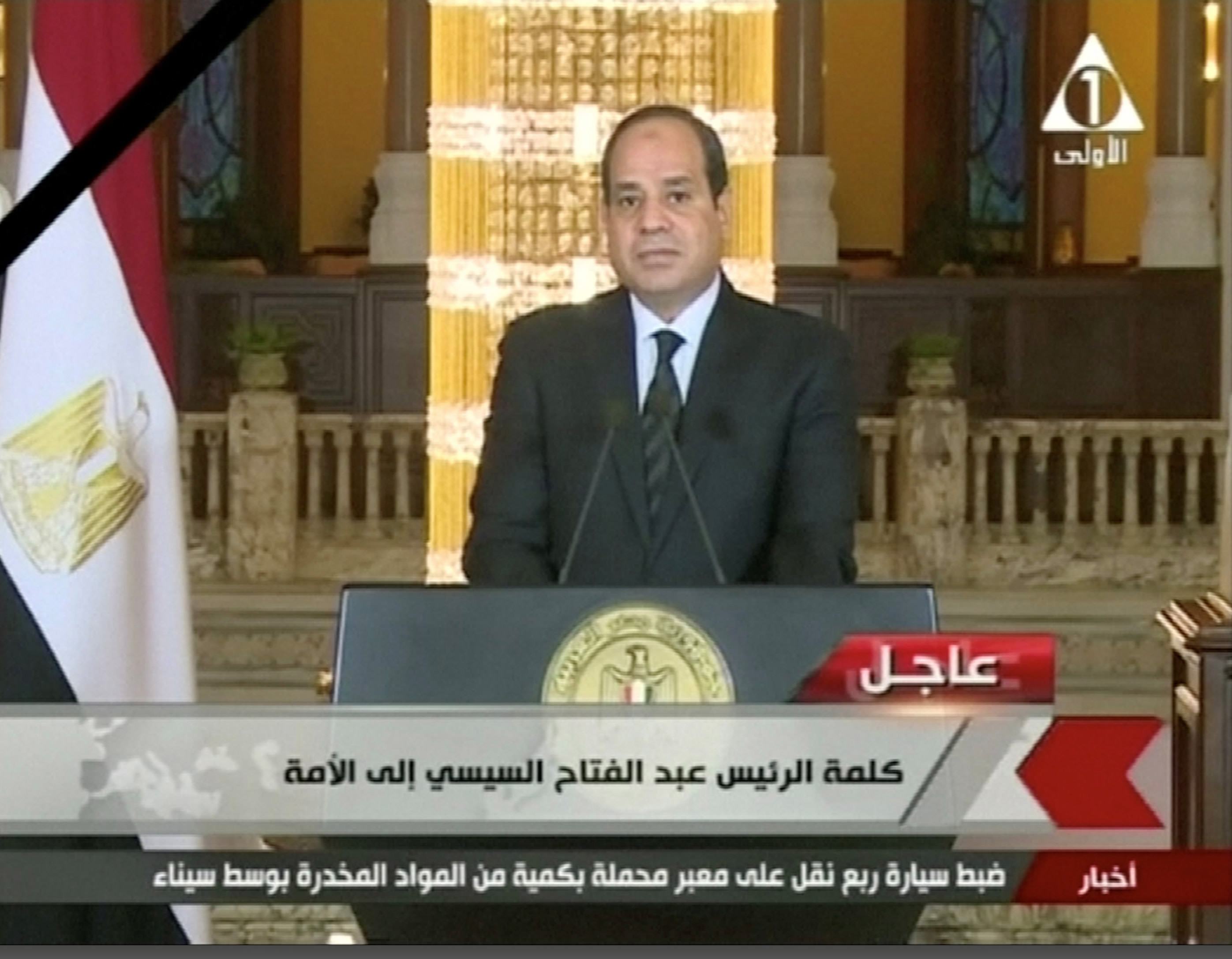
Egyptian President Abdel Fattah al-Sisi gives a televised statement on the
attack in North Sinai, in Cairo, Egypt, November 24, 2017. /Reuters Photo
Egyptian President Abdel Fattah al-Sisi gives a televised statement on the attack in North Sinai, in Cairo, Egypt, November 24, 2017. /Reuters Photo
“What is happening is an attempt to stop us from our efforts in the fight against terrorism, to destroy our efforts to stop the terrible criminal plan that aims to destroy what is left of our region," President Sisi said in a televised address.
"The armed forces and the police will avenge our martyrs and restore security and stability with the utmost force," Sisi said.
Hours after the attack, Egypt's military launched air strikes on targets in mountainous areas around Bir al-Abed, security sources and witnesses said.
Egypt later said it would delay the opening of the Rafah border crossing to Gaza after the attack due to security concerns. The crossing had been due to open for three days beginning on Saturday.
Who was targeted?
Striking at a mosque would be a change in tactics for the Sinai militants, who have usually attacked troops and police and Christian churches.

Arabiya news channel and some local sources said some of the worshipers were Sufis, who groups such as ISIL consider targets because they revere saints and shrines, which for Islamists is tantamount to idolatry.
Who might be behind the attack?
North Sinai, which stretches from the Suez Canal eastwards to the Gaza Strip and Israel, has long been a security headache for Egyptian security forces because of smuggling.
Local militant group Ansar Bayt al-Maqdis, once allied to al-Qaeda, split from it and declared allegiance to ISIL in 2014. It was "the most active" group in the region and launched recent attacks which mostly targeted army personnel since 2011, according to CGTN correspondent Yasser Hakim. Attacking Muslim mosque is "a new shift," Hakim said, but more details on who has attacked the mosque are still to be known.
According to Dong Manyuan, the senior research fellow at China Institute of International Studies, the alignment of Muslim Brotherhood and ISIL is the cause of Sinai terrorism.
"After the ISIL lost its so called territories in both Syria and Iraq, the leader began to encourage followers to show muscle in the Sinai Peninsula, and in Afghanistan," Dong said, the deadliest attack on Friday shows that the terrorist group has been "localized" and "Daesh (ISIL) has successfully established their presence on the Sinai Peninsula."

The Sinai branch is one of ISIL’s surviving branches following the collapse of its self-declared caliphate in Syria and Iraq after military defeats by US-backed forces.
Bloodshed in the Sinai worsened after 2013 when Sisi led the overthrow of President Mohamed Mursi of the Muslim Brotherhood.
ISIL earlier this year posted a video of the beheading of two Sufis in northern Sinai, accusing them of practicing “sorcery.”
In July this year, at least 23 soldiers were killed when suicide car bombs hit two military checkpoints in the Sinai, in an attack claimed by ISIL.
Militants have tried to expand their operations into Egypt’s heavily populated mainland, hitting Coptic Christian churches and pilgrims. In May, gunmen attacked a Coptic group traveling to a monastery in southern Egypt, killing 29.
How has the world reacted?
The terror attack has drawn widespread local and international condemnation.
The UN Security Council and Secretary-General Antonio Guterres have condemned the deadly attack in “the strongest terms" and called for the perpetrators to be brought to justice.
US President Donald Trump, in a post on Twitter on Friday, called the assault a "horrible and cowardly terrorist attack."
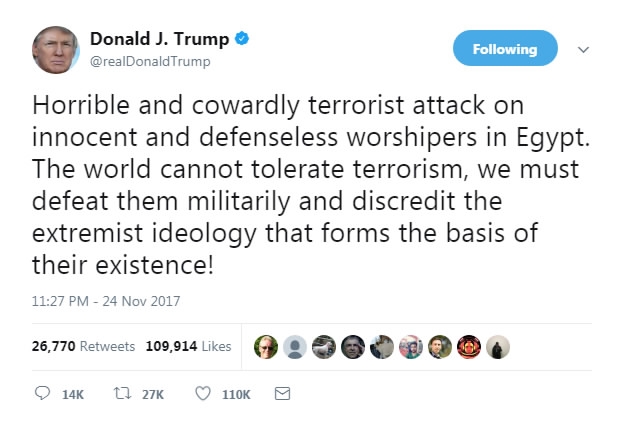
/Twitter screenshot
/Twitter screenshot
Trump later called Sisi to express his condolences and said the United States "stands by Egypt's side in its fight against terrorism and is ready to strengthen cooperation with Egypt in this field," according to a statement from Sisi's office.
France, UK and Italy, as well as Middle Eastern nations including Saudi Arabia, Palestine, Kuwait, also condemned the attack and expressed solidarity with Egypt.
(With input from Reuters, AP)