
17:40, 15-Feb-2019
IBM Think 2019: Human VS Robot, who won the debate?
Updated
17:30, 18-Feb-2019
 []
[]
Share







Copied
03:47
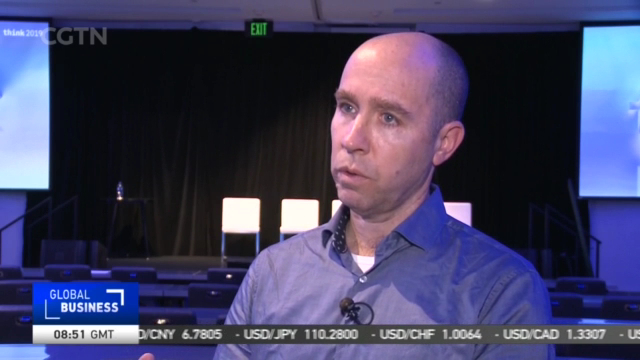
Tech giant IBM is holding its annual IBM Think conference in San Francisco. This year, it gave the world a look at groundbreaking innovations that herald our technology future.
At IBM Think, the world's first live stream public debate between a human and an Artificial Intelligence-driven machine.
"But I suspect you've never debated a machine."
Both sides had fifteen minutes to prepare for the debate resolution "We should subsidize preschool".
The machine, Project debater, drew on a collection of 10 billion sentences and 400 million articles to formulate a four-minute opening argument in support of subsidizing preschool.
"While I cannot experience poverty directly, and have no complaints concerning my own standard of living. I still have the following to share. Regarding poverty, research clearly shows that a good preschool can help kids overcome the disadvantages often associated with poverty."
The machine is competing against Harish Natarajan, a grand finalist at the 2016 world debating championships.
HARISH NATARAJAN EUROPEAN DEBATE CHAMPION "Yes, you could make it slightly more accessible for individuals to attend preschool, that doesn't mean those individuals that are as poor as Project Debater seems to want the teams to care about people are going to be those who have the ability to send their child to preschool."
"Giving opportunities to the less fortunate should be a moral obligation of any human being. And it is a key role for the state."
NOAM SLONIM PRINCIPAL INVESTIGATOR, PROJECT DEBATER "Debater needed to listen to Harish Natarajan for four minutes making very subtle and complex arguments and still generate a rebuttal. This is a different level of language understanding and still the system I think was performing very well."
When the debate ends, polls indicate Natarajan won since he swayed the opinion of 17-percent of the audience toward his favor.
"Congratulations to him."
NOAM SLONIM PRINCIPAL INVESTIGATOR, PROJECT DEBATER "I feel that this is out of the comfort zone of artificial intelligence and this is why it is so fascinating. It has so many open questions, so I feel the debate we saw is just the beginning."
But polls did show the computer enriched the audience's knowledge more than the human debater.
RANIT AHARONOV, MANAGER PROJECT DEBATER TEAM "What the system was able to do and is very difficult for a human to do in a short amount of time is get a lot of information and data. But the human I think was clearly better in building arguments step by step. I don't think that AI should be striving to get the same kind of intelligence of humans. But rather we should use the strength of computers which is different from human intelligence, to augment and enhance humans in what they do."
Other futuristic technology on display at the event, included IBM Q System One. It performs Quantum Computing, a radically different approach that scientists believe could solve problems too complex even for even supercomputers.
MARK NIU SAN FRANCISCO "So sophisticated is the IBM Q System One. It must be kept inside an airtight case that keeps the temperature colder than outer space. Any change in temperature could disrupt the pristine computing environment."
Other tech making its debut included the Verifier, which attaches to a smartphone to detect food bacteria and even determine whether a food product is counterfeit.
DONNA DILLENBERGER, IBM FELLOW THOMAS J. WATSON RESEARCH CENTER "Seventy-three percent of the extra virgin olive oil coming into this US is mislabeled or counterfeit. We've done this not only with olive oil and other cooking oils. We've used this to tell the difference between red wine, cabernets. We've used this to tell the difference between white wines."
Dillenberger believes the technology can go beyond the smartphones by being embedded into everything from cutting boards to the very utensils we use to consume our meals. Mark Niu, CGTN, San Francisco.