
17:54, 15-May-2018
Palestinian Diaspora 70 Years On: Israel says Palestinian refugees can never return home
 []
[]
Share







Copied
03:48
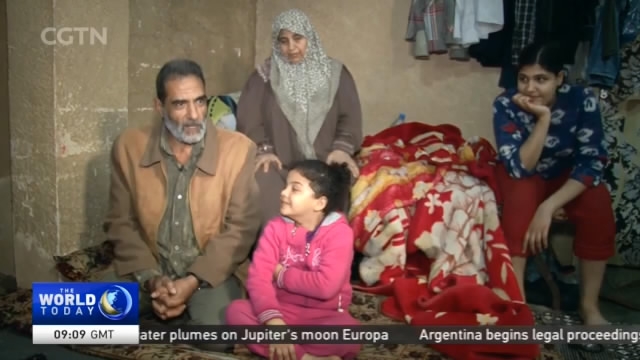
In May 1948, the British mandate over Palestine ended and Jewish settlers declared the creation of Israel. For Palestinians, it was a "catastrophe" or in Arabic - "Nakba". Israeli troops and militias drove 800 thousand Palestinians from their villages and towns and seized their land. One of the places the refugees fled to was Lebanon. CGTN's Natalie Carney takes a look at the Palestinian diaspora, 70 years on.
This is the Shatila refugee camp in Beirut, Lebanon, built in 1949 for newly arrived Palestinian refugees. It was only meant to be a temporary solution.
MAHMOUD ABBAS ABU MUJAID , DIRECTOR CHILDREN'S YOUTH CENTER SHATILA "I don't know what to say about the situation in Shatila. As you see with your eyes, that it is misery. It's a small area, established for 3000 people, now we have over 22,000 people in the same location, the same size, which makes the lives very difficult in all aspects."
Mahmoud Abbas Abu Mujaid, a Palestinian refugee himself, is the director of the Children's Youth Centre, one of the only facilities providing the camp's youth with education and recreational activities.
As of 2017 some half a million Palestinian refugees in Lebanon are registered with the United Nations Relief and Works Agency, an estimated ten percent of the country's population. But unlike citizens, Palestinian refugees cannot obtain free treatment at Lebanese hospitals and are barred from most public schools. Even for second or third generations born and brought up in the country, it is almost impossible for Palestinians to get citizenship, unlike in other countries such as Jordan.
MAHMOUD ABBAS ABU MUJAID, DIRECTOR CHILDREN'S YOUTH CENTER SHATILA "As refugees They are not having the right to develop their community, to develop their life."
SYLVIA HADDAD, EXECUTIVE DIRECTOR JOINT CHRISTIAN COMMITTEE FOR SOCIAL SERVICES "They don't have the right to work. They don't have the right to own a house. The difficulty in their being able to travel easily. They are not living a normal decent life."
Sylvia Haddad and her staff at the Joint Christian Committee for social services is also providing practical education and vocational training to refugees and other impoverished communities in and around Shatila, which itself is difficult at best.
IMAN CHEHADE, VOLUNTEER CHILDREN'S YOUTH CENTER SHATILA "Look, here is one example for million of this show in the camp. Everything with each other.
Palestinian Iman Chehade has lived in Shatila for nearly 20 years.
IMAN CHEHADE, VOLUNTEER CHILDREN'S YOUTH CENTER SHATILA "As you see the cable for satellite, the cable for internet, the cable for water, the cable for electricity, the electricity for a generator, you have many cables with each other. If they have water, touch the water and touch you – you will die."
The war in neighboring Syria has also pushed a million and a half refugees into Lebanon, many joining the fight for survival in Shatila camp, such as Fuad Abu Khaled, a Palestinian refugee twice over.
FUAD ABU KHALED PALESTINIAN REFUGEE IN SHATILA REFUGEE CAMP "A family living well here eats twice a day. That's really a rich family. A normal family eats once a day. And there are families that sometimes can't afford one meal."
Today, there are over 12 million Palestinians worldwide of which 5.4 million are refugees, making up one of the world's largest refugee population. Most are scattered across the Middle East either in camps like Shatila or in independent living arrangements. 300,000 are estimated to live in the United States and Canada while a further 100,000 Palestinian refugees are spread out across the EU. Yet, 70 years on it still remains unclear when or even if Palestinians will ever be able to return home. Natalie Carney CGTN Beirut, Lebanon.