
16:09, 21-May-2019
China's Indigenous Religion: Taoism emphasizes harmony between humanity and nature
Updated
16:00, 24-May-2019
 []
[]
Share







Copied
03:59
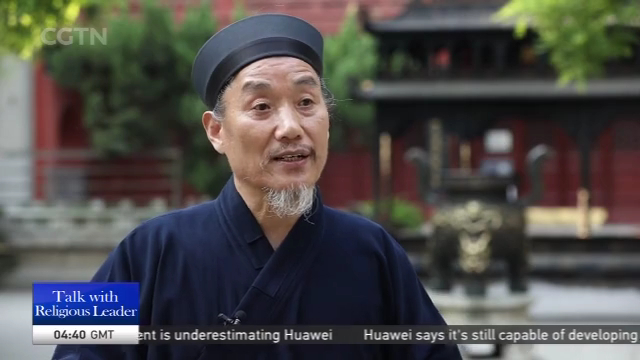
Taoism is one of China's best-known religions. It's an ancient tradition of philosophy and religious belief carrying a deep-rooted Chinese worldview. But what exactly is Tao? Why do so many westerners find Taoism fascinating? What is the impact of the ancient philosophy on modern life? And, how does it promote communication and exchange between civilizations? Our reporter Su Yuting went to the largest Taoist establishment in Beijing, the Baiyun Temple, to find out more.
This is a movement to achieve balance, respecting the rules of nature and following a way of life.
Zhong Daosong is a Taoist master in Baiyun Temple. He has learned martial arts for many decades to set aside impatience, and hatred, and to build upon harmony with a calm and peaceful heart.
ZHONG DAOSONG TAOIST MASTER, BAIYUN TEMPLE "The Dao, or the Way, is the approach in accord with the flow of Nature. The basic idea of the Taoists is to enable people to realize that, since human life is really only a small part of a larger process of nature, the human lives which make sense are those which are in harmony with nature. Although different countries and various regions have their own cultures, if we pursue harmony between humanity and nature, there will be no friction and no violence."
Taoism is China's indigenous religion. It's also a religion of unity and opposites, as evident in its best-known symbol, the circle of yin and yang. This represents two primal opposite forces in the universe: light and darkness, male and female, hot and cold.
SU YUTING CGTN REPORTER "That's a very famous sentence noted by Chinese philosopher Lao Tzu in Tao Te Ching, the ancient text of Taoism, over 2,000 years ago. In English, it means 'The supreme good is like water, which benefits all of creation without trying to compete with it.' This philosophy has fascinated and inspired people in China, as well as those in many Asian countries and more recently in the West, over the course of many centuries."
Taoism has become increasingly influential in the west. Many foreigners are fascinated about learning the way of Tao.
BOUCHAIN ARLETTE FRENCH TAOIST BELIEVER "I really want to be integrated into the culture of Taoism, especially in the fields of alternative medicine, meditation and martial arts such as Tai Chi."
LINDENBLITH FRANCK FRENCH TAOIST BELIEVER "The spirit of Taoism is just like this temple, it's full of tranquility with a very gorgeous and profound culture."
Meng Zhiling, Vice Chairman of the China Taoist Association, says that Taoism explores the ultimate creative principle of the universe --- the combination of heaven, the earth and humans.
MENG ZHILING, VICE CHAIRMAN CHINA TAOIST ASSOCIATION "The culture of Taoism is universal without any barriers. It has boosted cultural exchanges and mutual learning. The reason why western people like Taoism so much is mainly because Taoism has no boundaries. Tao explores the ultimate creative principle of the universe."
For many Taoist masters like Zhong Daosong, they believe in the ancient Chinese philosophy and wisdom. Chinese culture emphasizes co-existence, and that can be found in Taoism. Wide hearts embrace all, and all rivers run into the sea. That's the beauty of peace and harmony. Su Yuting, CGTN, Beijing.