
19:37, 30-Jul-2019
Indonesia's Imported Waste: Village residents capitalize on waste from UK, US
Updated
20:21, 30-Jul-2019

Share






Copied
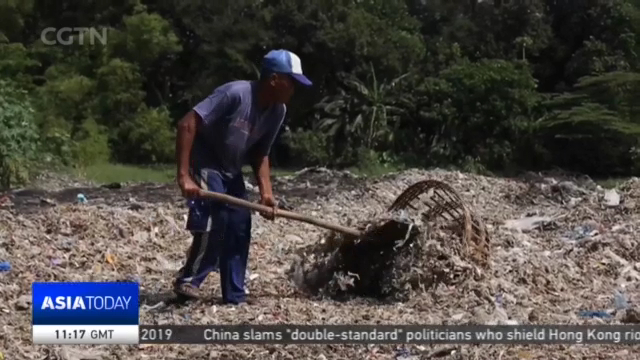
Indonesia is working on tightening policies to eventually ban developed nations from sending their waste into the country. But as CGTN's Silkina Ahluwalia reports, an entire village in East Java relies heavily on the imported waste as their source of income.
Just an hours drive out of East Java's capital city, Surabaya is Bangun Village. It may look like an ordinary town. But in the past year, it has become a dumping ground for developed nations that continue to export their waste into Indonesia. Giman has been a resident here since he was a young boy. Today, he is the head of the village and this growing pile of waste provides income for his entire family.
GIMAN, HEAD BANGUN VILLAGE "I put three of my children through university by selling waste items for the past 18 years. We want the government not to shut this down because as you can see, this is a poor neighborhood and this is our livelihood."
He spends his day scavenging the area for anything from cans to plastic bags and scraps.
SILKINA AHLUWALIA MOJOKERTO, EAST VILLAGE "What you're seeing is the literal meaning of 'one man's trash is another man's treasure'. The waste here comes from countries like the UK, the United States and Germany. Scavengers here say they can make up to 9 US dollars per day selling these items to recycling facilities and other industries."
The UK is the highest exporter of waste into Indonesia with imports reaching 68 thousand tons in 2018. This is followed closely by Germany's 59 thousand tons. Now, the Indonesian government is working to strengthen their policies to make waste imports illegal, going as far as sending the waste back to their country of origin.
PRIGI ARISANDI ENVIRONMENTALIST "There needs to be a meeting point between the residents and the government. 3,000 people rely on the waste as their source of income. We have to see a gradual change. It can take 1 to 3 years. The residents need to know there are other ways they can make money. But they also should know this is not normal or healthy. Being exposed to burned plastic waste has serious health issues in the long run."
And while the locals rely heavily on the imported waste in Bangun Village, the Indonesian government is beginning to educate the residents on the health and environmental impacts it has on the region. Malaysia is another country that's trying to ban waste imports. My colleague Rian Maelzer has more from Kuala Lumpur.
Workers sift through locally produced plastic waste. It is then mixed with used plastic packaging from the US, washed twice, shredded, dried, and turned into plastic pellets for shipping to China.
This clean, legal operation is in sharp contrast to the unlicensed factories that sprouted up in Malaysia last year when the country became the number 1 destination for Western plastic waste after China shut its doors.
Much of the waste couldn't even be recycled, and was just dumped or burned. The government has cracked down hard on the importation of plastic waste, hitting legal recyclers hard too.
DANIEL LOO MALAYSIA PLASTICS RECYCLERS ASSOCIATION "It actually crippled the whole industry. For us as a legal operators, we don't import those kinds of rubbish."
RIAN MAELZER MERU, MALAYSIA "Malaysia's domestic waste recycling is still at a really rudimentary level, so it's not producing enough raw material to sustain the legitimate recycling industry here."
DANIEL LOO MALAYSIA PLASTICS RECYCLERS ASSOCIATION "For this current moment, the government has actually set to every importer to have at least 30 percent of local waste to be absorbed by each and every factory."
That means they have to import the other 70 percent, and that has become increasingly hard. Some would like it to be tougher still.
PAUL SELVARAJ FEDERATION OF MALAYSIAN CONSUMERS ASSOCIATIONS "I think the way forward is to ban. Once it's stopped, then you can talk of regulation. Now it is gone way above what can be managed by the government. So the first step in terms of protection of the country, protection of consumers is to ban, and then to see the regulatory, that means what is recyclable."
The legal recyclers say they too are all for keeping out what they call plastic rubbish while allowing imports of recyclable plastics. They say it is vital to sustaining their industry, without which there will be no one left to recycle Malaysia's own homegrown plastic waste. Rian Maelzer, CGTN, Selangor, Malaysia.