Iran and Russia are actively engaging in safeguarding security in the Caspian Sea in cooperation with other littoral states. Top naval officials from both countries held talks on Saturday in Bali, Indonesia, where they were attending the third International Maritime Security Symposium (IMSS), Iran’s PressTV reported.
Both Tehran and Moscow agreed that security in the Caspian Sea should be maintained exclusively through cooperation among the littoral states of Azerbaijan, Iran, Kazakhstan, Russia and Turkmenistan. “We believe that the Caspian Sea is the sea of peace and friendship and in order to establish security in this sea, there is no need for foreign intervention,” Iran’s Navy Commander Rear Admiral Habibillah Sayyari was quoted as saying by PressTV.

Foreign ministers of the Caspian Sea littoral states: (L-R) Elmar Mamadyarov of Azerbaijan, Javad Zarif of Iran, Yerlan Idrisov of Kazakhstan, Sergei Lavrov of Russia and Rashid Meredov of Turkmenistan during their meeting in Moscow, on April 22, 2014. /AFP Photo
Foreign ministers of the Caspian Sea littoral states: (L-R) Elmar Mamadyarov of Azerbaijan, Javad Zarif of Iran, Yerlan Idrisov of Kazakhstan, Sergei Lavrov of Russia and Rashid Meredov of Turkmenistan during their meeting in Moscow, on April 22, 2014. /AFP Photo
The security of the Caspian Sea gains significance amid the growing interest in the region by global players, including China, owing to its geostrategic location and huge oil and gas reserves.
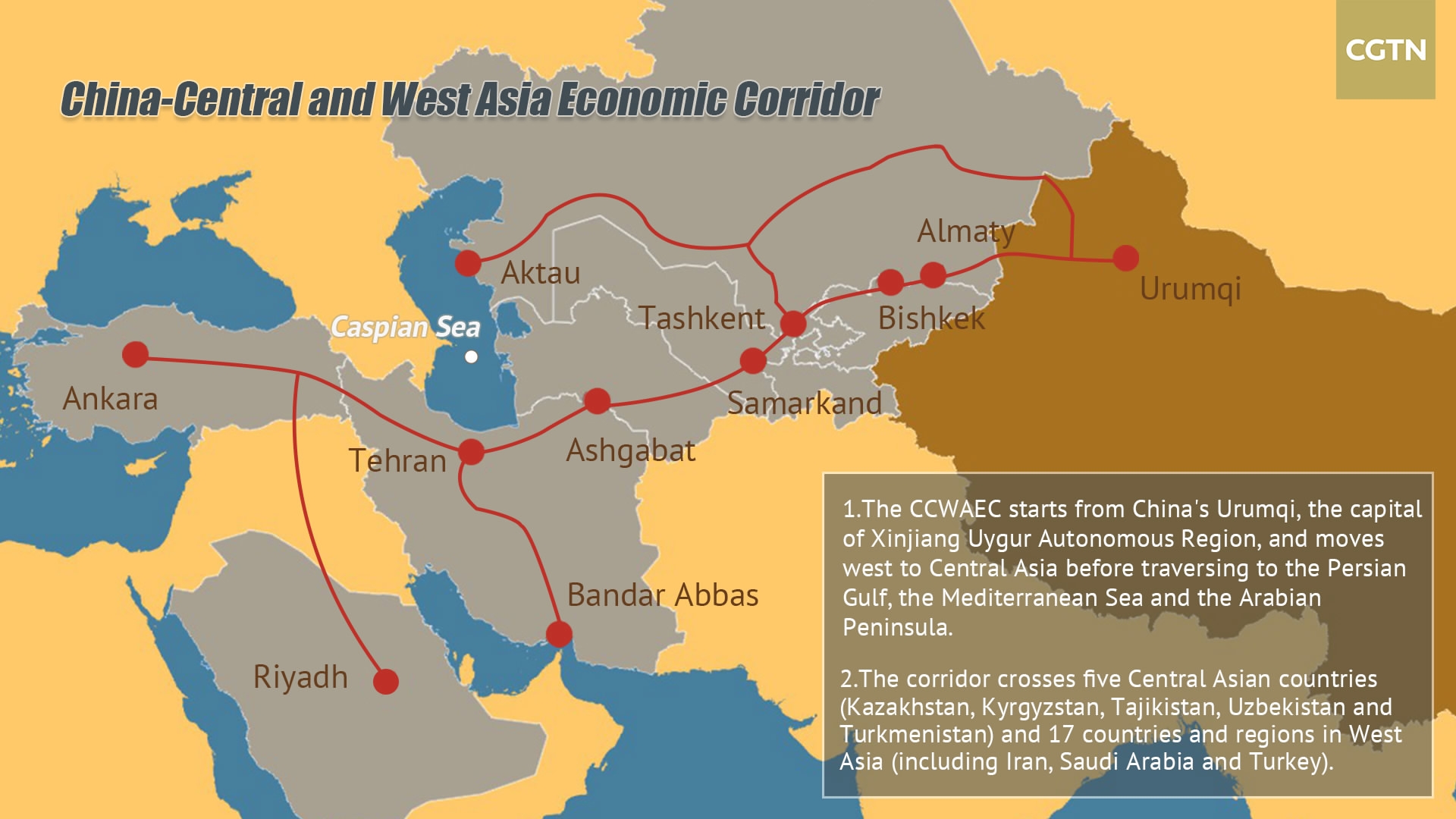
The Caspian Sea region – which also includes the immediate neighbors of the littoral states in the South Caucasus (Armenia and Georgia) and Central Asia (Kyrgyzstan, Tajikistan and Uzbekistan) – lies at a pivotal point in the China Central and West Asia Economic Corridor (CCAWAEC).
The region is, therefore, vital to Beijing’s Belt and Road Initiative (BRI) that envisions a route connecting Asia, Europe and the rest of the world.
Heavy militarization

An image grab made from a video made available on the Russian Defence Ministry's official website on October 7, 2015 reportedly shows a Russian warship launching a cruise missile in the Caspian Sea during a strike against ISIL's positions in Syria. /AFP Photo
An image grab made from a video made available on the Russian Defence Ministry's official website on October 7, 2015 reportedly shows a Russian warship launching a cruise missile in the Caspian Sea during a strike against ISIL's positions in Syria. /AFP Photo
The latest assertion by Iran and Russia comes nearly two years after Russia’s Caspian Fleet launched missile strikes on targets in Syria on October 7, 2015, making it the first time in history that the Caspian Sea was used for attacks beyond its immediate zone. A second strike was launched by the Russians on November 20, 2015. The missile strikes heightened the issue of security in the Caspian Sea region nations.
“Regarding the reaction of other Caspian states to the events of 7 October and 20 November, 2015, it should be admitted that Azerbaijan and Kazakhstan refrained from demonstrating their alarming [sic] at the official level. Actually, only Turkmenistan to some extent shared its concern about this matter with Russian authorities by expressing that the Kazakh colleagues were worried about what is going on over the issues of security of airspace over the Caspian Sea. Subsequently, Astana did not officially confirm or deny this information,” a report by the Almaty-based European Research Institute said.

Turkmenistan’s security forces take part in an anti-terrorist naval exercise on the Caspian Sea coast, about 60 km from the town of Turkmenbashi, September 5, 2012. /AFP Photo
Turkmenistan’s security forces take part in an anti-terrorist naval exercise on the Caspian Sea coast, about 60 km from the town of Turkmenbashi, September 5, 2012. /AFP Photo
The report titled “Current Security Issues in the Caspian Sea Region” stated that in the early 1990s the majority of the littoral states were opposed to the militarization of the Caspian Sea.
“However, confronted with a large range of issues related to the growth of drug-trafficking… illegal trade of sturgeon and the terrorist risks…. [to] onshore and offshore oil and gas infrastructure, they have revised their positions. Being convinced of the necessity for the military supervision of the Caspian basin, Azerbaijan, Kazakhstan and Turkmenistan decided to move ahead by forming national Caspian fleets,” it said.
As a result “since 2002, the practice for conducting large naval drills has become largely accepted by the Caspian Sea littoral states. However, such behavior only promotes militarization of the region…” it added.
Global prominence

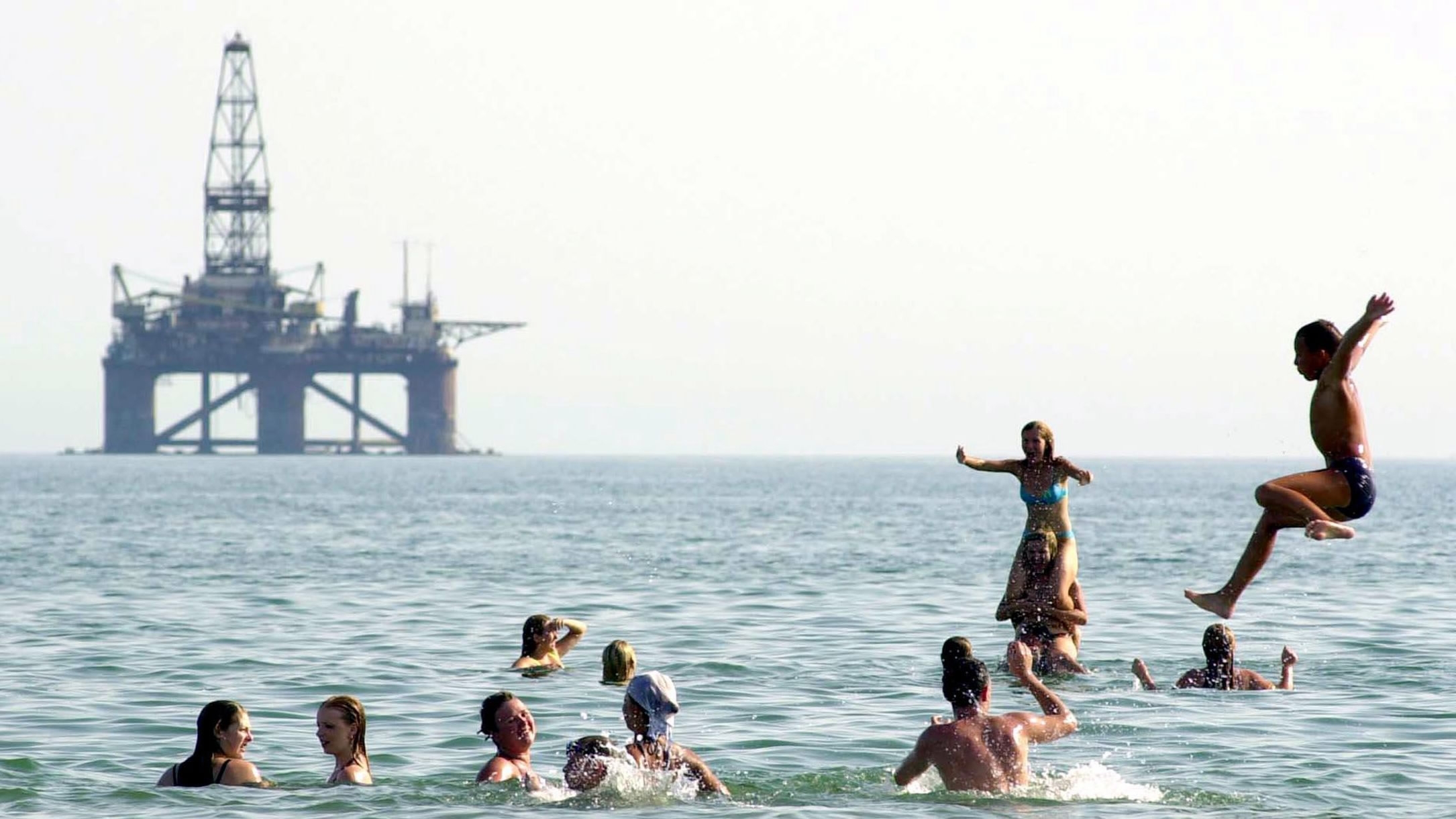
Boys cool off in the Caspian Sea, with offshore oil rigs seen in the background, in Baku, June 15, 2015. /AFP Photo
Boys cool off in the Caspian Sea, with offshore oil rigs seen in the background, in Baku, June 15, 2015. /AFP Photo
The Caspian Sea region has risen from relative oblivion to considerable prominence in international affairs following the breakup of the Soviet Union. Most major international players have shown increasing interest not only in maintaining ties with the regional powers, Russia and Iran, but also engaging in fruitful relationships with the new nations that emerged after the Soviet-collapse.
The growing interest in these new states among the international community is stimulated by essentially two factors, according to a study by Stockholm International Peace Research Institute (SIPRI) titled, “The Security of the Caspian Region”.
The SIPRI study counts geostrategic considerations as one of the primary reasons for this. “The new sovereign Caspian states occupy central positions in the heartland of the Eurasian continent and on the traditional trade routes between Europe and Asia. The concrete national strategies these states will follow have become of intense interest to the major extra-regional powers (the US, China and the European Union member states among them) and have induced them to start formulating their own policies in the Caspian Sea region,” the study said.

Chinese President Xi Jinping (L) and his Kazakh counterpart Nursultan Nazarbayev (R) launch "Beineu-Bozoy-Shymkent" gas pipeline in Astana, September 7, 2013. /AFP Photo
Chinese President Xi Jinping (L) and his Kazakh counterpart Nursultan Nazarbayev (R) launch "Beineu-Bozoy-Shymkent" gas pipeline in Astana, September 7, 2013. /AFP Photo
The second driving factor, according to the SIPRI study, for the widespread international interest in the Caspian Sea is motivated by the apparent large reserves of oil and natural gas in the region.
“Estimates of recoverable oil reserves range from 40-60 billion barrels to as high as 100 and even 200 billion barrels; those for natural gas range between 10 and 20 trillion cubic meters… It is widely accepted that the Caspian region’s recoverable oil and natural gas reserves are exceeded in size only by those of the West Asia and western Siberia,” the study said.
Growing Chinese presence
During the Soviet era, Russia was the most influential power in the Caspian Sea region. After 1991, the US made significant inroads into the region to reduce Moscow’s sway over the newly independent states.
In recent years, China and the EU member states have markedly expanded their presence in the region. Other players include India, Japan and South Korea, according to a study by The Jamestown Foundation, a Washington DC-based think tank.

The first piece of a gas pipeline to China outside of the city Turkmenabat, on August 30, 2007 /AFP Photo
The first piece of a gas pipeline to China outside of the city Turkmenabat, on August 30, 2007 /AFP Photo
China has booming economic and strategic relations with Russia and Iran, the two major Caspian Sea nations. Iran is already partly linked to a section of China’s BRI railport infrastructure project. Inaugurated in early 2015, the rail line links Iran to China via Turkmenistan and Kazakhstan.
In recent times, China has poured huge investments into Central Asia and the Caspian region – especially Kazakhstan and Turkmenistan – with two main infrastructure projects: The Kazakhstan-China oil pipeline and the Turkmenistan-China gas pipeline (also known as Central Asia-China gas pipeline).
Besides, the Caspian region is also vital to Beijing’s plan of building the China Central and West Asia Economic Corridor (CCWAEC) that would link the Asian giant with the Arabian Peninsula.
As envisioned in the BRI masterplan, the CCWAEC starts from China’s Xinjiang and moves west to Central Asia before traversing to the Persian Gulf, the Mediterranean Sea and the Arabian Peninsula.
The corridor crosses five Central Asian countries (Kazakhstan, Kyrgyzstan, Tajikistan, Uzbekistan and Turkmenistan) and 17 countries and regions in West Asia (including Iran, Saudi Arabia and Turkey).
In the light of increasing Chinese economic and strategic interests in the region, the joint initiative by Iran and Russia in safeguarding the security of the Caspian Sea in conjunction with their other regional partners appears reassuring.

 ["china","europe"]