
14:50, 29-Apr-2019
Interview with Malaysian PM: Mahathir Mohamad speaks to CGTN about BRI, Huawei visit
Updated
14:40, 02-May-2019
 []
[]
Share







Copied
07:26
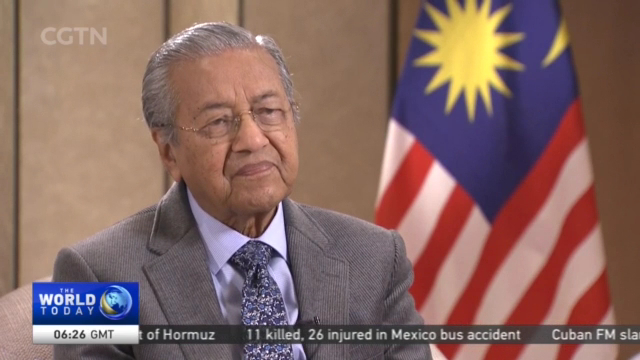
The Second Belt and Road Forum for International Cooperation wrapped up in Beijing last week, attracting 37 foreign heads of state and government. Among them was Malaysian Prime Minister Mahathir Mohamad. It was the 94-year-old's second visit to China in less than a year. CGTN's Wei Lynn Tang caught up with him to get his thoughts on the Belt and Road Initiative and about his visits to Chinese companies like Huawei.
WEI LYNN TANG CGTN REPORTER "You've just attended the Second Belt and Road forum. And this forum has addressed key issues from increasing transparency to strengthening debt sustainability. How do you see this appeasing skeptics, and what does this mean for future cooperation between Malaysia and China under the Belt and Road framework?"
MAHATHIR MOHAMAD MALAYSIAN PRIME MINISTER "Initially we thought the BRI was about Silk Road, land route to Europe, and the sea route through the Straits of Malacca and South China Sea. But now it is quite clear that it is practically a world-wide project involving not only Southeast Asia and China, but also Middle East, Africa and even Latin America. It is an effort to improve connectivity all over the world. It is a much bigger initiative than we at first thought. I am very glad that I'm here because now I understand better the intention behind this idea of the BRI."
WEI LYNN TANG CGTN REPORTER "There are still a lot of doubts surrounding the BRI, and Malaysia has recently revived two major Chinese-backed projects after months of renegotiation. So the East Coast Rail Link for one the price tag is now lower, at the same time Malaysia gets to hire more local workers. Do you see this as a major step forward for the BRI in addressing some of the concerns surrounding it?"
MAHATHIR MOHAMAD MALAYSIAN PRIME MINISTER "In the first place, the problems we had with the ECRL and Bandar Malaysia - it's not about Malaysia and China. It's about money, it is too expensive for us, we have to reduce the cost. Even if the project is with any other country, we would have to adopt the same strategy to reduce borrowings from other countries. It is not linked to the BRI. Chinese companies have been investing a lot in Malaysia, I met them just now and I find that they have put in a lot of money into Malaysia. And they seem to be happy to quite happy with it. And we welcome their investment in Malaysia as much as we welcome all FDI."
WEI LYNN TANG CGTN REPORTER "So China was open and accommodating in the negotiation process?"
MAHATHIR MOHAMAD MALAYSIAN PRIME MINISTER "Yes, China understands the probem of Malaysia to the extent they can they have been accommodating, and they have reduced the costs and to fit in with Malaysia's own financial capacity."
WEI LYNN TANG CGTN REPORTER "Malaysia's national car maker Proton will build an assembly plant in Pakistan. Proton is of course co-owned by China's Geely. It's interesting to see this cross-market BRI collaboration. How else do you think Malaysia can work with China to further tap into other BRI markets?"
MAHATHIR MOHAMAD MALAYSIAN PRIME MINISTER "China has been able to develop a lot of new technologies and we need that technology. We need to learn from China on IT, AI, new methods of communication and data gathering. All these things are available now in China. Even sophisticated medical equipments are being built in China now. So we look to China to supply our needs because normally the cost in China is less than the cost in Europe and they can compete in our market against European suppliers. So I would imagine that in the future, more and more products coming from China would be available in Malaysia."
WEI LYNN TANG CGTN REPORTER "You have visited Huawei's R&D center and an AI company called SenseTime. Why specifically these two companies, what did you learn from this visit, that perhaps you hope to bring back to Malaysia?"
MAHATHIR MOHAMAD MALAYSIAN PRIME MINISTER "These companies have shown their ability to innovate and to make full use of the new technologies and the new knowledge. For example, we talked about AI, we know about it and we must know the application. And Huawei has developed applications including their 5G to the extent that it is far ahead of most other companies in the world. Their research I think is very deep and expanded to many areas. So we want to know from them what they are capable of, so we can make use of their technology and products to improve especially communications in Malaysia."
WEI LYNN TANG CGTN REPORTER "Some countries though have expressed concerns that Huawei may pose what they deem as a national security threat. Do you share the same concerns?"
MAHATHIR MOHAMAD MALAYSIAN PRIME MINISTER "We don't. I think that there is no stopping the development of technology. Even if you keep a company out of a country, today companies and their technologies can reach out across borders, so you can't erect barriers against expansion of modern technology. They will be able to reach you, whether you keep your borders closed or not."
WEI LYNN TANG CGTN REPORTER "So will Huawei build Malaysia's 5G network then? And what's the timeline?"
MAHATHIR MOHAMAD MALAYSIAN PRIME MINISTER "We are studying. I must admit we need to make comparisons between Huawei and other technology providers. Up to now, I think Huawei is very competitive and it has developed technologies that are not available elsewhere."