
18:50, 19-Jun-2018
Fusing the East and the West: New exhibition analyses Silk Road's influence on the West
 []
[]
Share







Copied
03:53
Cultural exchanges between China and Italy during the 13th to the 16th centuries are considered significant to the artistic evolution of both countries. And this exhibition at the National Museum of China is rediscovering Chinese-inspired elements hidden in Italian Renaissance art, and re-examining Western influence on Chinese art. Li Qiong reports.
For more than two thousand years, the Silk Road has facilitated the frequent exchanges between the East and the West.
Travelers, camels and ships which once traveled that route are of course gone now, but their legacies are left on exquisite works of art.
And this exhibition at the National Museum of China has some of that art work on display.
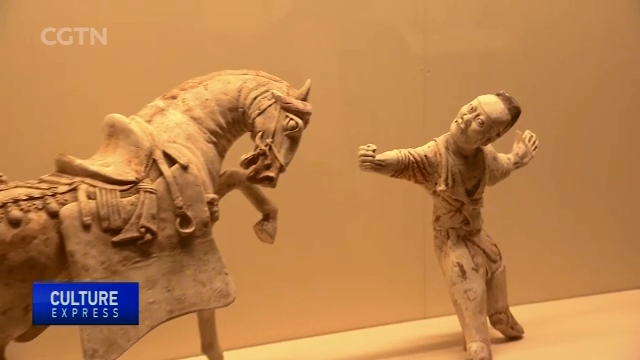
LI JUN CURATOR, NATIONAL MUSEUM OF CHINA "These sculptures paint a scene of a Northern barbarian in ancient China training a dancing horse along the Silk Road. Horse dancing was popular among the Persians, and was introduced to Chinese royal families during the Tang Dynasty."
China is home to mulberry trees and was the first country to produce silk, which was rare and luxurious in ancient times. The trade route between China and Europe was therefore known as the "Silk Road".
LI JUN CURATOR "In the 15th century, exchanges between China and Rome has been frequent. Chinese silk became popular among royal family and the rich in Rome. This picture titled "Fresco Flora" was discovered in a room in Pompeii. She's wearing silk, imported from China."
The beginning of the Italian Renaissance was not only a process parallel to the introduction, consumption, imitation and re-creation of silk, but also the stories that took place on the Silk Road.
These goods and maps show how significant the Chinese invention of the compass was in expeditions after it was introduced to the West.
In the 13th century, European travelers like Marco Polo were able to travel to the East with the aid of the compasses and nautical charts. They witnessed the prosperity of China's economy and culture in the Yuan Dynasty. And years later when they returned to Europe, they found cities like Venice were experiencing its own revolution during the European Renaissance.
LI QIONG BEIJING "From the 13th Century to the 16th Century, westerners who travelled between Europe and Asia were like a bridge connecting the two vast continents. Reflecting on this historical period, many wonder whether the exchanges between Chinese and Western cultures may have been a factor in the European Renaissance."
Much of the iconography of both cultures appear similar at some point. For example, "The Madonna and Child" is one of the most famous images in Christian art, while "Guanyin with a child" is also an equally important icon in Chinese folk tradition.
WEI NA DEPT. OF EXHIBITION PLANNING AND FINE ARTS, NATIONAL MUSEUM OF CHINA "It's the first time the National Museum of China carried out comparison between Chinese and foreign cultural relics of the same period. Curator Li Jun went to Italy to view collections at different museums. There were some relics unavailable for the exhibition but are important, so we used replicas. The National Museum of China also collected relevant pieces from domestic museums like the Palace Museum and Inner Mongolia Museum. The entire process took us more than a month."
The exhibition "Embracing the Orient and the Occident: When the Silk Road Meets the Renaissance" runs through August 19, at the National Museum of China. Li Qiong, CGNT, BJ.