
10:01, 04-Mar-2019
Bolivia Carnival: Elaborate costumes color the streets of Oruro
Updated
10:00, 07-Mar-2019
 []
[]
Share







Copied
03:39
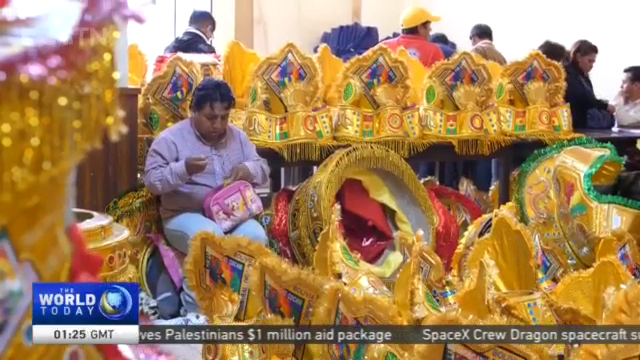
Now to Bolivia, where this year's carnival celebrations are well underway, with people dressed in colorful costumes dancing through the streets all night long. CGTN's Joel Richards reports from the city of Oruro.
Carnival celebrations run well into the night in Oruro on Saturday, for dancers and revelers alike, as the groups continue to march through the city in their traditional dress. This group dance, the Morenada, pays tribute to black slaves brought to this mining city centuries ago. Their masks depict anguish. The rattles evoke the sound of ankle shackles. Several groups dance the Morenada at this carnival, each with a distinctive style. For the past year, Elvis Flores worked to make more than 300 of these costumes for one of the Morenada groups. It took more than 60 people in all to complete the order.
ELVIS FLORES ARTISAN, EL DANZANTE "There is no machine that can help us, all this work that you can see is made by hand."
Not only does Flores design these costumes, he also dances with the group.
ELVIS FLORES ARTISAN, EL DANZANTE "It makes you cry, seeing the effort and work of so many people. For people this is a great economic and material and human effort, you can't imagine how satisfying it is to dance."
Reina has travelled from La Paz to dance in the carnival for the first time. She is with the Caporales as part of the dance troupe, Los Huari. Her costume evokes an old legend.
REINA CAPORAL DANCER, LOS HUARI "We used to have rattles here, which represented rebellion against the masters, but now it is a more modern design."
The costumes evolve but remain loaded with symbolism. Of all the dances, the Diablada is one of the most famous. Behind one of these masks is Edgar Rios.
EDGAR RIOS ARTISAN, BORDADOS RIOS "What characterizes the devil is the mask which represents the seven deadly sins. Then there is the chest piece which is sewn, it is a shield that protects our soul from the devil. We have the skirt with five parts representing the five-point star. Then there are boots, gloves and the cape on the back which are related to the seven sins."
Rios is the third generation in his family to make carnival costumes.
EDGAR RIOS ARTISAN, BORDADOS RIOS "Everything we do is manual, there is no machine. We like this, we carry this in our blood, this art of costume making."
There are more than 60 artisans in this city. The costumes made by Elvis are for the Central Cocani Morenada groups, founded in 1924.
ROLANDO BARRIENTOSPRESIDENT, MORENADA CENTRAL COCANI "The artisan costume makers have been very important in creating the Andean aesthetic and we have produced the most beautiful Morenada that is in Bolivia."
For dancers and designers alike, it is their devotion to the patron, the virgin, that drives their art and keeps this carnival growing every year.
ROLANDO BARRIENTOS PRESIDENT, MORENADA CENTRAL COCANI "When we reach the Virgin, we feel alive."
It is the costumes and devotion that give this carnival its energy.
JOEL RICHARDS ORURO, BOLIVIA "And it's that energy that's helped make this one of Latin America's famed carnivals. Organizers say over 300,000 have made it to this mining city, with many more expected in the coming days to see this stunning display. Joel Richards, CGTN at the Oruro carnival in Bolivia."