
13:40, 20-May-2019
Tibet Plateau Expedition: Scientists study water exchange to perfect climate model
Updated
13:40, 23-May-2019
 []
[]
Share







Copied
03:45
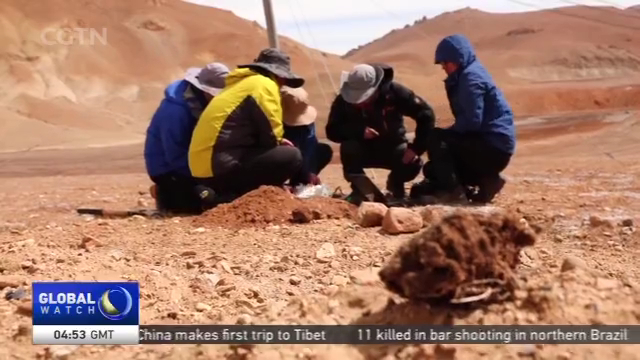
China's Second Tibetan Plateau Scientific Expedition and Research Project is underway. The vast area at the heart of Asia is where the continent's weather is made. CGTN reporter Tao Yuan followed a team of scientists who are trying to study the water exchange on the plateau.
"They are moving so fast."
When Dr. Yang Kun shot this video six years ago, he was excited beyond words.
PROFESSOR YANG KUN, DEPT. OF EARTH SYSTEM SCIENCE, TSINGHUA UNIV. "As long as the weather is good, we can see clearly the clouds moving up the mountains."
His team studies the transfer of water and energy on China's Tibet Plateau - Part of a huge effort to understand the vast area of land that's been given names such as "Asia's Water Tower," or the "Third Pole."
PROFESSOR YANG KUN, DEPT. OF EARTH SYSTEM SCIENCE, TSINGHUA UNIV. "Back when I got my Ph.D., my postdoctoral advisor talked me into a lofty purpose - he said, the weather forecast of East Asia depends heavily on the Plateau, but the forecast is not very reliable. If we try, maybe we could improve the model."
So begins two decades of research on the plateau.
Setting up monitoring stations in the mountains along the China-Bhutan border, Dr. Yang and his team study how water vapor crosses the Himalayas.
Coupled with soil moisture observation, the data will support the Earth's multiple water cycle observation satellites.
PROFESSOR YANG KUN, DEPT. OF EARTH SYSTEM SCIENCE, TSINGHUA UNIV. "The terrain on the plateau is complicated. Disasters such as blizzards, landslides and mountain floods can be terrible. We try to monitor the pattern, build a model out of it to foresee a disaster. That would help mitigate the loss of property and lives."
Meaningful work, but equally dangerous.
Some scientists have lost their lives trying to understand the Tibet Plateau.
Its altitude, freezing temperatures, harsh weather and geography can all be deadly.
Dr. Yang considers himself lucky.
PROFESSOR YANG KUN, DEPT. OF EARTH SYSTEM SCIENCE, TSINGHUA UNIV. "The glaciologists and limnologists' work is more dangerous. They are the real heroes. My team hasn't come across any accidents, but I worry every day. Let's talk about something else."
The interview was cut off.
For once, the cool-headed scientist was overcome with emotion.
Under these snowy mountains, generations of scientists have carried on their quest.
A lifetime's work may only be, at best, a small step toward solving nature's many unpredictable puzzles.
PROFESSOR YANG KUN, DEPT. OF EARTH SYSTEM SCIENCE, TSINGHUA UNIV. "The Tibet Plateau is so big and fluid. Its diverse vegetation, various lakes, mountains and glaciers are all so complicated that sometimes you wonder how reliable your data will be! If one day, my work can help improve the current climate prediction model even just a little bit, that'd be my life-long dream!"
And countless scientists like Dr. Yang are living just that dream.
TY, CGTN, on the Tibet Plateau.