
Business
22:32, 13-Apr-2018
Experts expect to resolve trade frictions through constructive dialogue
 ["china"]
Share







Copied

The current China-US trade conditions were decided by the two countries' economic structures and industrial competitiveness, a spokesman from the General Administration of Customs said.
Experts said roughly 60-70 percent of the trade imbalance between China and the US has been distorted and that a constructive dialogue will help resolve the disputes.
China ran a surplus of 58 billion US dollars with the US in the first quarter, up 19.4 percent from the same period last year.

VCG Photo
VCG Photo
US-dollar-denominated Chinese exports to America was up 14.8 percent year-on-year. But that growth rate was down from the 16.8-percent growth in the same period last year. Meanwhile, Chinese imports from the US in the first quarter were significantly down from the 33-percent growth in last year's first quarter.
The spokesman said that China didn't intentionally pursue a trade surplus. He also said that China's trade surplus with the US isn't that big if calculation methods and service and intermediary trade are taken into account.
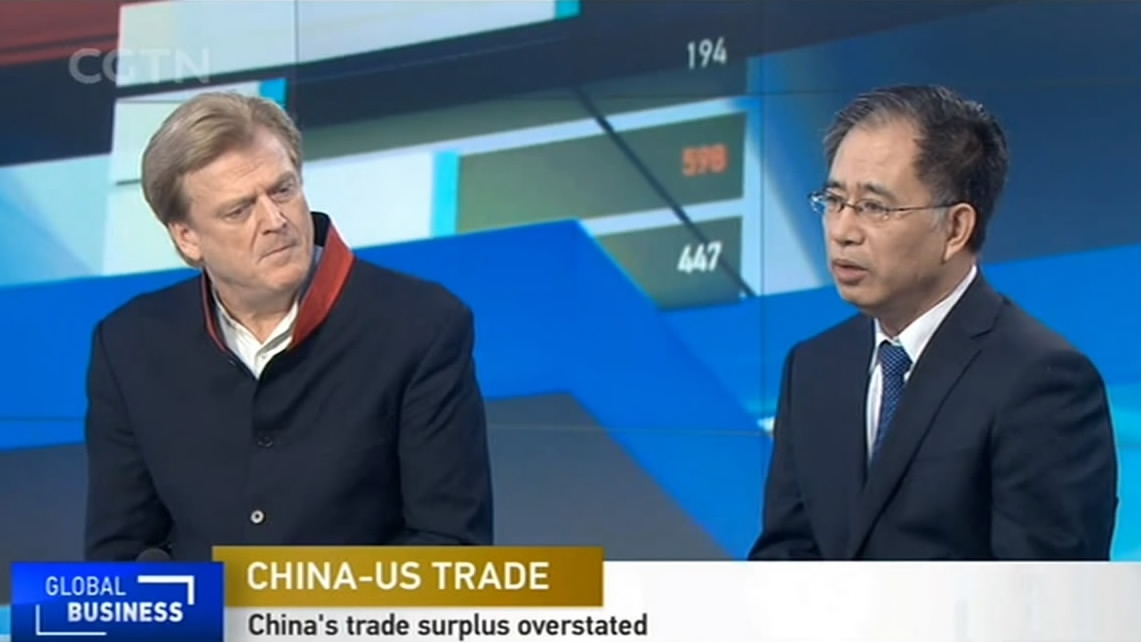
In fact, back in 1994, the two countries have established a platform for dialogue and negotiating trade frictions, according to Liu Baocheng, dean of the Center for International Business Ethics at the University of International Business and Economics.
CGTN Photo
CGTN Photo
“There was a high level of consensus that the trade data had been distorted [in 1994], because the [added] value has not been included into the trade balance calculation. And no side really pushed hard to [reach] a consensus on that topic. So the ‘legacy’ is still there,” Liu explained.
As the trade dispute with the US develops, the worst case will be “the Great Depression No.2,” based on Patrick Byrne, CEO of Overstock and tZERO. And the best scenario, from Byrne’s perspective, is that the two countries will revise the overall economic relationship, then resolving the disputes through a constructive dialogue.
(CGTN’s Yan Yunli also contributed to the story.)