
Politics
19:49, 01-Nov-2017
Three things Abe achieved from the snap election
 ["china"]
Share







Copied
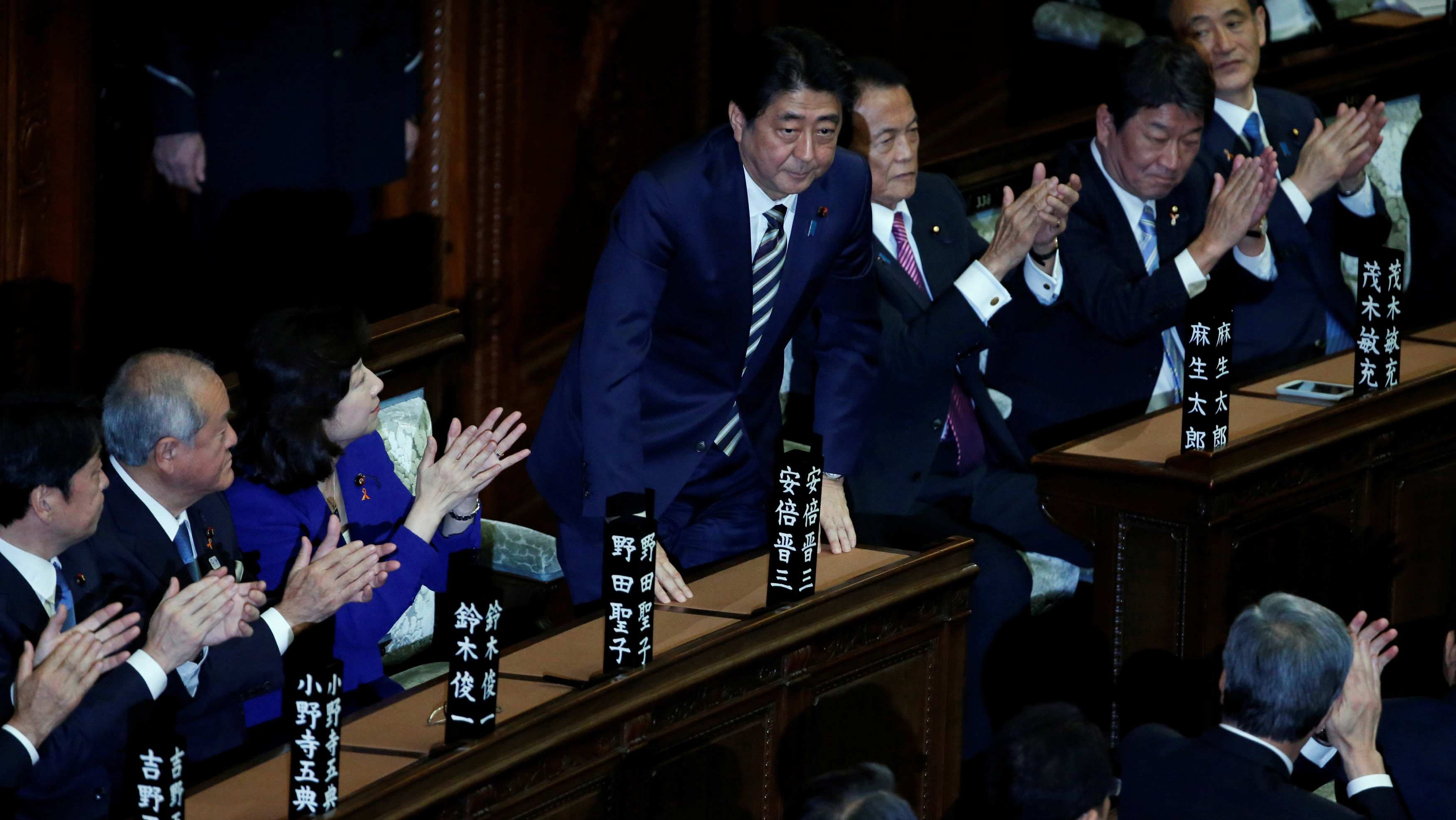
Shinzo Abe formed his fourth cabinet after being re-elected Japanese Prime Minister on Wednesday following his ruling coalition's big win at the polls last month. But he faces many challenges on domestic and diplomatic fronts.
The coalition won 313 out of 465 seats in the lower house in a well-timed and well-calculated snap election, giving Abe the two-thirds majority he needed to revise Japan’s pacifist constitution.
Experts say Abe achieved three things from the election. First and foremost, he managed to dodge more fierce questioning from the opposition on school scandals that had plunged cabinet support to its lowest rate.
And by holding the lower house election one year early, Abe bought himself another year to work on revising the constitution without worrying further about his popularity.

Japanese Prime Minister Shinzo Abe gestures as he talks with ruling Liberal
Democratic Party lawmakers at the Lower House of Parliament in Tokyo on November 1. /Reuters Photo
Japanese Prime Minister Shinzo Abe gestures as he talks with ruling Liberal Democratic Party lawmakers at the Lower House of Parliament in Tokyo on November 1. /Reuters Photo
The 48 percent of public who voted for the Liberal Democratic Party say they mostly voted in hopes for continuation of “Abenomics”, the prime minister's economic recovery program, as well as firm defense strategies to counter threats from the Democratic People’s Republic of Korea.
The irony of the whole story is that without Pyongyang, which is critical of the Abe administration, lobbing missiles towards and over Japan, Abe’s support rate was unlikely to have recovered enough to allow him to call the snap election.
However, experts say he will take this result as a public endorsement to carry out a revision of the pacifist constitution.
Abe hopes to include a clause to the war-renouncing Article 9 specifying that the nation’s Self-Defense Forces are constitutional. For decades, experts have argued that maintaining the defense forces and sending them on overseas missions were in violation of the constitution.
The prime minister hopes to muster public support for the proposed change and hold a referendum in 2019.

Japanese Prime Minister Shinzo Abe, leader of the Liberal Democratic Party (LDP),
smiling during a news conference after Japan's lower house election, at the LDP
headquarters in Tokyo on October 22. /Reuters Photo
Japanese Prime Minister Shinzo Abe, leader of the Liberal Democratic Party (LDP), smiling during a news conference after Japan's lower house election, at the LDP headquarters in Tokyo on October 22. /Reuters Photo
Although Abe was aggressive on diplomacy, traveling to over 120 regions and nations in the last five years, Japan's relationship with China and S. Korea has been rather stagnant.
He has been eyeing opportunities to invite Chinese President Xi Jinping and S. Korean President Moon Jae-in to Tokyo at an earliest opportunity, hoping to hold trilateral and bilateral meetings with the two leaders.
This year marks the 45th anniversary of normalization of relations between China and Japan. But history and territorial issues continue to hinder diplomacy.
Tokyo also seeks to accelerate talks with Moscow on jointly developing the disputed Kuril Islands, or the Northern Territories. Abe and Russian President Vladimir Putin have met frequently, but slow progress in resolving the issue has irritated former Japanese residents of the islands as they get older with hopes of a return receding.
It will not be an easy year for Shinzo Abe, analysts say. Balancing diplomatic challenges and economic recovery efforts whilst keeping his eyes firm on contenders for his party's presidential election in September 2018.