
13:11, 18-May-2019
Protecting Diversity: Race against time to save ancient Tibetan culture
Updated
13:10, 21-May-2019
 []
[]
Share







Copied
03:18
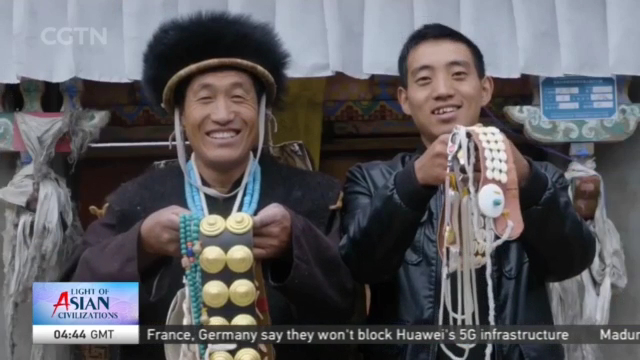
China is hosting a range of special events and activities this week to celebrate the diversity of Asia's various civilizations and cultures. Today, we'll look at Tibet, and as the region modernizes and grows, there are fears that some of its ancient customs and languages could forever be lost. The Chinese government believes diversity is a key part of the country's make up and is determined to protect unique cultures, such as those found in Tibet. Our Jonathan Betz has more.
Deep in the Tibetan mountains lives a people you've likely never met and a language you've probably never heard. Tobgye is speaking Lhoba - a unique community composed of several tribes.
For centuries, the Lhoba lived largely in isolation where few outsiders are allowed. In fact, Tobgye tells me I'm the first American he's ever met.
TOBGYE LOHBA VILLAGER "In the past, our father's generation used to hunt for a living. The life in our village has undergone enormous changes."
Only 3,600 Lhoba remain in Tibet. So, the Chinese government is turning to tourism. Encouraging busloads of Chinese tourists to visit and watch events like traditional sword dances.
TSERING CHOTSO LHOBA TOUR GUIDE "It doesn't matter even if we have contact with the outside world. It's our job to protect our culture."
Many Lhoba who used to hunt and farm now work as performers or tour guides. But some worry the attention also brings new challenges.
TSERING CHOTSO LHOBA TOUR GUIDE "We used to build only with wood, but now many houses are built with cement and bricks. As we increasingly connect with the outside world, we are getting a bit worried."
China officially recognizes Lhoba as the smallest of its 56 ethnicities. Government officials are eager to show off their work to protect minorities. Whether it's promoting traditional weavers or supporting schools that teach Tibetan medicine.
LUO DEMING, DEPUTY DIRECTOR LINZHI BUREAU OF CULTURE, RADIO & TELEVISION "The culture is the soul and tourism is the platform. We must preserve the cultural heritage from our ancestors and pass it on."
Tobgye works for the government and is pushing to get his native language better recorded.
TOBGYE LOHBA VILLAGER "Our time is changing rapidly. The Lhoba language doesn't have any writing. So I think the culture and customs, as well as the language of the Lhoba ethnic group, are disappearing."
For him, it's a race against time to save an ancient culture facing a new world. JB, Nanyi Village, Tibet.