
13:36, 01-Jul-2019
Through Their Eyes: Afghanistan: Hunting for precious gems in a war zone
Updated
16:59, 09-Jul-2019

Share






Copied
Time now for our special series "Through Their Eyes", which focuses on Afghanistan. The country is home to an untold wealth of natural resources. The problem is extracting them amid a world of war. The region's Panjshir Valley is home to a rich supply of emeralds and other gems. Today, CGTN's Sean Callebs introduces us to an ambitious man who frequently riskes life and limb hoping for change and prosperity.
In Afghanistan, people know all that glitters is not gold. Massoud Sultani, proudly shows off sapphires, rubies, but more than anything he says, Afghanistan is home to a rich treasure trove of emeralds.
MASSOUD SULTANI EMERALD MINER "These stones are sold in high prices at international markets, but, unfortunately here in Afghanistan, they are sold for very low prices."
Legally gems, and semi-precious stones are sold here, along Kabul's Chicken Street. A small mountain of a blue stone called Lapis rests in the bowels of a shop - waiting to be polished - then will wait even longer for a buyer to come along. There's not much business in a war zone. So, Sultani says much mining is illegal, and most gems are smuggled out of Afghanistan with the government fully aware of the problems.
MASSOUD SULTANI EMERALD MINER "If the Afghan government would invest in the gemstone industry, I am sure they would benefit, something like 300 or 400 million dollars over the course of two or three years."
It may be an over-statement. So, to back up his point, Sultani offered to take us to the heart of the emeralds mines in the mountains of the Panjshir Valley.
SEAN CALLEBS PANJSHIR VALLEY, AFGHANISTAN "If this nation is going to be able to life itself out of generations of poverty, it has to find a way to generate income. And, one way is all of the natural resources that remain untapped because of decades of insecurity here, amid this rugged landscape. It is just absolutely awe inspiring as we make our way up. It would take us hours to walk, but we aren't walking. We have horses to take us up to the top of the mountain."
We pass dozens of mines. And the young and old, poring through rubble for a hidden gem. The mines are simply holes punched into the mountain by Mujahidin fighters over the years. The Taliban has never made it into the region, but warlords have, controlling illegal mining and smuggling.
MASSOUD SULTANI EMERALD MINER "I can tell you the government only has control of about two to three percent of the mines here. That is it. 95 percent of them operate illegally."
After several hours, we reach the base camp of Sultani's mine, which he says is legal, passed down through his family over generations. Inside, it's about what you would expect. It operates about safely as anything in Afghanistan. A few holes are drilled, in go the explosives, then, you literally run for it. This is exactly why the government makes it nearly impossible to legally export emeralds. They are fragile, much more fragile than a diamond, and are easily destroyed.
MASSOUD SULTANI EMERALD MINER "This is the challenge we face in the Panjshir, extracting emeralds. We use explosives to reach the gems, and that ends up damaging the stones, lowering the quality."
The Afghan government wants a halt of this type of mining until there is peace in the country. It wants to preserve the limited amount of emeralds and other gems until modern, proper mining equipment can be used here.
SEAN CALLEBS PANJSHIR VALLEY, AFGHANISTAN "It's been about 10 minutes since the blast, and the acrid smell from the explosion is still in the air. The good news is there's some positive signs there could be emeralds or precious stones back up in this hole. So the first job is clear out all the rubble so they can explore further."
Sultani brought us here because he wants to show off the region's potential.
MASSOUD SULTANI EMERALD MINER "My real target is that any person, any business association, or any country that is passionate and will help us reach international markets if we modernize the method and use improved machinery, the emerald extraction process would increase 90 percent."
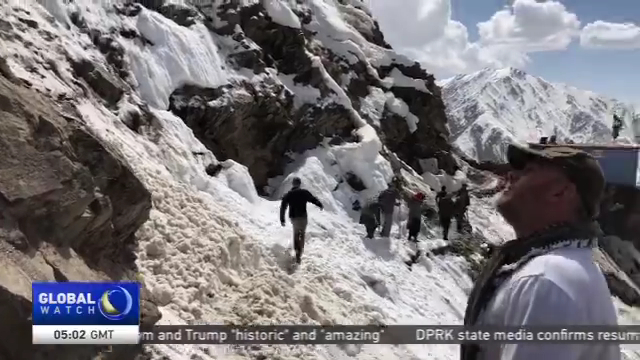
And he convinced on this day we will find gems, and orders one more blast. This time we decide to wait outside the mine. At nearly four-thousand meters, it is the first really warm day of the season, which is melting the snow. Suddenly, triggered by the powerful blast. The locals say we are lucky to be alive.
SEAN CALLEBS PANJSHIR VALLEY, AFGHANISTAN "We just went through an avalanche. If you can look, hand, pants torn up. Snow just came barreling down. This used to be a walkway. I went down that hill. Back up now. This just shows the dangers of what people have to go through to work up here."
We, limp down the mountain. But mining goes on the way it always has - with no chance of ending the cycle of danger, and yielding slim rewards. Sean Callebs, CGTN, in the Panjshir Valley of Afghanistan.