
17:27, 26-Mar-2019
Common Development for Asia: Can Singapore maintain competitive edge?
Updated
17:20, 29-Mar-2019
 []
[]
Share







Copied
03:28
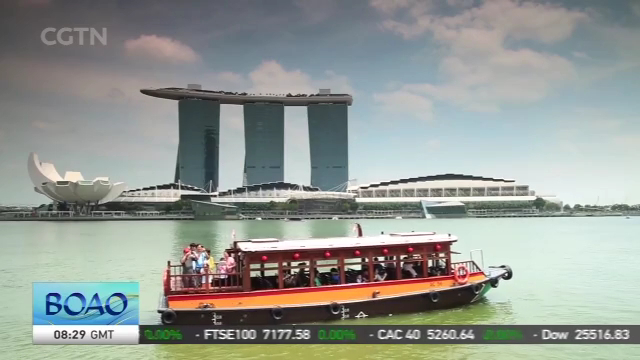
Singapore's rise from a city-state with no natural resources to an economic powerhouse is one of the great success stories. The tiny nation took the top spot in the 2018 Asian competitiveness report. It also ranked second on the World Economic Forum's competitiveness index that same year. So, what gives Singapore its competitive edge? CGTN's Miro Lu reports.
Safe, Stable, Sustainable. These are just some of the words used to describe Singapore.
An economic miracle, the city-state has consistently maintained its position in the top five of most competitiveness indices.
Pro-business policies, ever-improving infrastructure, political stability, favorable tax environment and its strategic geographical location have all contributed to the country's competitive advantage.
BEH SWAN GIN, CHAIRMAN ECONOMIC DEVELOPMENT BOARD "The fact that investors trust that the environment in Singapore will be pro-business, it will be stable, and we have proven that over many decades. And we have strong rule of law, strong protection of intellectual property. Why investors and talents want to come to Singapore is really the livability in Singapore."
MANU BHASKARAN, FOUNDING DIRECTOR & CEO CENTENNIAL ASIA ADVISORS "The ease with which people can be hired, licenses obtained, taxes paid, trading across borders. All these things are extremely easy to do in Singapore."
Singapore's Economic Development Board overlooks business strategies for the city-state. They believe that innovation especially digital innovation will play a key role in maintaining the nation's competitive edge.
BEH SWAN GIN, CHAIRMAN ECONOMIC DEVELOPMENT BOARD "Singapore's competitiveness will be defined by the innovation capacity and capability. We have spent a few decades to build up a science and technology base here. The startup ecosystem for the past 6-7 years has been very vibrant, because south-east Asia is starting to attract a lot of investment interest and a lot of entrepreneurs."
With global competition intensifying, the rest of Asia is working towards enhancing its own competitiveness. They are making tremendous efforts in terms of infrastructure and policy reform.
MANU BHASKARAN, FOUNDING DIRECTOR & CEO CENTENNIAL ASIA ADVISORS "We are finding reformist governments in India, in Indonesia and elsewhere making a huge effort to improve the basics of their business environment."
Asia is not without its challenges. Manu Bhaskaran who follows Asian economy closely, warns that the trend towards deglobalization and protectionism could impact the region's competitiveness.
MANU BHASKARAN, FOUNDING DIRECTOR & CEO CENTENNIAL ASIA ADVISORS "This part of the world, including Singapore is highly dependent on global economy. The region depends on foreign inflows of capital both direct investment in factories and so on as well in terms of portfolio capital investing in equity and bond market. We depend on tourism."
MIRO LUSINGAPORE "Some analysts believe that an aging population, rising costs, and insufficient productivity may hurt Singapore in the long run. But despite these challenges and increased competition from its neighbours, the republic's value proposition as a business hub remains strong. Miro Lu, CGTN, Singapore."