
14:45, 16-Jan-2019
Decoding Chang'e 4's Mission: The first green plants grown on the Moon
Updated
14:17, 18-Jan-2019
 []
[]
Share







Copied
03:19
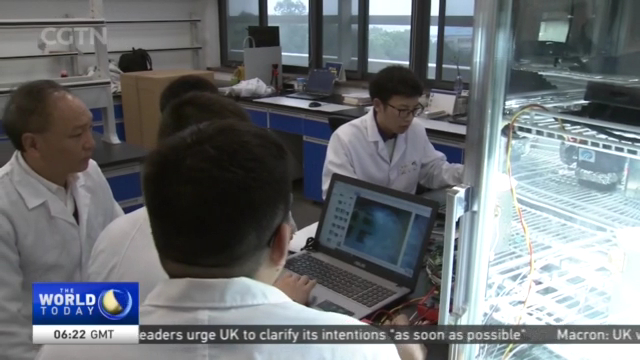
With the 50th anniversary of man's first steps on the moon six months away, China's Chang'e 4 spacecraft is up there doing more than walking. A team of scientists from Chongqing University sent a small biological payload up with the spacecraft. CGTN's Zheng Quanbin shows us how those unique and special passengers are doing now.
One giant step for the plant and animal kingdoms.
Scientists from Chongqing University are studying the growth and development of these species at low gravity, under strong radiation, and under the natural light on the moon.
The tests aim to provide a research basis for the future establishment of a human lunar base.
LIU HANLONG, VICE PRESIDENT CHONGQING UNIVERSITY "After the startup of the payload on the first day, the micro-ecosystem within it began to grow and develop in so-called biological lunar surface mode. The live photos show that the seeds germinated well in the load, which means we have grown plants and seen the very first green leaf on the surface of the moon. This will provide necessary research data and information to build a moon base and other related projects."
To provide sufficient statistics and research support, Chinese engineers maximized the capacity of this delicate "jar". The payload consists of a biological module, thermal control module, illumination-control module, and more. It carries multiple organisms including potato seeds, cotton seeds, rapeseeds and yeast.
LIU HANLONG, VICE PRESIDENT CHONGQING UNIVERSITY "The selection of the biological species on board is very strict. First, because of the limited room in this space 'jar', the plants or creatures inside can't be large. Secondly, the demand for the experimental subjects must withstand low gravity, strong radiation, severe temperature differences and other extreme conditions on the surface of the moon."
XIE GENGXIN, CHIEF DESIGNER OF BIOLOGICAL EXPERIMENT PAYLOAD CHANG'E 4 LUNAR MISSION "As we know, no air nor oxygen exists on the moon, and the temperature is always very extreme. Over 100 degrees Celsius in the daytime and 180 degree Celsius below freezing at night. If some of them leaked, they would have no chance to survive, they would be decomposed to harmless organics with no pollution on the moon."
Through January 12, the cotton and rapeseeds successively sprouted with green leaves. In the open environment, rapeseeds, cotton and potato seeds also sprouted in good condition.
XIE GENGXIN, CHIEF DESIGNER OF BIOLOGICAL EXPERIMENT PAYLOAD CHANG'E 4 LUNAR MISSION "In addition to achieving the minimum goal of plant seeds flourishing on the moon's surface, the selection of biological species under the payload this time is based on the long-term consideration of further research in astrobiology, which also provides vital data and evidence for the survival of human beings on the moon and even on other planets in the future."
Now the experimental data and information are coming back and waiting for further study and analysis.
As the moon task continues, more big steps and history might be made in the coming days and years.