
13:25, 20-Jun-2019
World Refugee Day: UN: More than 70 million displaced across globe
Updated
17:19, 09-Jul-2019

Share






Copied
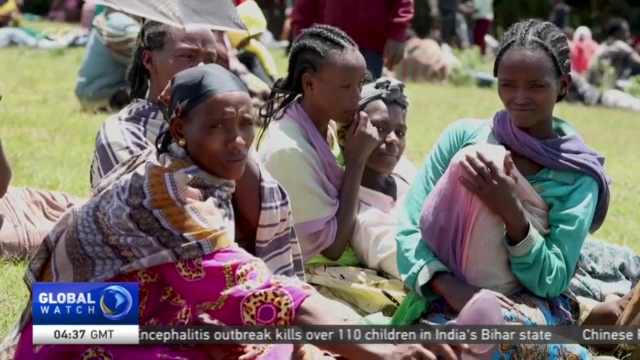
This year's World Refugee Day is being marked with a grim update from the UN. The number of people displaced by war, violence and persecution reached a record high of over 70 million in 2018. The UN's report found that on any given day last year, some 37 thousand people were forced from their homes. Here's UN correspondent Liling Tan with more on the staggering numbers.
At nearly 71 million people, the global population of persons displaced by war and violence is twice the number from 20 years ago, and larger than the population of Thailand.
NINETTE KELLEY, DIRECTOR UN HIGH COMMISSIONER FOR REFUGEES IN NEW YORK "In fact the number now is the largest number ever recorded. And it speaks to the failure in the international political arena to both mitigate and prevent conflict."
FILIPPO GRANDI UN HIGH COMMISSIONER FOR REFUGEES "One key factor pushing people out of their homes is conflict, is crisis, all of which require political solutions. And those political solutions are difficult because the world has become very divided and unable to make peace."
There were 26 million refugees in 2018, half a million more than the previous year, and largely from the same five countries with protracted conflicts -- Syria, Afghanistan, South Sudan, Myanmar and Somalia.
But new and re-emerging crises were also behind the spike. In Ethiopia, a surge in intercommunal violence displaced more than 1 million people within the country, while the Venezuela exodus has become one of the world's biggest displacement crises.
LILING TAN NEW YORK "It doesn't stop there. There's also the Rohingya crisis which now counts 1 million refugees in Bangladesh. People are still being displaced in Iraq, Yemen, Sudan, the Democratic Republic of the Congo, the Central African Republic, Eritrea, Burundi, and the list goes on. And despite the daunting number of people fleeing violence and seeking refuge, governments are still closing doors and building walls."
FILIPPO GRANDI UN HIGH COMMISSIONER FOR REFUGEES "We tend to think of the one big refugee crisis affecting the rich world. This is the perception that many people have. And it is wrong. The statistics tell us another story - that it is very often, unfortunately, a crisis of the poor. The refugees are poor, and the communities hosting are poor, and they are the ones that are most impacted by the situation."
NINETTE KELLEY, DIRECTOR UN HIGH COMMISSIONER FOR REFUGEES IN NEW YORK "Take Bangladesh for example. It's one of the least developed countries. It has one of the highest-density populations of any country in the world. It struggles under huge pressures to be able to deliver basic services to its own population, and there it is, providing security to over a million Rohingya refugees who have fled from Myanmar."
Among the numerous unsettling statistics - children account for half of the global refugee population, with more than 100 thousand of them traveling alone last year. And the rate of people able to return home has remained stagnant. Liling Tan, CGTN, at the United Nations in New York.