
19:41, 30-Jun-2019
Japan After-Work Drinks: Country trying to take pressure off workers to go for drinks after work
Updated
17:01, 09-Jul-2019

Share






Copied
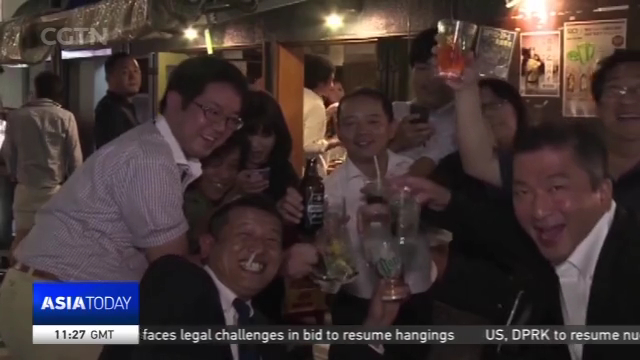
Long a mainstay of Japan's office work culture, the tradition of after-work drinking now faces its own cut-backs despite record high employment levels. The pressure is on for less drinking, increased productivity, and a more inclusive workplace. CGTN's Steve Ross tells us more, from Tokyo.
TIMOTHY LANGLEY LANGLEY ESQUIRE "I'm going to finish work at maybe seven or eight o'clock. I'll go drinking for an hour or two; I'm good, then I can join my friends, I drink a little bit less expensively, and then I go home at 11 or 12 o'clock. I'm good!"
Timothy Langley, of Tokyo-based public affairs and management consultancy Langley Esquire, describes both the good and bad points of Japan's traditional after-work drinking culture. While offering a chance for spirited team-building, after-work drinking also extends the hours away from home, often excluding those who have family obligations, or simply don't wish to drink. With pressure from Japan's government and Keidanren business federation, as well as from workers in Japan's current record high-employment economy, reduction of after-work drinking is a rising workplace goal.
"The government and Keidanren are in a bit of a hard space. They need to have more productive employees."
TIMOTHY LANGLEY LANGLEY ESQUIRE "Now, the Japanese employees have a little bit more power. They have expectations, and they have issues – they have demands."
Some of those demands are being made by women, who may find after-work drinking outings impinging on time with family, and re-imposing a feminine social role that claws back part of the status hard-won in the office.
TIMOTHY LANGLEY LANGLEY ESQUIRE "It's different than what they would be doing at work. At work, they're not really subservient, they're kind of – it's somewhat egalitarian. But when you go out, you're supposed to be dainty, you're supposed to be subservient, you're supposed to play a female role. And that, that really rubs a lot of people the wrong way."
STEVE ROSS TOKYO "For now, the campaign to reduce after-work drinking has behind it just the good intentions of government and business leaders, and lacks the force of law. But with Japan's increasingly diverse workforce, experts say that workstyle reform will need to be taken seriously if Japanese employees are to thrive in a global innovation marketplace."
Takuma Tagawa, a consultant for Work Life Balance, a Tokyo-based company that helps Japanese firms understand the advantages of time off for their workers, says that reducing after-work drinking could shift office decision-making back to its rightful place.
TAKUMA TAGAWA WORK-LIFE BALANCE "When you reduce after-work drinking, companies have to make the important decisions during the daytime, allowing all employees to get involved in the process. This will lead to increased motivation for the employees."
But, one look at Tokyo's nighttime street scenes reveals that after-work drinking is a well-entrenched Japanese custom. Many workers say drinking parties serve as a remedy to the traditional, stiff office culture.
OFFICE WORKER TOKYO "It's because of the lack of communication in the workplace that the employees cannot discuss their honest opinions with their boss or colleagues unless they are drinking. And I think this lack of communication in the workplace is problematic."
Previous government and business council efforts to implement workstyle reforms have met with minimal success. This time, raising awareness of after-work drinking issues may sensitize businesses to the needs of their employees, offering the workers a choice, at least.
TAKUMA TAGAWA WORK-LIFE BALANCE "It is up to the individual whether to accept or reject the invitation for after-work drinking. That's the paradigm shift we wish to create, where individuals can act independently and conduct business the way they like."
Steve Ross, CGTN, Tokyo.