
Climate
21:07, 14-Nov-2017
Scientists say new islands could solve Bangladesh land crisis
 ["china"]
Share







Copied
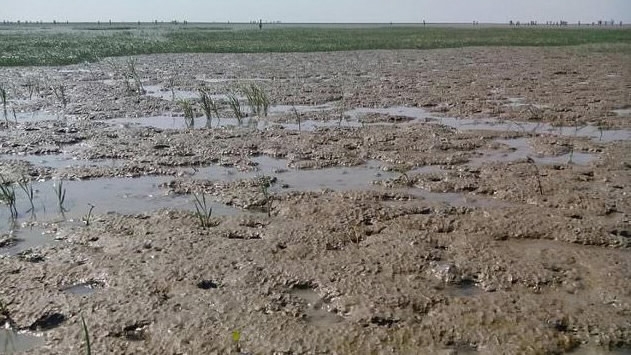
Islands are sprouting off Bangladesh that experts say could help mitigate the threat posed by global warming.
The government said Monday that 29 islands with a combined area of 507 square kilometers had emerged from the Bay of Bengal since 2007.
Every year rivers flowing down from the Himalayas carry an estimated one billion tonnes of silts and deposit them in the Bay of Bengal off the coast of Bangladesh, forming islands in the shallow waters.

Climate change is threatening Bangladesh. /AFP Photo
Climate change is threatening Bangladesh. /AFP Photo
Many of these islands, known as chars in Bangladesh, are already inhabited and may help to fight the threat of rising sea level.
Climate scientists have predicted that by
2050 rising sea levels will displace
about 18 million people.
"Every year Bangladesh has new land emerging and new land being devoured by rivers and sea," said Maminul Haque Sarker, head of the Center for Environment and Geographic Information Services.
He said studies by the Dhaka research center had shown a net gain of territory of around 12-14 square kilometers.
Most of the new land is near the estuary of the Meghna river, which is the confluence of the main tributaries of the two main Himalayan rivers of the Ganges and the Brahmaputra.
One of the islands has controversially been earmarked as a possible temporary base for the hundreds of thousands of Rohingya refugees from Myanmar currently living in squalid – mostly makeshift – camps in southern Bangladesh.

Scientists said dams could be set up to trap the vast amounts of sediment that flows from Bangladesh's rivers into the sea every year. /AFP Photo
Scientists said dams could be set up to trap the vast amounts of sediment that flows from Bangladesh's rivers into the sea every year. /AFP Photo
The United Nations says 615,000 refugees from the stateless Muslim minority have crossed into Bangladesh from Myanmar's Buddhist-dominant Rakhine state since late August.
The influx has overwhelmed existing facilities in the densely populated country, and authorities have struggled to find alternative land to house them.
A recent World Bank study projected that 40 percent of productive land in southern Bangladesh would be submerged by the year 2080 due to a rise in sea levels.
A decade ago the influential Intergovernmental Panel on Climate Change said a one-meter rise in sea levels would flood 17 percent of Bangladesh and create 20 million refugees by 2050.

A woman standing where her house was before Cyclone Alia destroyed it in 2009. /The New York Times Photo
A woman standing where her house was before Cyclone Alia destroyed it in 2009. /The New York Times Photo
Local scientists, however, criticized the study for failing to take into account the silt islands, which are highly fertile.
Water expert Zahirul Haque Khan said dams could be set up to trap the vast amounts of sediment that flows from Bangladesh's rivers into the sea every year.
"Bangladesh can gain hundreds of square kilometers of new land by trapping silt through cross dams and engineering interventions," said Khan, director of Institute of Water Modelling in Dhaka.
Source(s): AFP