
14:01, 13-Apr-2019
Turkey Economic Reform: Government seeks to restore confidence of investors
Updated
14:00, 16-Apr-2019
 []
[]
Share







Copied
03:39
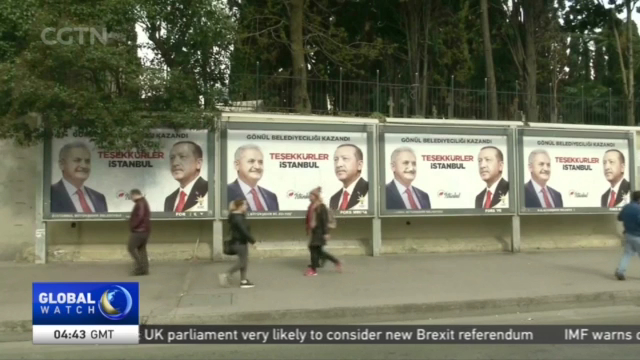
Turkey has rolled out a new plan for economic recovery. It aims to bring the recession-hit country back to growth. Analysts have expressed concern that the results of last month's local elections could further hurt the Turkish economy. But whether the economic reforms will be enough to boost confidence remains to be seen. CGTN's Michal Bardavid has the details.
In February, the Turkish government introduced an initiative to tackle inflation - specifically food prices. Turkish President Recep Tayyip Erdogan declared a war on what he called "food terrorism" and opened municipality-run stands that sell vegetables for half the price of retailers.
Though some appreciated the effort, critics are now saying people in queues hoping to get cheaper vegetables damaged the country's image and made some citizens more aware of the financial situation they were in.
The economy seems to be part of the reason AK Party lost some support in Ankara and Istanbul during the local elections in March. An ambiguity related to the results in Istanbul which have still not been declared officially, is also not helping.
Now the Turkish government is taking action to restore confidence, both domestically but also for foreign investors.
MICHAL BARDAVID ISTANBUL "On April 10th Turkey's Treasury and Finance Minister Berat Albayrak unveiled government measures as part of a reform package aimed at revitalizing the recession- hit economy. He also stressed efforts would be taken to lower inflation which was just under 20% in March."
Albayrak announced state-owned banks would receive $4.9 billion dollars' worth of government debt securities support as they struggle to deal with bad loans. He stated taxes would increase for those with high-income and that the country's pension system would be overhauled.
The minister also stated a "National Unity in Agriculture Project" would be created to tackle food prices. A tourism master plan to increase revenue was also announced aiming to host 70 million tourists by 2023.
Albayrak emphasized that they will "give priority to create an effective and healthy saving system, starting from state to individuals, to eliminate fragilities in the economy."
Some analysts stress the key to boost the Turkish economy lies in production.
FILIZ KATMAN, FACULTY MEMBER ISTANBUL AYDIN UNIVERSITY "If production is given support, in a direct way, not indirectly and production can be increased because the volume of production will increase this would cause prices to drop significantly, then we wouldn't need to import as much, and when we don't import we won't need foreign currency as much. All of these are interrelated issues."
Some political decisions are also having an impact on the economy. Last year, a dispute with the U.S. gave a blow to an already tumbling Turkish Lira which lost more than one-third of its value in 2018.
Now Ankara is once again at odds with Washington, this time over Turkey's decision to purchase an S-400 missile defense system from Russia. If the deal goes forward and the U.S. issues sanctions, Turkey's economy would likely suffer, making the situation even more challenging for the ruling AK Party. Michal Bardavid, CGTN, Istanbul.