
20:50, 14-Apr-2019
Retracing Silk Road Culture Exchange: Belt and Road countries work together in archeology, protection
Updated
20:50, 17-Apr-2019
 []
[]
Share







Copied
03:52
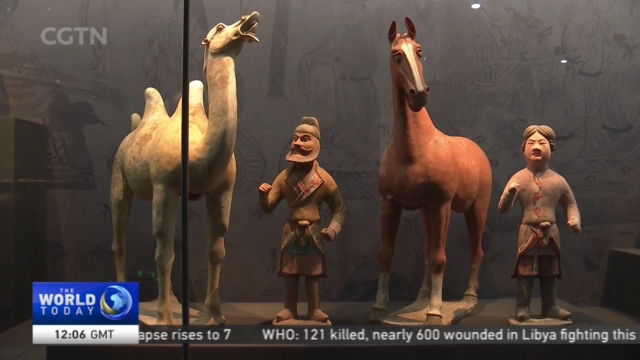
The ancient Silk Road witnessed an exchange of goods and ideas among the civilizations it connected. And now, some of these connections have been unearthed by Chinese archeologists and their counterparts in central Asia. CGTN reporter Liu Yang went to northwest China's Shaanxi Province where the Silk Road began to find out more.
Retracing of the civilizations along the ancient Silk Road. Excavated in northwest China's Shaanxi Province last year, these two gilded silver hairpins date back to over one thousand years ago during the Tang dynasty. And they're appearing on camera for the very first time. At the Research Center of Materials Science and Archeology of China's Northwestern Polytechnical University, Professor Yang Junchang is explaining the impact of art and how it connects ancient civilizations to students from countries along the Belt and Road. He says the usage of gold is under the influence of the Eurasian prairie culture. Last year, the university and Kazakhstan's National Museum signed a laboratory agreement.
YANG JUNCHANG, PROFESSOR NORTHWESTERN POLYTECHNICAL UNIVERSITY "Our university has the advantage of researching cultural relic protection, we have a strong academic team in materials science and other related majors. We mainly focus on materials and ancient technology research, material degradation mechanism research, and cultural protection material selection for the future."
There is substantial evidence of gold being used in ancient China as early as the Shang dynasty 1600BC. Some of these students noticed many similarities of the designs with those from their own countries.
HA AFAR HASAN, IRAQI STUDENT NORTHWESTERN POLYTECHNICAL UNIVERSITY "There is much meaning, not just about the element or crystal structure. Similar civilization between China and Iraq, when I look to something here, so as in my country, right now my feeling is very enjoy because I can see something here not just in my country, there is also something here (quite similar) I am attention for this one."
SUNGAT SABIT, KAZAK STUDENT NORTHWESTERN POLYTECHNICAL UNIVERSITY "Before we were using woods or eating, but after silk road, they have started to use the ceramic plate, and for earrings, they have the same shape."
KAMBAROVA SOKHIBA, UZBEK STUDENT NORTHWESTERN POLYTECHNICAL UNIVERSITY "Females back to thousands of years ago, what kind of jewelry they wore, I found similarities with my country in some details with this jewelry."
ABDURAKHMON KAIUMOV, TAJIK STUDENT NORTHWESTERN POLYTECHNICAL UNIVERSITY "I found lots have the same shape on the top of the home gate in my country, also sometimes when they remove the gate, they remain the mirror to its place, I asked the older generation, they said (the shape) means luck."
At the Shaanxi Academy of Archeology, many relics show the emergence of rich cultures in the Mediterranean and Asia. Experts say technology is key in unveiling those connections.
ZHAO XICHEN, DEPUTY DIRECTOR SHAANXI ACADEMY OF ARCHEOLOGY "Through technical means, the stories behind those cultural relics can be discovered, and the meaning can be found. The ancient technology was mutually constructed by different civilizations. In recent years, we had joint excavations in Kazakhstan, Kyrgyzstan and Uzbekistan."
To enhance scientific and technological cooperation in archeological conservation and talents cultivation, Northwestern Polytechnical University has welcomed nearly 80 leading international universities and museums to form the Belt and Road Cultural Heritage Conservation and Sci-Tech Innovation Alliance. Liu Yang, CGTN, Shaanxi Province.