
11:13, 11-May-2019
US-Mexico Border: A tale of two communities: El Paso and Juarez
Updated
17:10, 13-May-2019
 []
[]
Share







Copied
04:43
In the final part of our week-long series on the US southern border, we go to the city of El Paso, in Texas. US President Donald Trump says the wall that was built there 11 years ago, made the state a safer place. But the mayor says otherwise, and others believe the wall splits the community. CGTN's Dan Williams has this story, from the border.
A breathtaking view of the border cities of El Paso, Texas and Juarez, Mexico. Combined, the region is home to two and a half million people. Making to one of the largest binational urban areas on the border.
DEE MARGO MAYOR OF EL PASO "You can go to the top of one of our bank buildings and look south and you cannot tell where El Paso ends and Juarez begins."
What does separate the two cities is this a towering fence or border wall. This barrier runs for some 200 kilometers and was erected in 2008.
Between 2008 and 2012, Juarez was labelled the world's most violent city as drug violence increased and cartel rivals fought to gain control of the border city.
U.S. President Donald Trump says the contrast between the two cities demonstrates the effectiveness of a wall. But that's not the case according to El Paso's Mayor, Dee Margo.
DEE MARGO MAYOR OF EL PASO "We were considered the number two or number three as the safest city in the nation before the fence went up, and we're number one since."
For many, family life is so scattered across the border, that the two communities remain intertwined regardless of a wall or barrier fence.
JOSE ARTURO RAMOS JUAREZ BINATIONAL AFFAIRS OFFICE "People live in Juarez, live in El Paso and their families. Their family lives in El Paso has a cousin or an uncle or whatever so that creates that atmosphere of togetherness."
DAN WILLIAMS EL PASO, TEXAS "This though is one of the key factors that threaten to undermine the local economy. Huge lines of traffic all coming in from Mexico adding hours to the commute."
The journey time from Juarez into El Paso can take as long as five hours to cross by car and even longer for trucks.
The Kentucky Bar in Juarez relies on tourism thanks to a pretty decent claim to fame. It is here, they say, where the Margarita drink was invented.
Legend has it a barman concocted the cocktail after a customer had asked for a special drink for his wife, Margarita. The establishment says it sells as many as sixteen hundred of them a day but the long queues at the border are damaging trade.
FEDERICO KENTUCKY CLUB MANAGER "We hope that this ends soon because the trade and commerce is feeling suffocated. The relations between families and friends, even the schools because there is not that fast flow that we should have."
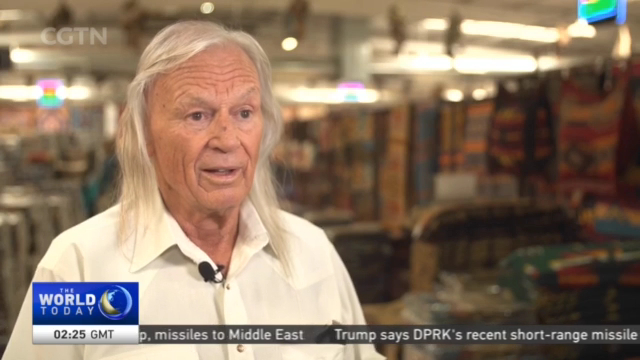
The situation could get worse. In March, President Trump threatened to close the border with Mexico. Back in El Paso, I meet Dusty Henson. He began selling saddle blankets in 1970. The company has since grown to include an eclectic range of products. Henson says closing the border would be devastating.
DUSTY HENSON, OWNER, FOUNDER THE EL PASO SADDLEBLANKET COMPANY "For me personally, it is everything. We do a few other countries, South America, Central America but Mexico is the main place. If they shut that border down and close it off, it is going to hurt a lot of people. It will shut us down."
Some people here would like to see the wall removed completely allowing the region to unite.
FERNANDO CARCIA BORDER NETWORK FOR HUMAN RIGHTS "The wall it is disrupting the historic relations between the two communities. El Paso and Juarez cannot be understood by themselves. I think we are one community at the end of the day and that wall divides this community."
Two cities separated by a wall but with a history and a future that relies on each other. Dan Williams, CGTN El Paso, Texas.