
09:14, 19-May-2018
'A Tale of Jerusalem': Modern Jerusalem: How the east side lives
 []
[]
Share







Copied
05:15
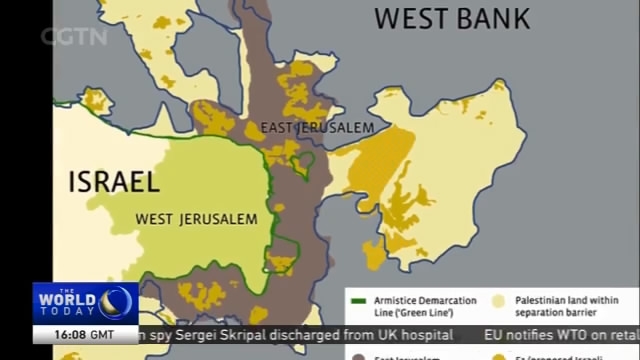
In comparison, East or Palestinian Jerusalem seems frozen in time.
When Israel occupied the East in 1967, Palestinian residents living under Jordanian rule up to that time were subject to Israel's laws which granted Palestinians permanent residence but not full citizenship.
Throughout the years, Israel has used complicated legal loopholes and bureaucratic means in expropriating Palestinian land.
The international community does not recognize East Jerusalem's annexation.
YOUSSEF NATSHEH ARCHEOLOGIST, EAST JERUSALEM "Political power I don't know. We cannot predict it really. But we know from history that might and mighty, strength, it's not going to be forever.”
Today, the result of lacking infrastructure planning is over-crowding, poor sanitation & few public parks or recreation areas for four hundred thousand residents.
Apartment block alley scenes like this are not uncommon.
Mere blocks away, this hidden gem. An Ottoman-era palace sitting on the 1967 armistice or green line between East & West Jerusalem.
Taken over & revamped into a hotel by Americans in the late 1800's, the landmark has weathered conflicts and wars, seemingly protected by an invisible shield.
THOMAS BRUGNATELLI, GM AMERICAN COLONY HOTEL EAST JERUSALEM "This is kind of an untouchable place. First of all, because it's in East Jerusalem. Secondly, because it's the place where East meets West. This is where Israelis used to come - and still come - to talk with Palestinians."
Those talks have stagnated and the dialogue critical to addressing Jerusalem's East versus West future status is frozen, just like progress in much of the city's East Side.
Moving West from the Old City a striking landscape of Jerusalem appears.
The scene suggests a modern western city with very little resemblance to the Eastern side.
ABAHER EL SAKKA PROFESSOR OF SOCIOLOGY BIRZEIT UNIVERSITY "The main change in Jerusalem happened after the 1967 occupation, Israeli authorities have worked to change its demographic structure and architecture. The occupation wanted to create a modern city suitable to be the Capital of Israel in West Jerusalem. In attempts to portray its more civilized than the East, laws were formed to boom business there. It suffocated the business owners in the East forcing some of them away. They also renamed neighborhoods to wipe out the Arab history from that side."
Some locals believe it's the stable status given to West Jerusalem that has encouraged local investors to come rebuild the city.
United Nations security council resolutions clearly give Israel the rights for Western Jerusalem, based on the borders prior to the 1967 occupation Israel lead.
So despite Israel's obvious control of East Jerusalem, the Westside has been much more appealing for Israel's new immigrants.
URI ROSENBACH ART GALLERY OWNER IN WESTERN JERUSALEM "I think that part of the difference is clear because definitely there is a political division, between East and West since there has not been a political solution about what's going to be the end of Jerusalem, there is a certain feeling of permanence in West Jerusalem, and there is uncertainty in East Jerusalem."
This side of the city quickly grew, colossal buildings are replacing the old ones.
Galleries of contemporary art are spreading, together they make many parts in West Jerusalem look more like Europe than most Middle Eastern cities nearby.
URI ROSENBACH ART GALLERY OWNER IN WESTERN JERUSALEM "A lot of the Western civilization Is here a lot of Jewish immigrants are coming from Europe, it has really developed into a well to do area. You obviously have religious or alder religious choose to live in West Jerusalem. There is a certain amount of affluence and a certain pride of Kind of coming here and building a new country."
ABAHER EL SAKKA PROFESSOR OF SOCIOLOGY BIRZEIT UNIVERSITY "A new architecture started to rise, Israeli architecture. They didn't only bring western technologies to build Jerusalem they also used Palestinian stones in their building to make anyone who sees them a feeling that they are hundreds of years old, which with exception to few Jewish buildings before 1948 is not true."
ADEL EL MAHROUKY JERUSALEM "The Vision of West Jerusalem is to grow even bigger, skyscrapers are expected to fill the horizon in the coming years. This side of the holy city is very close to the Palestinian-Israeli conflict, yet has managed to grow independently."