
Culture
18:35, 24-Mar-2018
Will 'Pacific Rim Uprising' succeed in China?
 ["china"]
Share







Copied

Guillermo del Toro's "Pacific Rim" seems like ages ago, but five years later, it's time to rise again as that film's sequel "Pacific Rim Uprising" made a strong impression on Friday both in China and the US.
But this time, things have changed. del Toro gave up the production to work on his Oscar-winning "The Shape of Water" and, in the intervening years, the Chinese presence in Hollywood has become more significant than ever.
"Pacific Rim Uprising," directed by Steven S. DeKnight, who is best known for his work on the "Spartacus" and "Daredevil" TV shows, is set in 2030, ten years after the first movie's Battle of the Breach, and humanity needs to again fight the Kaiju: Giant monsters set on destroying the world.
Critical ratings and box office
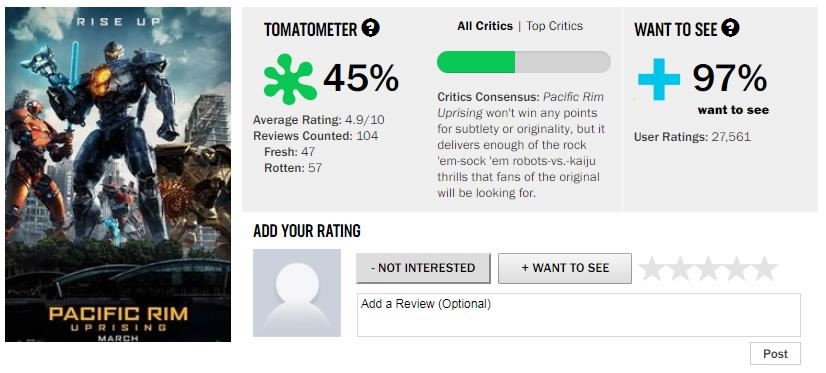
The film received a 65 percent fresh rating at movie review site Rotten Tomatoes on March 21 – but it dropped to 45 percent when it was officially released two days later. On MetaCritic, "Pacific Rim Uprising" received a simmilar rating of 46 marks out of 100, but the more generous IGN gave it 6.5 out of 10.

Screenshot of Douban
Screenshot of Douban
The Chinese audiences' reactions are more complicated. The film got only 5.8 points out of 10 on local movie platform douban.com.

But on online ticketing platform Taopiaopiao, the viewer's rating stands at 7.8 and nearly 360,000 people added the film to their to-see list.
However, the box office is a different story. Box Office Mojo reported that "Pacific Rim Uprising" grossed a solid 2.35-million US dollars from screenings late on Thursday night. It is expected to top "Black Panther" at the weekend box office, ending its five-weekend streak at No. 1.
Variety put the sequel's weekend gross at 23 million dollars, falling short of the first installment's 37-million US dollar opening, which was followed by a gross of 411-million US dollars worldwide - 112-million of which coming from the Chinese market.

"Pacific Rim Uprising" grossed 144 million yuan on its opening day in China. /Screenshot via http://piaofang.maoyan.com
"Pacific Rim Uprising" grossed 144 million yuan on its opening day in China. /Screenshot via http://piaofang.maoyan.com
Speaking of China, "Pacific Rim Uprising" has already raked in 144 million yuan, or 22.8-million US dollars on the opening day, accounting for 68.8 percent of the total national cinema revenue that day.
Strong Chinese presence
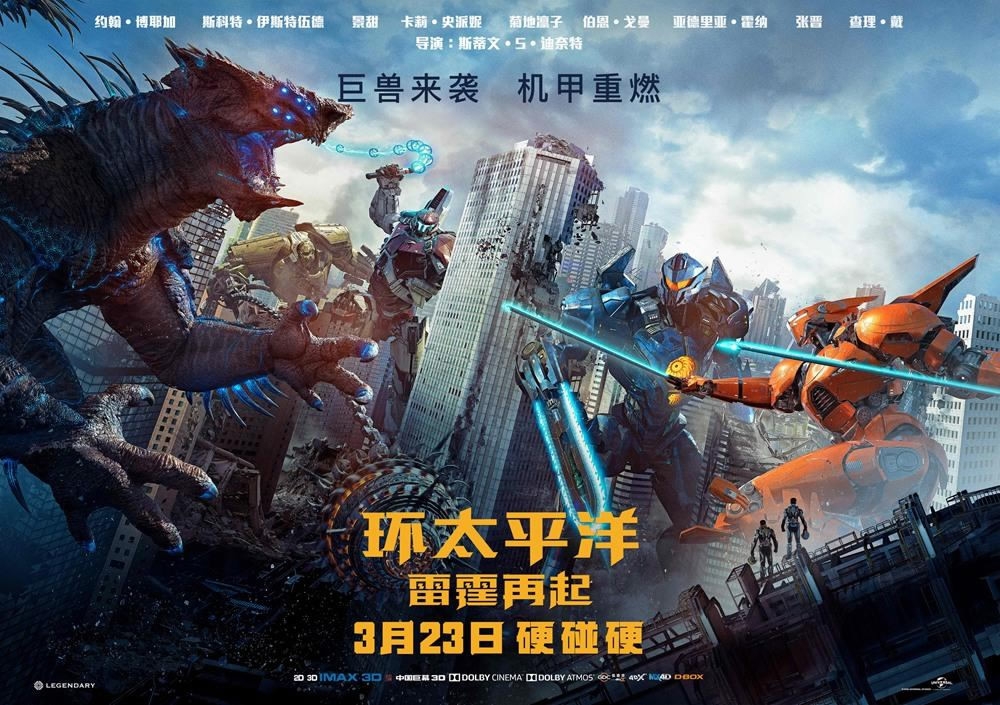
A Chinese poster of "Pacific Rim Uprising" /Photo via mtime.com
A Chinese poster of "Pacific Rim Uprising" /Photo via mtime.com
The success of "Pacific Rim Uprising" is arguably a reflection of China's uprising in the region.
It's no longer surprising to see Chinese elements – actors and brands alike – in Hollywood movies.
But "Pacific Rim Uprising" goes further than usual by having a whopping seven Chinese actors on board and filming several of its scenes in the coastal resort city of Qingdao, in east China's Shandong Province.
The production companies behind the film include Legendary Entertainment, bought by the Dalian Wanda Group in 2016, and Beijing-based Perfect World Pictures, which partially explains the large Chinese presence in the movie.

Chinese actress Jing Tian /Photo via Douban
Chinese actress Jing Tian /Photo via Douban
One of the actors is "Kong: Skull Island" actress Jing Tian, who also took on a leading role in Zhang Yimou's "Great Wall". She plays Shao Liwen, the highly intelligent CEO of an international group, who DeKnight described as "extremely smart, brilliant, not very good with people - really a Chinese tech billionaire."
"I love the idea of including Chinese actors and actresses in this movie and made them a big part of the movie this time around," DeKnight told Global Times. "Especially Jing Tian… the character is woven into the story so neatly."
DeKnight was also of all praise towards the one-month shoot in Qingdao. He told Global Times that it was "an amazing, inspiring experience" that "elevated the movie and gave it that kind of international, cohesive world-coming-together feeling that you just wouldn't get with a cast from just the US or just Australia."
However, not all the Chinese choices work. During one particular scene, the logo of e-commerce giant JD.com takes over the frame. "It distracted me from the movie," said Zhang Cong, who went to see the film in the early hours of Friday. "There are a lot of Chinese actors... and a lot of Chinese. It kinda let me feel the producers are appealing to Chinese audiences."