
Politics
23:02, 18-Jun-2018
Bavarians give Merkel two weeks to reach EU deal on migrants
 ["china"]
Share






Copied
00:55

Bavaria's Christian Social Union (CSU) on Monday gave German Chancellor Angela Merkel two weeks to reach a European deal on migrants before they would demand immigration curbs that could fracture her governing coalition.
The CSU leadership agreed on Monday to delay until after a June 28-29 EU summit the introduction of an entry ban for refugees who have already registered in other EU countries, allowing Merkel time to reach a multilateral deal.
Merkel opposes any unilateral move by German Interior Minister Horst Seehofer, who is also CSU chairman, that would reverse her 2015 open-door policy on migrants and undermine her authority. Monday's compromise means he can introduce immediate expulsion for one subset of migrants.

German Interior Minister and leader of the Christian Social Union (CSU) Party Horst Seehofer speaks at a press conference after the party meeting at the CSU headquarters in Munich, June 18, 2018. /VCG Photo
German Interior Minister and leader of the Christian Social Union (CSU) Party Horst Seehofer speaks at a press conference after the party meeting at the CSU headquarters in Munich, June 18, 2018. /VCG Photo
"We wish the chancellor much luck," Seehofer told a news conference in Munich, announcing that he would nonetheless issue orders for people who have already been expelled to be turned back at the borders.
"This is not about winning time or anything like that but rather that in July, if there is no result at European level, we must implement this – that is a question for the functioning of our constitutional state," he added.
US President Donald Trump waded into the political crisis facing Merkel Monday, declaring that the German people were "turning against their leadership" over immigration.
"We don't want what is happening with immigration in Europe to happen with us!" he said in a pair of tweets.
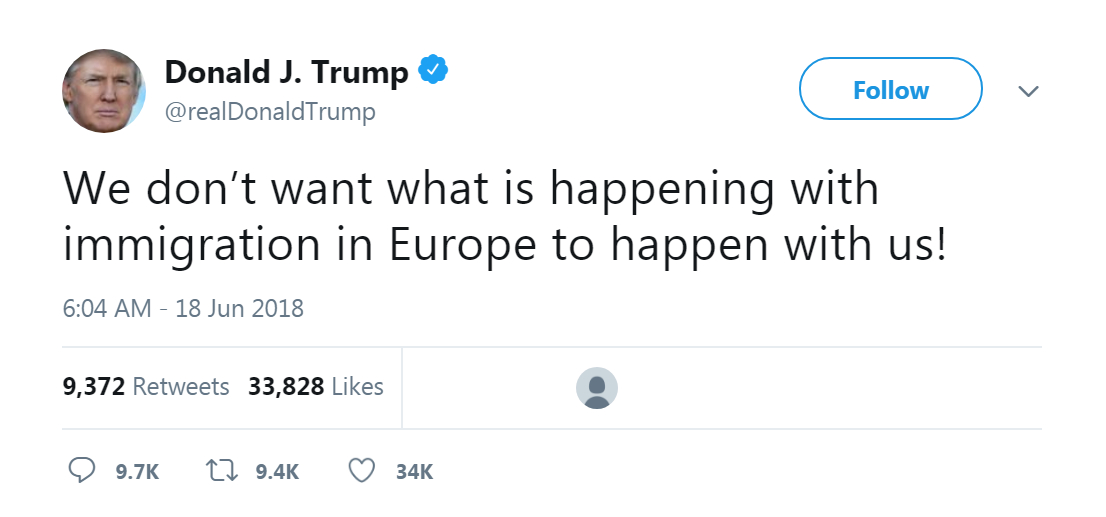
Screenshot of US President Donald Trump's tweet
Screenshot of US President Donald Trump's tweet
'Nothing automatic'
Merkel welcomed compromise in the dispute, which has threatened to destabilize a coalition cobbled together just three months ago, and said her Christian Democrat (CDU) party would decide how to proceed after the two-week deadline elapsed.
"After the European Council, the (CDU) party presidency will decide what to do next,” she told a news conference. “There is nothing automatic.”
Merkel has insisted that an EU-wide settlement can be reached at a June 28-29 Brussels summit, and says Seehofer's plan to turn away migrants who have previously been expelled would prejudice her chances of reaching that deal.
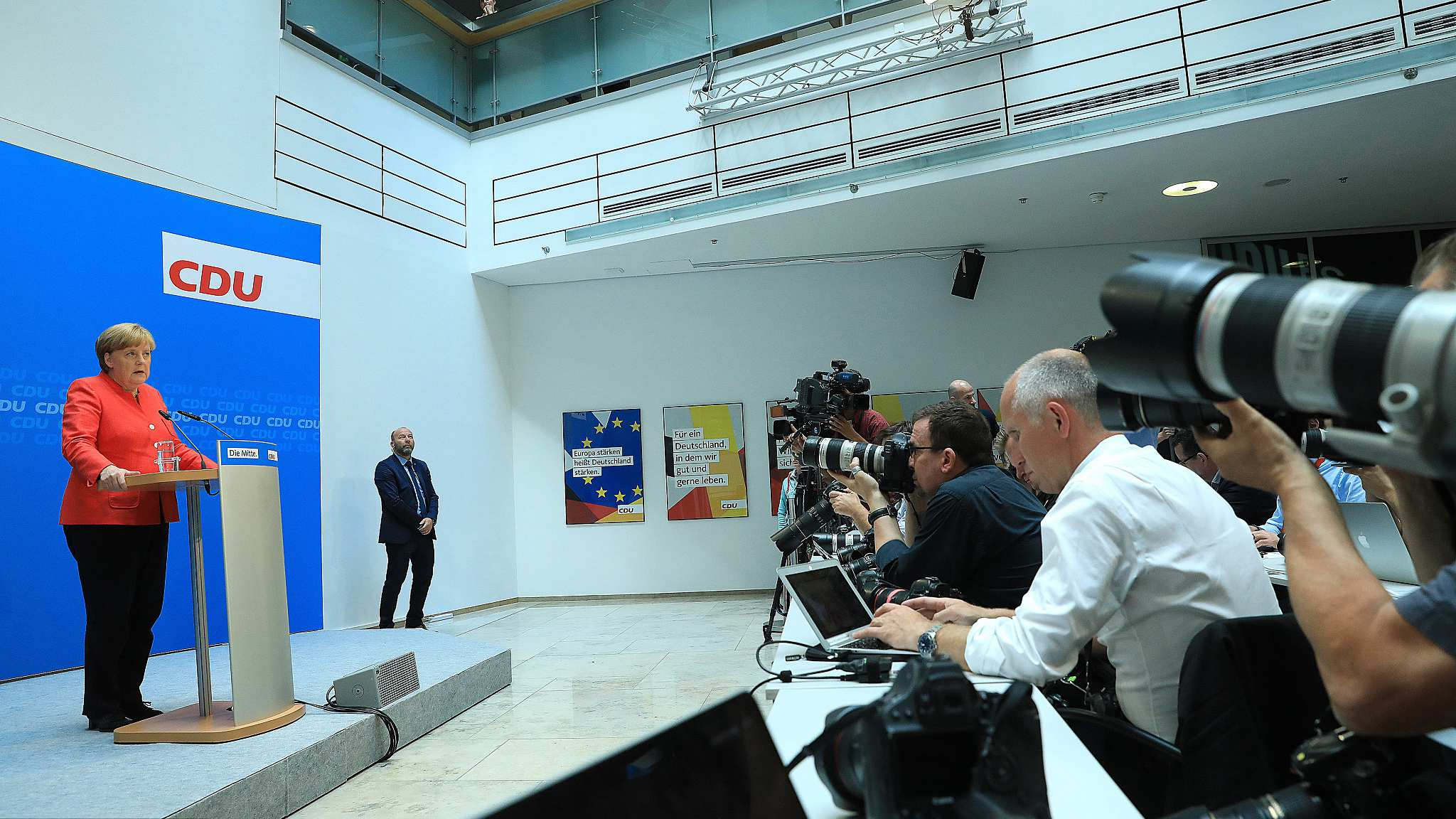
Angela Merkel, Germany's chancellor and leader of the Christian Democratic Union (CDU) party, speaks during a news conference at the CDU headquarters in Berlin, June 18, 2018. /VCG Photo
Angela Merkel, Germany's chancellor and leader of the Christian Democratic Union (CDU) party, speaks during a news conference at the CDU headquarters in Berlin, June 18, 2018. /VCG Photo
The CSU, which faces regional elections in October, fears it could be toppled from its decades-old perch atop the wealthy southern state by the anti-immigration Alternative for Germany (AfD) party if it does not tighten policy towards migrants.
Merkel’s open-door migrant policy is widely blamed for the rise of the right-wing AfD, now the main opposition party in Germany’s federal parliament.
More than 1.6 million migrants, mostly Muslims fleeing wars in the Middle East, have arrived in Germany since 2014.
7368km
Source(s): AFP
,Reuters