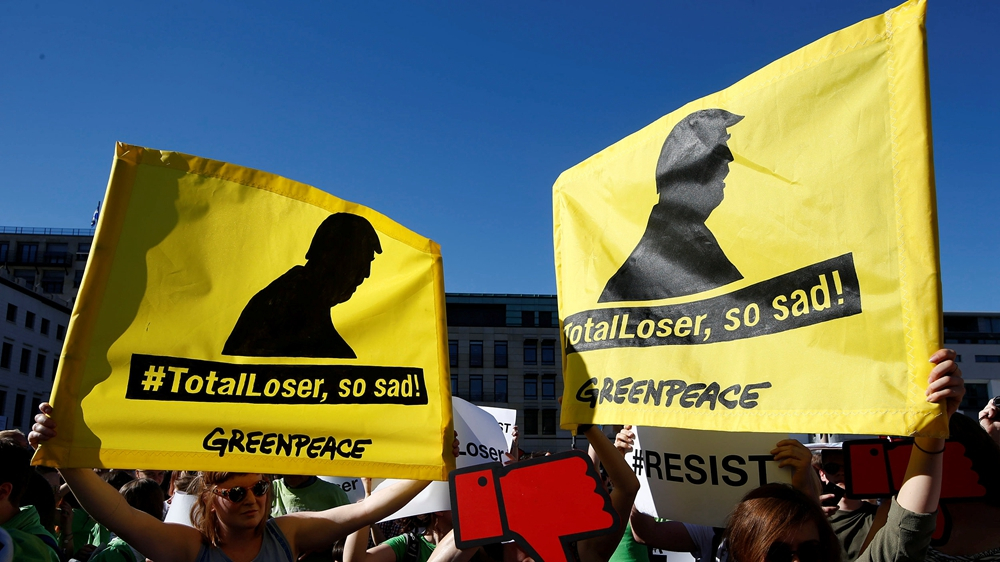
Experts regretting US's pulling out of the Paris climate agreement exactly one year ago said the move has hurt the long-range efforts to tackle climate change.
Last year, US President Donald Trump announced the exit of his country from the climate deal, citing heavy financial commitment from the US as the main reason.
The decision was met by strong disapproval from world leaders, including those of the US allies, such as the Canadian Prime Minister Justin Trudeau, who tweeted his country was "deeply disappointed."
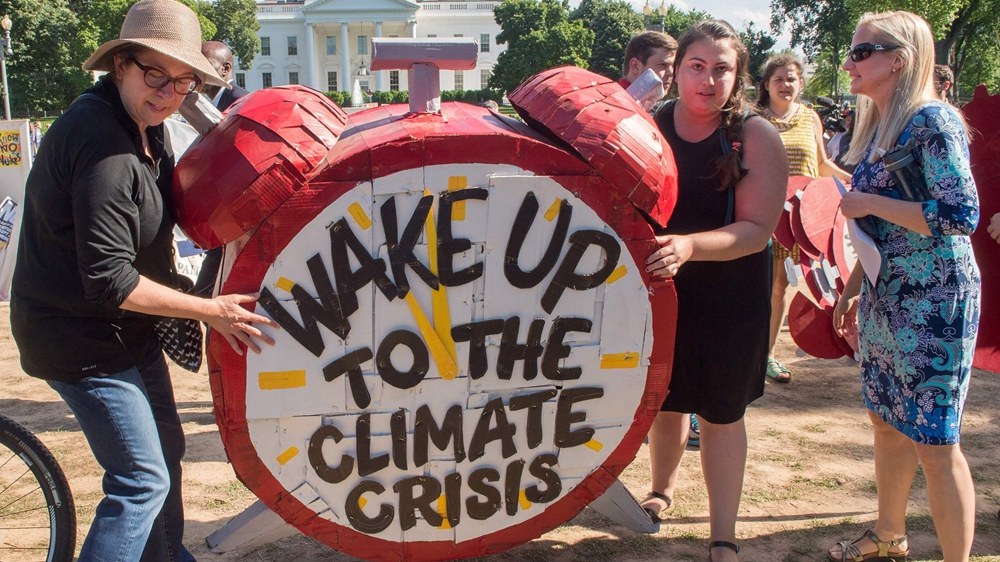
June 1, 2017: Protesters hold up signs during a demonstration in front of the White House in Washington, DC, US. /VCG Photo
June 1, 2017: Protesters hold up signs during a demonstration in front of the White House in Washington, DC, US. /VCG Photo
The 2015 Paris deal committed nations to a long-term goal to reducing greenhouse gas emissions and keeping the global temperature hike “well below” two degrees Celsius above pre-industrial levels.
One year later, climate experts quoted by a New York Times report said, although the remaining signatories have launched a smattering of bilateral and multilateral initiatives to fill the gap left by the US departure, the momentum is compromised.
The report cites foreign officials and observers as saying other countries might become dismayed at cutting emissions when the United States, a much larger contributor to global warming, won’t even acknowledge that it’s happening.
Andrew Norton, director of the London-based International Institute for Environment and Development, also said Trump’s decision to stop further U.S. payments into a major fund to help poorer countries adopt clean energy threatened climate action around the world.

June 1, 2017: The Paris city Hall is illuminated in green following the announcement by US President Donald Trump that the United States will withdraw from the 2015 Paris accord. /VCG Photo
June 1, 2017: The Paris city Hall is illuminated in green following the announcement by US President Donald Trump that the United States will withdraw from the 2015 Paris accord. /VCG Photo
“Without the money and support crucial to delivering the Paris Agreement, the global effort to address climate change may be fatally undermined,” he warned in a statement.
This is not the only example of US's exodus from multilateral accords or agencies causing negative effects.
The Iran Nuclear Deal Exit
At the beginning of May, Trump announced the withdrawal from the Joint Comprehensive Plan of Action (JCPOA), or more widely known as the Iran nuclear deal, which sent shock waves through the international community.
The JCPOA signed during the Obama administration in 2015 aimed at curbing Iran's nuclear activities in return for the lifting of sanctions that had been imposed by the UN, US and EU.
The deal has won large-scale endorsement from major powers in the world like China, Russia and the EU.
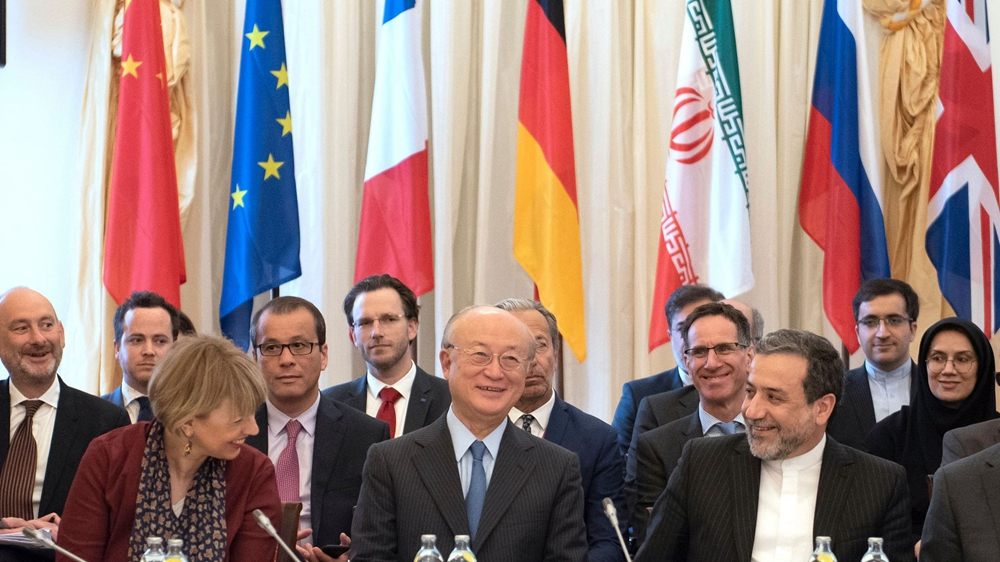
(L to R) Secretary-general of the European Union External Action Service (EEAS) Helga Schmid, director general of the International Atomic Energy Agency IAEA, Yukiya Amano and political deputy at the Ministry of Foreign Affairs of Iran Abbas Araghchi attend a special meeting of the Joint Commission of parties to the JCPOA on Iran's nuclear deal at Coburg palace in Vienna, Austria on May 25, 2018. /VCG Photo
(L to R) Secretary-general of the European Union External Action Service (EEAS) Helga Schmid, director general of the International Atomic Energy Agency IAEA, Yukiya Amano and political deputy at the Ministry of Foreign Affairs of Iran Abbas Araghchi attend a special meeting of the Joint Commission of parties to the JCPOA on Iran's nuclear deal at Coburg palace in Vienna, Austria on May 25, 2018. /VCG Photo
Trump called the deal "defective to its core" and promised to reimpose sanctions on Iran, which he did follow up with by slapping new sanctions on six Iranians and three Iran-based entities on Wednesday.
Some large international corporations, such as the French oil giant Total, dealing business with Iran are also considering pulling out of the country under the US sanctions pressure, further destabilizing the economic prospect for Iran.
Iran, while expressing hope of continuing implementing the deal, is defiant to the US moves and threatened to restart its uranium enrichment program at an "industrial level" if the agreement falls apart.
In an attempt to prevent the deal from collapsing, British, Chinese, French, German and Russian officials have just concluded a meeting in Vienna with Iran's deputy foreign minister.
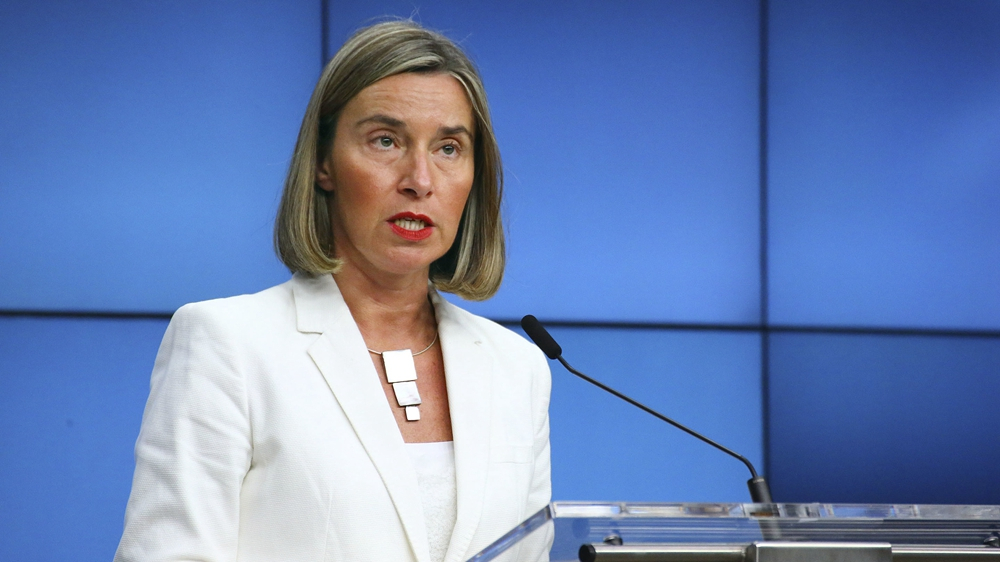
Federica Mogherini, European Union high representative for Foreign Affairs and Security Policy, speaks at a press conference after a meeting with foreign ministers of Iran, Germany, Britain and France in Brussels, Belgium, May 16, 2018. /VCG Photo
Federica Mogherini, European Union high representative for Foreign Affairs and Security Policy, speaks at a press conference after a meeting with foreign ministers of Iran, Germany, Britain and France in Brussels, Belgium, May 16, 2018. /VCG Photo
It is still unclear whether and when the remaining participants of the nuclear deal will present a plan that could help Iran ward off the economic ramifications of the US withdrawal from the nuclear deal.
Withdrawal from UNESCO
The Trump administration announced on October 12, 2017, that the US would withdraw from the United Nations Educational, Scientific and Cultural Organization (UNESCO), the 73-year-old UN organization that protects cultural heritages, again.
This time the US government cited "mounting arrears, the need for fundamental reform," and "continuing anti-Israel bias" the UN agency has put up, trying to legitimize its decision.
October 30, 2017: The UNESCO logo is seen during the opening of the 39th session of the General Conference of the United Nations Educational, Scientific and Cultural Organization (UNESCO) at their headquarters in Paris, France. /VCG Photo
October 30, 2017: The UNESCO logo is seen during the opening of the 39th session of the General Conference of the United Nations Educational, Scientific and Cultural Organization (UNESCO) at their headquarters in Paris, France. /VCG Photo
Over 30 years ago in 1984, the country left UNESCO for the first time, claiming the agency of being politicized and extravagantly expanding its budget.
The country's second pull-out disappointed many.
Stefan Simon, the director of Global Cultural Heritage Initiatives at Yale University told the New York Times that US accounts for 22 percent of UNESCO's budget, and its withdrawal would "painfully reduce UNESCO's ability to fulfill important missions, such as advancing and promoting literacy, gender equality, freedom of expression and scientific collaboration.”
Out of TPP
Shortly after his inauguration in January 2017, Trump pulled the US out of the Trans-Pacific Partnership (TPP) with an executive order.
Trump described the agreement as a ‘‘potential disaster.’‘ To replace the TPP, the American president vowed to negotiate separate bilateral trade deals.
The TPP was signed by 12 countries including the US, Japan, Australia, Canada, Singapore and Vietnam in 2015, with the aim of bringing down tariffs.

The 12 countries involved in the TPP prior to the US withdrawal. /Xinhua Photo
The 12 countries involved in the TPP prior to the US withdrawal. /Xinhua Photo
Trump's withdrawal has put the other 11 members in an awkward position, as most of them do not favor two-way trade talks with Washington for fear of being strong-armed into a disadvantageous deal.
The decision by the Trump administration has also incurred worries about the damage it is doing to multilateralism.
When asked about China's reaction to the US withdrawal from the TPP, Chinese Foreign Affairs Ministry spokesperson Hua Chunying said in January 2017, that China has always been advocating an open and win-win regional free trade arrangement, upholding the principle of establishing trade rules through fair negotiations among all participants.
Only when the "win-win" spirit is implemented can the common interest of different parties be guaranteed. Hua emphasized.
(Cover photo: People hold banners as they protest next to the Brandenburg Gate, besides the US embassy, against the US withdrawal from the Paris climate change deal, in Berlin, Germany, June 2, 2017. /VCG Photo )
(With inputs from Reuters)

 ["china"]