
Opinion
22:52, 18-Mar-2019
Is China adopting double standards on fighting terrorism?
Updated
13:06, 19-Mar-2019
 ["china"]
Share







Copied
Since last year, there has been a mounting chorus of Western criticism on China, which accuses the country of setting up detention centers across its Xinjiang Uygur Autonomous Region, constituting what some call staggering human rights violations.
However, the country has repeatedly refuted the claim by saying that it has been running "vocational training camps" instead which is intended partly to stamp out local extremist inclinations. On Monday, the government released a white paper elaborating on its efforts to counter terrorism and protect human rights in Xinjiang.
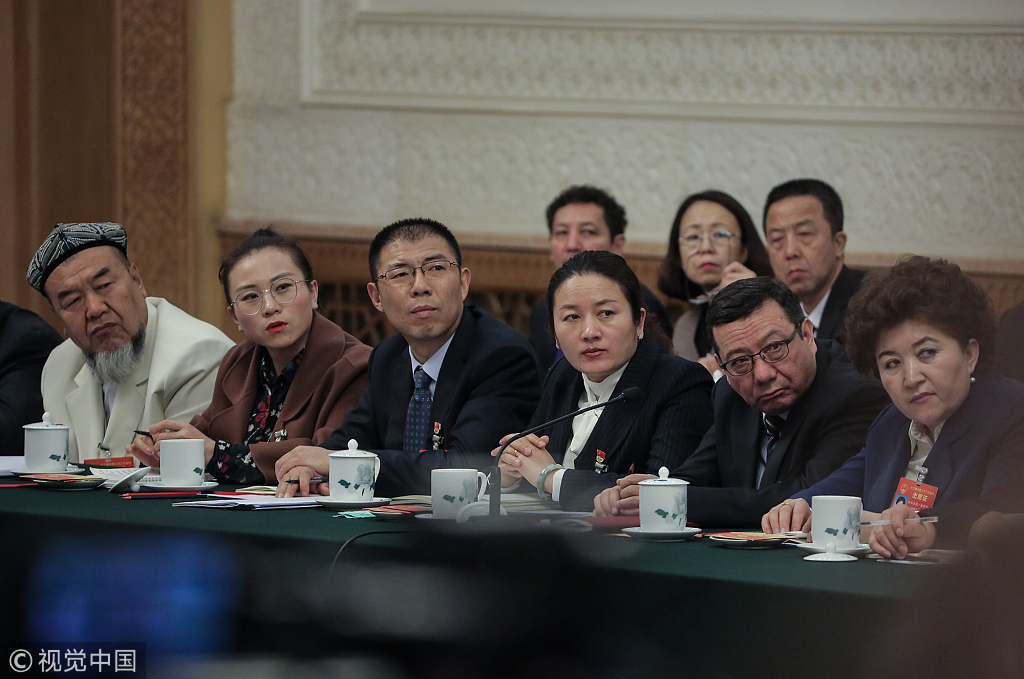
Delegates from the Xinjiang Uygur Autonomous Region attend a meeting during China's "Two Sessions," at the Great Hall of the People in Beijing, March12, 2019. /VCG Photo
Delegates from the Xinjiang Uygur Autonomous Region attend a meeting during China's "Two Sessions," at the Great Hall of the People in Beijing, March12, 2019. /VCG Photo
Trying to poke holes in such an explanation, a recent article on The Diplomat pointed out Beijing's "inconsistency" and "hypocrisy" on the issue, which says that the country, while "claiming to be cracking down on terrorism," has time and again refused to add Masood Azhar, the leader of the militant group Jaish-e-Mohammed in Pakistan, to the UN's global terrorist blacklist.
First of all, not making China's position on Masood Azhar the focal point of this piece, the issue is still worth explaining. There is no escaping that Pakistan and China do have cordial relations, which might affect China's position on the issue. However, that happens to virtually every country. More importantly, Long Xingchun, a professor at the School of Foreign Languages of China West Normal University, pointed out that India's "verdict" on Masood was based on assumptions rather than "concrete evidence" that is essential to prove Masood Azhar was directly behind a series of terrorist attacks in India.
"In the absense of such evidencie, China has a good reason for not backing the designation, not to mention that countries around the world frankly also disagree on how they define terrorism," said Long.
Second, coming back to the "revelation" that China adopts double standards on terrorism, as a matter of fact, the West is in no position to point fingers at China on the issue. They should have a look at how it has reacted to terrorist attacks in China and those in the West. It is conspicuous that when it comes to such attacks in China they have demonstrated much less sympathy than otherwise would have been seen in such incidents in Western countries.
For example, the New Zealand mass shooting that claimed 50 lives and caused 50 injuries last week has plunged the Western world into grief.
While Western reporters have been emphatic with their sympathy for victims of the incident, condemning the heartless murderer who was reported to be a white supremacist that denounced immigrants as "invaders" and appeared unapologetic for his anti-immigrant rhetoric, they were hesitant to do the same with similar events in China.
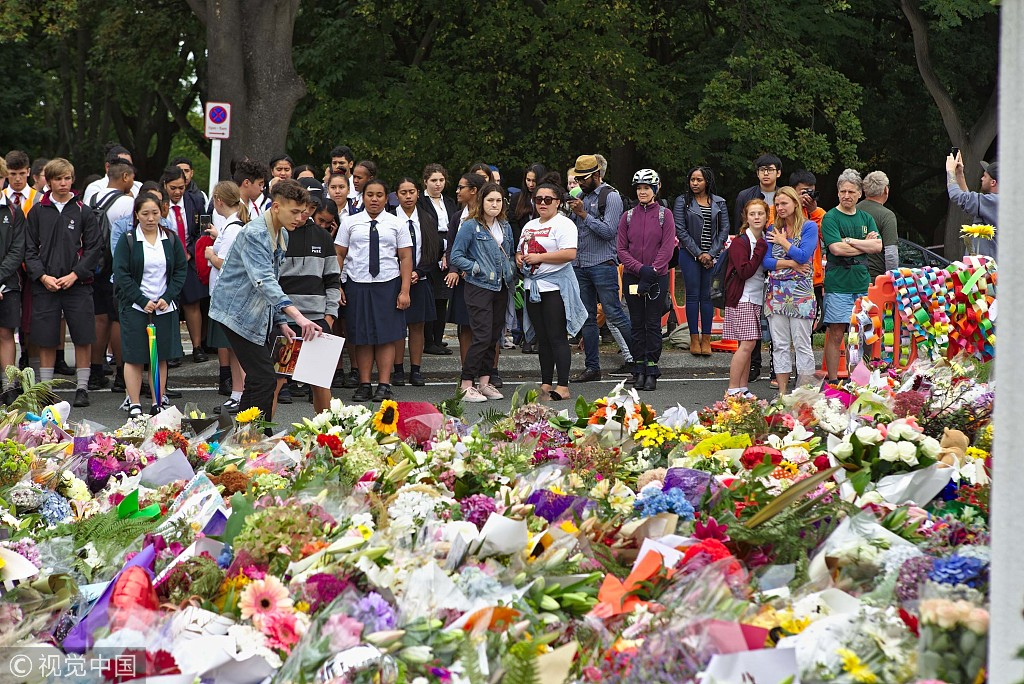
High school students pay tribute to the victims of the mosque terrorist attack at Deans Ave vigil near the Masjid Al Noor Mosque, in Christchurch, New Zealand, March 18, 2019. /VCG Photo
High school students pay tribute to the victims of the mosque terrorist attack at Deans Ave vigil near the Masjid Al Noor Mosque, in Christchurch, New Zealand, March 18, 2019. /VCG Photo
For example, when covering a terrorist attack that killed 31 people in China's Kunming City in 2014, rather than "praising the heroism of people on the scene" that was seen on Western media with the New Zealand shooting, a common Western report would instead draw attention to "rights groups" in China that "accuse China's government of cultural and religious repression".
Such glaring double standards of the West are indeed commonplace. Boiled down, the nub of the problem lies in a deep disconnect with China and the naive belief held by some that upholding liberal values is key to solving all problems across countries, even though China itself is not free of the problem of disconnect with the world, either.
It is true that we are living in an era of accelerating globalization where better communication and transportation are supposed to build bridges between countries and people. However, in reality a true understanding between countries still falls short.
The assumption that one country's reality can be replicated in another has caused more misunderstanding rather than less.
When the West accuses China of suppressing minorities' rights, oftentimes citing the policy that "forces children to speak Mandarin at school," their understanding of the situation is not grounded in China's reality, a correct judgment of which requires one to take into account a broad range of factors including the country's demographics, history, values, traditions and events happening at the current time.
A dogmatic pursuit to see liberal values flourishing everywhere has caused them to misinterpret the situation in China, believing policies as such are born out of ill will.
However, by encouraging these kids from ethnic minority groups to speak Mandarin at school, the Chinese government is by no means prohibiting them from speaking their own language or cherishing their cultural heritage, according to Victor Gao, director of the China National Association of International Studies.
"The simple reason is that a common language is needed to enable better communication between different ethnic groups aross the country. It is also good for the economy and good Mandarin skills helps them find a job," he said.
A parallel can be drawn to similar discussions happening in the West – as European countries come to grapple with the immigration issue with the increasing influx of immigrants, debating if crimes rates are brought up by immigrants, some argue that at any rate, immigrants should learn how to integrate first by learning the local language and culture.
The same logic applies to China's anti-extremism and terrorism efforts. While Western countries have been discouraging hate speech and rushing to curb their racial tensions which at times give rise to massive social violence, China suffers from the problem of social instability of its own and is on its way to developing better solutions.
The bottom line is that every country is plagued by its own full set of issues and while the way they are handled can always be improved there are no one-size-fits-all solutions across the board.
(If you want to contribute and have specific expertise, please contact us at opinions@cgtn.com.)