
Energy
23:06, 09-Jun-2018
Analysis: Bright chances for energy cooperation at SCO Summit
 ["china"]
Share







Copied

The 18th Shanghai Cooperation Organization (SCO) Summit is taking place in the eastern Chinese city of Qingdao on June 9-10, with leaders discussing collaboration in such fields as security and counter-terrorism.
Agreements on economic cooperation and people-to-people exchanges are also expected to be inked during the two-day event. In the field of energy cooperation, there's also a chance for member states to write a new chapter in history.
Market shift
The global energy market is undergoing a major shift on two levels, according to an analysis piece published by China News Service (CNS).
The first is location shift. The production center of energy is moving westward, while the consumption center is expanding towards the East. Both directions point towards Central Asia, where most SCO countries are located.
The second is energy structure shift. Reliance on coal and oil as energy sources is weakening amid a rise in demand for natural gas and various types of new energy. China, one of the founding members of the SCO, is the world's largest country in photovoltaic and wind power installations.
"China is willing to support other SCO members on new energy cooperation," energy researcher with National Development and Reform Commission Zhou Dadi told CNS.
"It's predictable that SCO members will establish closer ties on energy cooperation," he said.
Stabilizing supply chains
With SCO member states at the center of the global energy market shift, it is possible for these countries to improve the current energy supply chains around the world, reaching a new global energy order that is fairer to people.
Energy cooperation is a necessity for SCO members, according to the SCO Development Report 2018 released by the Chinese Academy of Social Sciences.
The report says the SCO countries could partner in the following three areas to achieve their goal:
1. Stabilize the global energy supply chain and prevent unnecessary outage
2. Establish a better platform to negotiate energy prices
3. Help each other in the field of research to find cleaner and cheaper energy sources
Actual steps
In addition to the above-mentioned suggestions, concrete measures have already been taken to increase energy cooperation among SCO countries.
To that end, the SCO Energy Club was founded in December 2013. Twelve SCO members, observer states and dialogue partners have joined the club, holding four high-level meetings since.
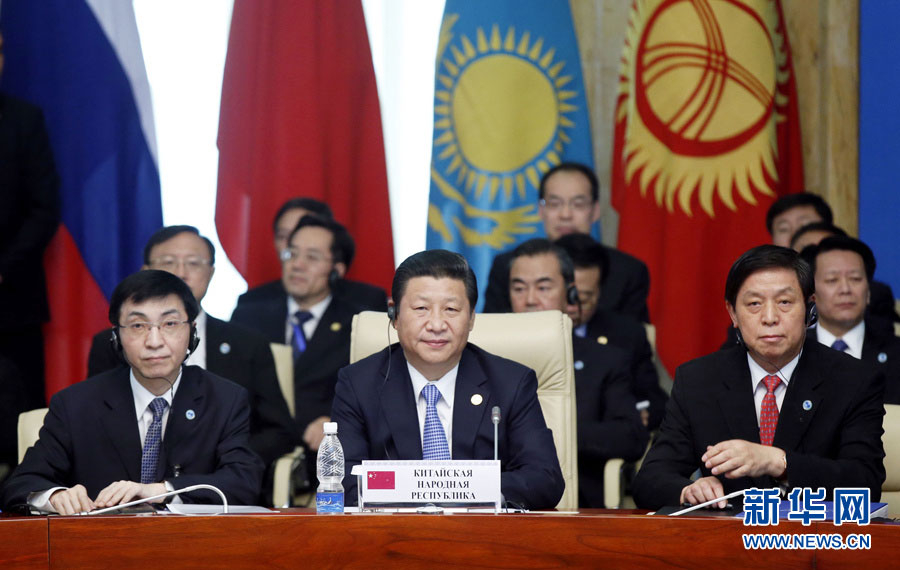
Chinese President Xi Jinping proposed the Energy Club at the 2013 SCO summit. /Xinhua Photo
Chinese President Xi Jinping proposed the Energy Club at the 2013 SCO summit. /Xinhua Photo
The club could be a great framework for the countries to have deeper coordination on future plans.
Apart from multilateral arrangements, members have also been engaged in bilateral agreements in the energy sector.
China and Russia, for example, have been building a 3,371-kilometer natural gas pipeline since 2015, the largest energy cooperation between the two countries.
With ongoing projects and bright prospects, it is safe to say that the SCO has been an incubator for regional synergy in the field of energy.