
Tech & Sci
14:42, 29-Jun-2018
Urban policies can help China meet half its climate pledge
Updated
14:14, 02-Jul-2018
 ["europe","china","north america"]
Share







Copied
China can eliminate up to a whopping 30 percent of carbon emissions – nearly half of its climate pledge – by focusing efforts on the “super emitting” industrial sector in each city, a study claimed.
In the last few decades, China's massive economic growth has led to rapid urbanization, leading to the growth of hundreds of cities. These cities produce more than 85 percent of carbon emissions.
Concerned over the rising emissions, China under the Paris Agreement has already pledged to slash carbon intensity by nearly 65 percent to 2005 levels.
Last year, to put a cap on the rising emissions, China launched the much-awaited carbon trading scheme. At present, the scheme is open only to the power sector and likely to be extended to other industries in coming months.
Around 20 researchers from the University of East Anglia, Tsinghua University and other global research institutes studied carbon dioxide emissions from 182 Chinese cities by 17 fossil fuels and 46 socioeconomic sectors.
These cities hold 62 percent of the country’s population and accounted for 77 percent of the GDP in 2010.
The study titled "City-level climate change mitigation in China" published in the journal Science Advances, classified cities into five categories: service-based, high-tech, energy production, heavy manufacturing, and light manufacturing cities to understand their carbon emission intensity.
The study found, in 2010, these 182 cities emitted 7,610 million tons of carbon dioxide. Industrial sectors make up the largest share with 6,639 million tons of the emission or 87 percent of the cities’ total,” the study revealed.
Non-industrial sectors contributed the remaining 12 percent or 971 million tons, with two-thirds of emissions reported from farming and direct energy use in rural areas.
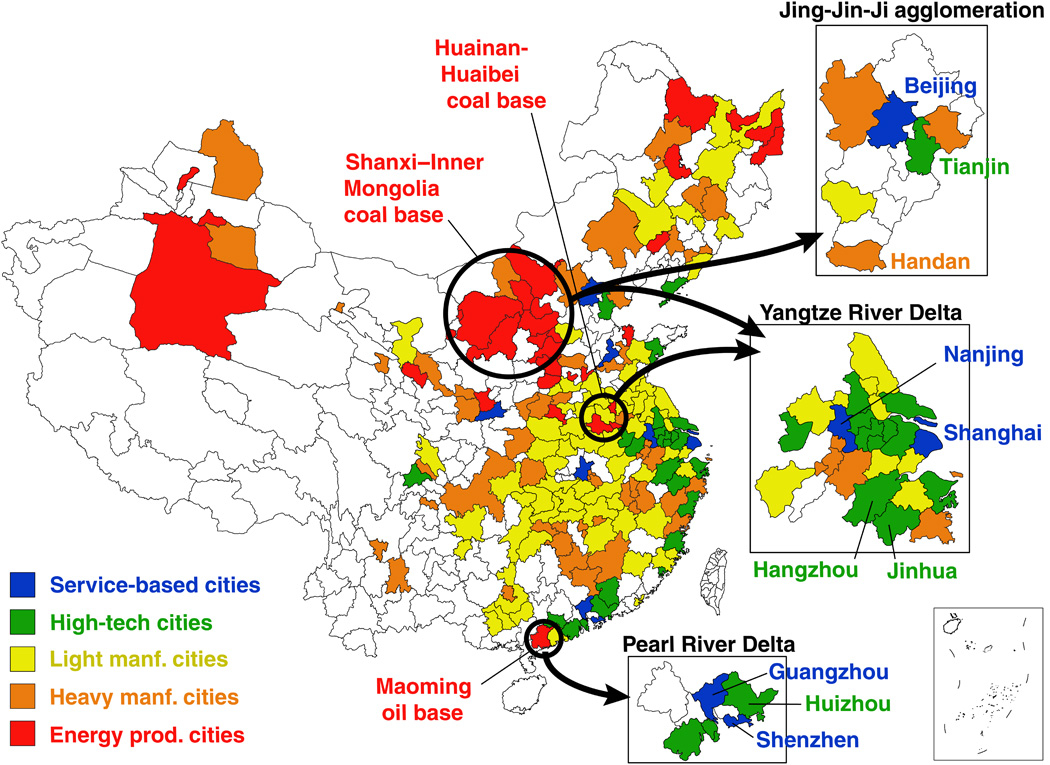
Cities have become a major source of emissions in recent years. /Science Advances Graphics
Cities have become a major source of emissions in recent years. /Science Advances Graphics
Coal was found to be a significant source of pollution in cities, contributing 74 percent of the total emissions. Oil and natural gas combustion added 15 and 2 percent, respectively. Industrial processes such as cement production added the remaining 9 percent.
In the recent years, to reduce choking pollution in cities, the government is shifting manufacturing and industrial units outside the cities. Researchers presented the example of Shougang Corporation, one of the largest steelmaking companies in the country, which was moved progressively from Beijing to Hebei Province.
The study found the outsourcing decision helped Beijing reduce carbon dioxide emissions by 7.6 million from 2010 to 2015, but emissions in Hebei Province increased by 87.1 million tons during the same period.
Yuli Shan, the lead author of the study and research fellow at the University of East Anglia, told CGTN, at present national policies aim at outsourcing the energy-intensive sector outside the city to optimize the economic structure, but this will soon lead the manufacturing sector to lose its economic growth.
“Cities should restore the previous structure, and instead upgrade the technology of manufacturing sectors to reduce the emissions. If this policy is enforced then our study suggests that it will lead to a reduction in up to 30 percent of total emissions in cities,” Shan said.
Shan also suggested that data reveals that each city should have its “own specific emission reduction policies,” as one size does not fit all in terms of emission control.
“Since cities have become a major emission hub, a city-specific policy will help China meet carbon emission goals early and cost-effectively,” Shan added.