
Economy
16:12, 28-May-2019
U.S.-Japan trade relations: What's happening and what's at stake?
Updated
17:59, 28-May-2019
 ["china"]
Share







Copied
02:33
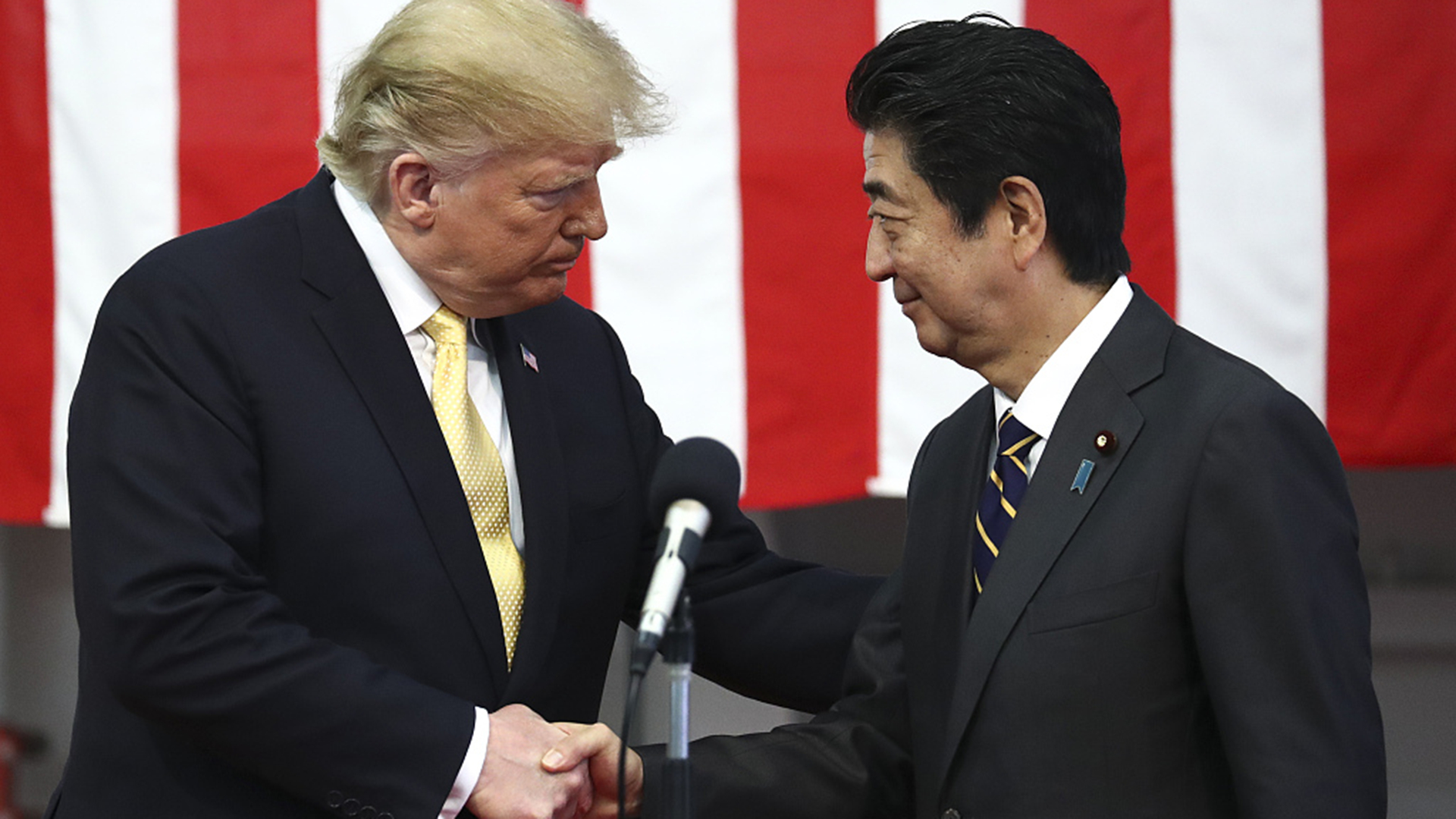
More than two years after U.S. President Donald Trump walked away from a regional Asia-Pacific trade agreement, the world's largest and third-largest economies are negotiating a deal of their own.
The two sides are eager to strike a deal as elections in both countries are pushing close. But there are still several difficulties to overcome before Trump and Shinzo Abe can both get what they want.
Trump says nothing will be finalized with Japan on trade before the country's upper-house elections in July. This might be a relief for Abe, giving him more time to come up with the best terms.
If he makes concessions on import taxes on U.S. produce in exchange for Washington not raising tariffs on Japanese cars, it would be great news for both Japanese carmakers and U.S. farmers.
But it would reflect badly on himself, and Japan's credibility. A bilateral deal on the side with a protectionist country could be interpreted as a betrayal to the other 10 countries in the Trans-Pacific Partnership (TPP), and a contradiction to Japan's image as a free trade advocate.
If Abe goes tough and says no to favorable terms for U.S. companies, he may risk damaging Japan's pillar car industry.
U.S. farmers are hurting now.
Take wine for example. There's no duty on wine entering Japan from the EU and TPP member Chile. And wine from Australia, another TPP member, has a 5.6-percent tariff that will soon drop to zero. But wine from California has a 15-percent tariff.
Officials from both countries have indicated they want to wrap up negotiations quickly. But another obstacle is the scope of the deal.
During April's talks at the White House, Tokyo reportedly hoped to limit the scope of the talks to trade in goods, while Washington wants a comprehensive Free Trade Accord. This would include e-commerce and music distribution services.
Japan's trade deficit against the U.S. in 2018 was around 67.6 billion U.S. dollars, the fourth largest after China, Mexico, and Germany.
U.S. Treasury Secretary Steven Mnuchin has said Washington wants trade deals to prevent Japan from manipulating its currency to boost exports. Similar clauses are in the revised NAFTA. The Japanese finance minister said his country wouldn't accept linking currency policy with trade matters.
Trump and Abe will meet again at the G20 Summit in Osaka next month, where Trump is also expected to meet with Chinese President Xi Jinping.