
Business
21:32, 16-May-2018
Chinese delegation arrives in Washington for trade talks
 ["china"]
Share







Copied
A Chinese delegation led by Vice Premier Liu He arrived in Washington on Tuesday at the invitation of the White House to continue discussions over the ongoing China-US trade disputes that began with the Section 301 Investigation.
Delegation members
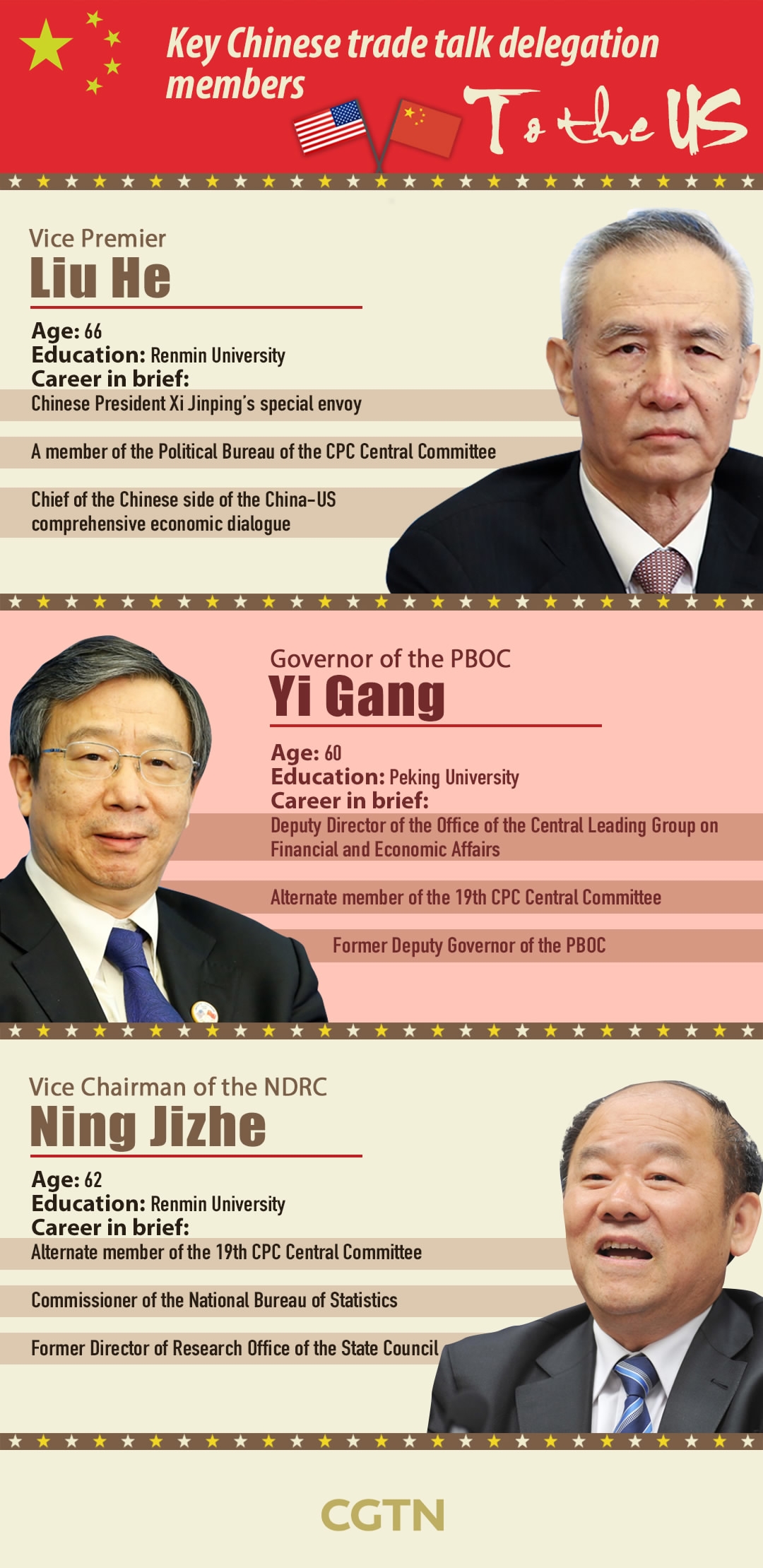
Liu is Chinese President Xi Jinping’s special envoy, a member of the Political Bureau of the Communist Party of China (CPC) Central Committee, and Chief of the Chinese side of the China-US comprehensive economic dialogue.
Other delegation members are from major economic sectors of the Chinese government, including:
Yi Gang, Governor of the People’s Bank of China
Ning Jizhe, Vice Chairman of the National Development and Reform Commission
Liao Min, Deputy Director of the Office of the Central Commission for Financial and Economic Affairs
Zheng Zeguang, Vice Foreign Minister
Luo Wen, Vice Minister of Industry and Information Technology
Zhu Guangyao, Vice Finance Minister
Han Jun, Vice Minister of Agriculture and Rural Affairs
Wang Shouwen, Vice Minister of Commerce and Deputy International Trade Representative
Continuing discussions
It is the third round of discussions between China and the US on the tariff proposal based on the Section 301 Investigation. The tariff threat is part of the US response to what it says are unfair Chinese intellectual property and technology transfer practices.
Liu headed to Washington at the invitation of the US government for the first round of discussions in late February, and agreed with his US hosts that the two countries should settle trade disputes by cooperation.
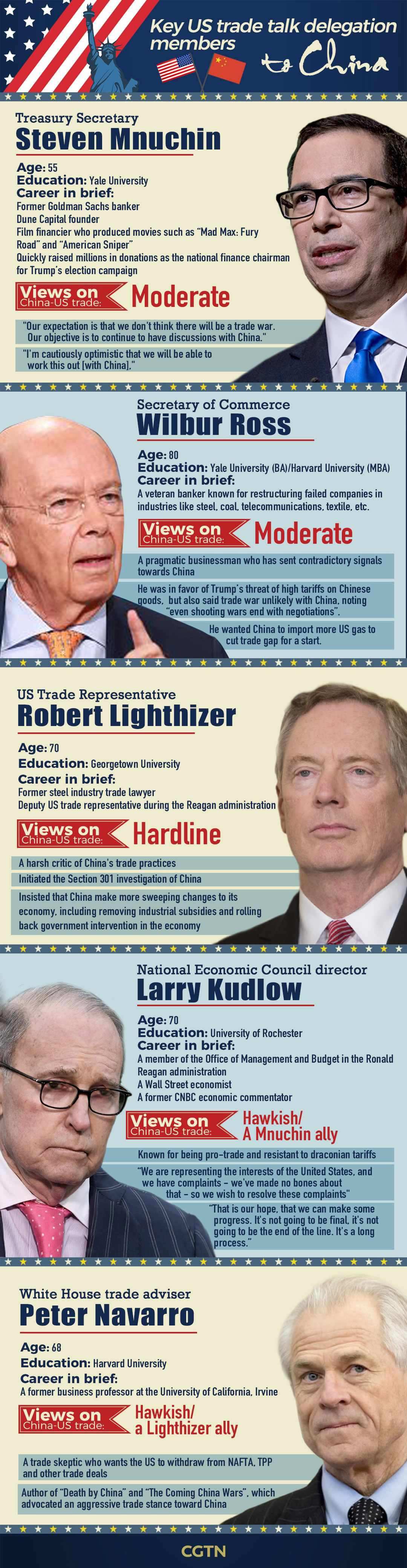
Earlier this month, the US delegation led by US President Donald Trump’s special envoy and Treasury Secretary Steven Mnuchin came to China for the second round of discussions, but the two sides reached only a few concrete agreements.
“Because these trade and economic issues are relatively large, we can't expect one or two rounds of discussions to resolve all the problems. We need to identify priorities and take reasonable measures to solve them one by one,” said Zhang Xiaoqiang, executive director of the China Center for International Economic Exchanges.
However, the mood is positive for the third round of discussions, as Trump indicated in a tweet on Sunday that he is considering easing up on Chinese telecom giant ZTE. It is a move seen as a sign that trade tensions are becoming alleviated and is welcomed by China.
Meanwhile, a Treasury Department report released Tuesday showed that China’s holdings of US bonds, bills and notes climbed 11 billion US dollars to 1.19 trillion US dollars in March. China remains the US's largest foreign creditor despite the trade tensions.

Public hearings in the US
While the Chinese trade delegation is visiting Washington, the Office of the US Trade Representative (USTR) is holding a three-day public hearing starting Tuesday over the proposed tariffs on imported Chinese goods worth approximately 50 billion US dollars.
Over 120 representatives from the business communities of the US and China can testify on the potential impact of the tariffs during public hearings, according to USTR.
The US Chamber of Commerce, representing the American business community, says levying punitive tariffs on one another is the wrong answer to trade disputes.
“US tariffs, together with certain Chinese retaliation, will disrupt global trade and supply chains, further damaging American businesses, workers, farmers, ranchers and investors,” the US Chamber of Commerce said.