
Business
14:08, 06-Oct-2018
The Inspirers: Artisan brings new life to small town
Updated
14:03, 09-Oct-2018
 ["china"]
Share







Copied
05:29
For many small towns across America, manufacturing and agriculture keep their economic engines running. But in the face of automation and consolidation, some believe innovation will become the true backbone.
In Washington's Yakima Valley, a two-hour drive southeast of Seattle, lies the town of Tieton, with a population of 1,200.
In the city park 13 years ago, Seattle resident and artist Ed Marquand stopped on his bike ride to fix a flat tire. He remembers the view.
He said it's obvious that things in the town were just barely holding on.
Ed began buying properties and brainstorming with friends on what he could do here that couldn't be done in Seattle. He then founded Mighty Tieton, an incubator for artisans and design-related light manufacturing businesses that have brought new life to the town.
He and his partner purchased several buildings, housing Paper Hammer Studios and other firms. He said he found that the appreciation for the hand-made artisan business is something that is lost in this country.
"But in Mexico or other Central American countries, people will know the guy who made the furniture, the potter who threw the pots, the woman who made the tortillas."
At his Paper Hammer Studios, people can find workers like Maria Solorio. She did much of the work to create a book that celebrates the lone surviving tree in a village in Costa Rica.
There is also a retrospective of the work of Japanese textile designer Reiko Sudo.
Ed said they are able to attract people like Maria and as they work on this kind of work, "they become better at it than anyone I could imagine getting in Seattle to do this work."
And just down the road is Mighty Tieton's warehouse and headquarters. Inside, machines date back to the 1950s, and some even further.
Years ago, welder Steve Morgan was laid off, but he'd taken art classes decades earlier that made him perfect for this job.
Steve Morgan, the letter pressman of Paper Hammer Studios, said it's nice to know something he can enjoy. The precision, texture and artistry of his work are all things that can't be replicated with a laser printer.
Ed said much of the equipment and techniques people use here are from 100 years ago. As society goes digital, Ed thinks "there's a human desire to be attracted to things that are more tactile, handmade, and to appreciate that craft."
Inside the Mighty Tieton warehouse, people will find some artistic surprises. Visitors who come to the artist's special showings are also treated to a percussion performance.
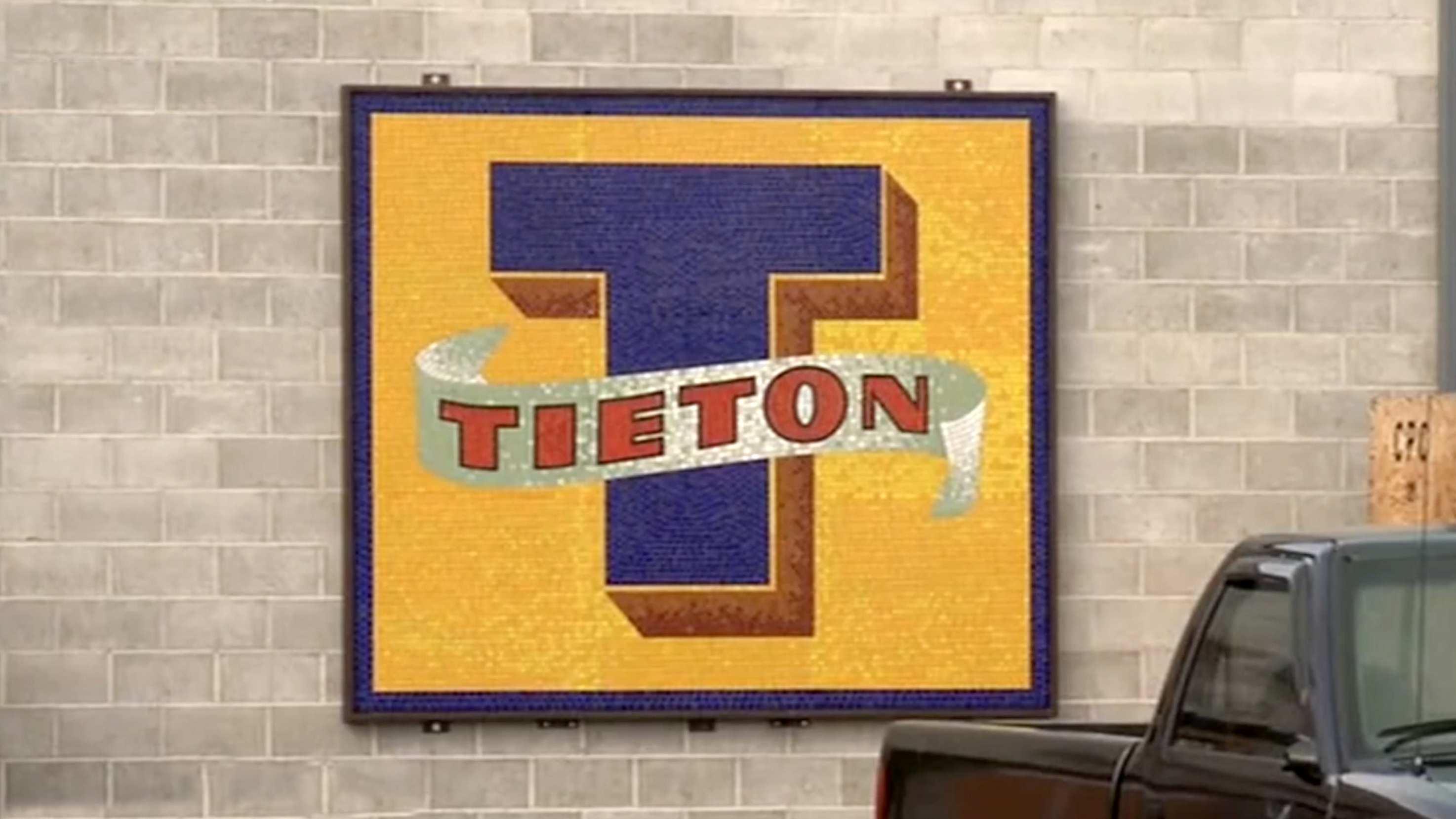
Mighty Tieton has positioned itself as an incubator for artisan business, aiming to break the mold of the stereotypical image of the starving artist. One of Mighty Tieton's fresh ideas is creating seven, two-and-a-half meter wide glass mosaics to be placed all around the city square.
The designs are based on vintage fruit box labels from the 1930s to 1960s as an homage to the area's farming families and packing companies that helped make Tieton what it is today.
Mighty Tieton has so far secured funding for three of the murals – and a fourth is raising money on Kickstarter. It hopes visitors will stop off the highway to see the beautiful 10,000-tile work of art, and then spend money while in town.
Ed says the good old days can never come back. That's why he keeps searching for ideas that make both commercial and cultural senses – as a model and inspiration for farming communities across the country.