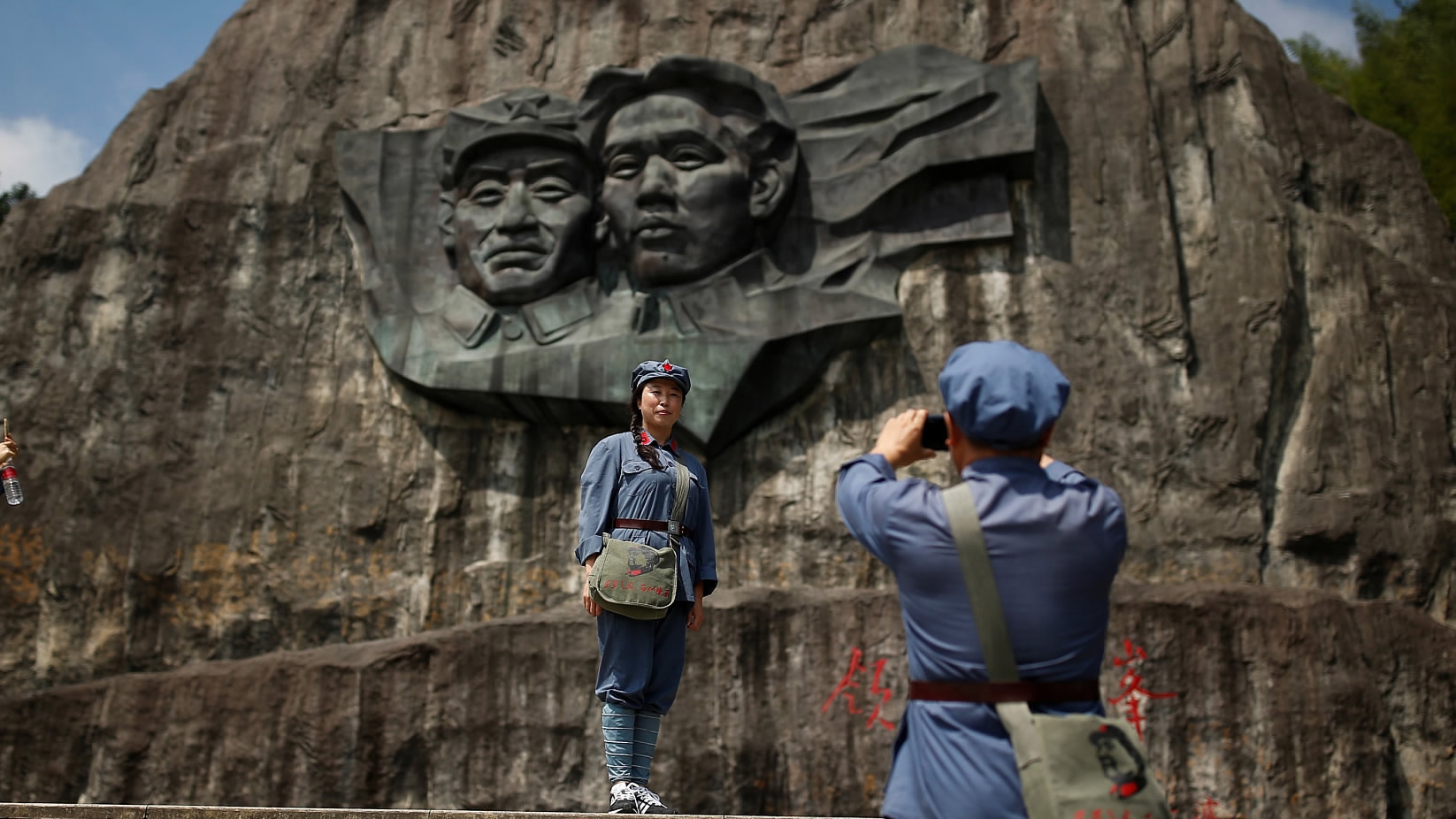
On April 28, 1928, two armed forces of the Communist Party of China (CPC) met in Jinggangshan, east China's Jiangxi Province. One was led by Mao Zedong and the other headed by Zhu De and Chen Yi.
The two joining forces established the Fourth Red Army, which not only consolidated the CPC's status in history, but pushed China's revolution a giant step forward.
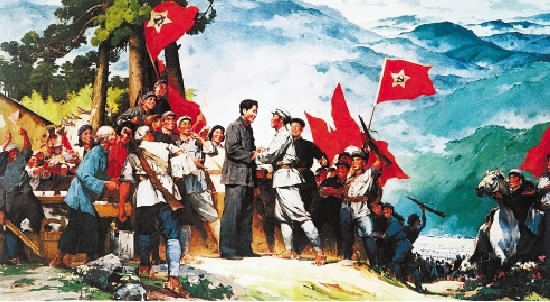
A painting depicts the meeting of the two armed forces of the CPC at Jinggangshan, Jiangxi Province, 90 years ago. /Xinhua Photo
A painting depicts the meeting of the two armed forces of the CPC at Jinggangshan, Jiangxi Province, 90 years ago. /Xinhua Photo
Many call Jinggangshan-which literally means "well gang mountain" in mandarin-the cradle of the Chinese Revolution. Yet the significance of the country's revolutionary heartland did not end here.
During the last 90 years, Jinggangshan witnessed drastic growth and improvement in livelihood.
The county-level city was the first region in the country to be taken off the list of "impoverished counties" in February 2017, meaning only less than two percent of its residents are living with a less than 2,800 yuan (400 US dollars) income per year.
Read more: Jinggangshan first to be delisted as ‘impoverished county’ in China
To be exact, the poverty rate has rapidly dropped from 1.6 percent in 2016 to 0.42 percent in 2017, as Jinggangshan's mayor Jiao Xuejun told Xinhua.
Zuo Xinfa is a Jinggangshan local who offers tourists ciba, a traditional hand-made Chinese dish in which glutinous rice is pounded into paste.
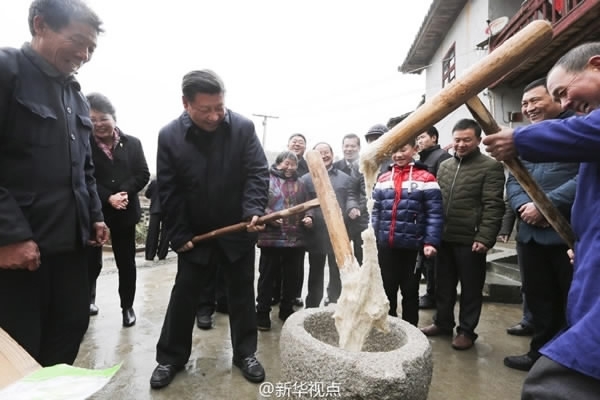
February 2016: Chinese President Xi Jinping helps make the dough for "ciba", a glutinous rice delicacy, during a visit to the village of Shenshan in Jinggangshan, Jiangxi Province. /Xinhua Photo
February 2016: Chinese President Xi Jinping helps make the dough for "ciba", a glutinous rice delicacy, during a visit to the village of Shenshan in Jinggangshan, Jiangxi Province. /Xinhua Photo
The 67-year-old told Xinhua that his family earned more than 50,000 yuan (7,888 US dollars) last year from their adobe-house turned restaurant.
"We already cast off poverty and are on the way to a well-off life," Zuo said per Xinhua's record.
The Jinggangshan municipal government invested 460 million yuan mainly in social security, health care, resettlement and industrial development to consolidate poverty-alleviation achievements in 2017, 40 million yuan more than that in 2016, Wu Taiming, head of the rural work department of the CPC Jinggangshan municipal committee told Xinhua. Wu said they are making sure the farmers do not return to poverty.
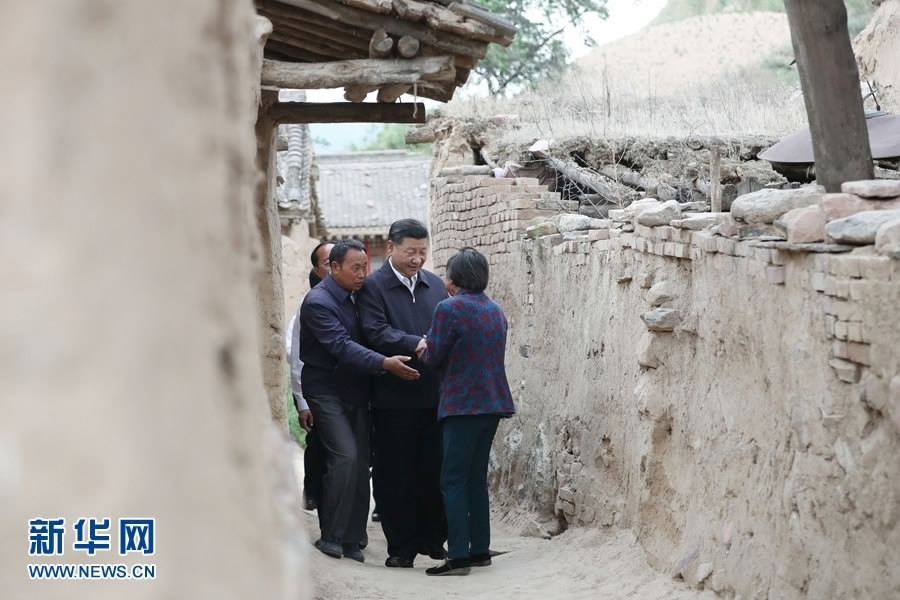
June 21, 2017: Chinese President Xi Jinping inspects poverty-relief work in China's Shanxi Province. /Xinhua Photo
June 21, 2017: Chinese President Xi Jinping inspects poverty-relief work in China's Shanxi Province. /Xinhua Photo
The first rural revolutionary base of the CPC was required to "play a demonstrative and leading role" in the fight against poverty by Chinese President Xi Jinping, who visited the area in February 2016.
The local government attributed the success to the national campaign of targeted poverty relief, meaning "measures and work to alleviate and eliminate poverty must be precise; policies should be made according to the (needs of) households and individuals," as Xi explained while visiting households in Shenshan, Jianggangshan.
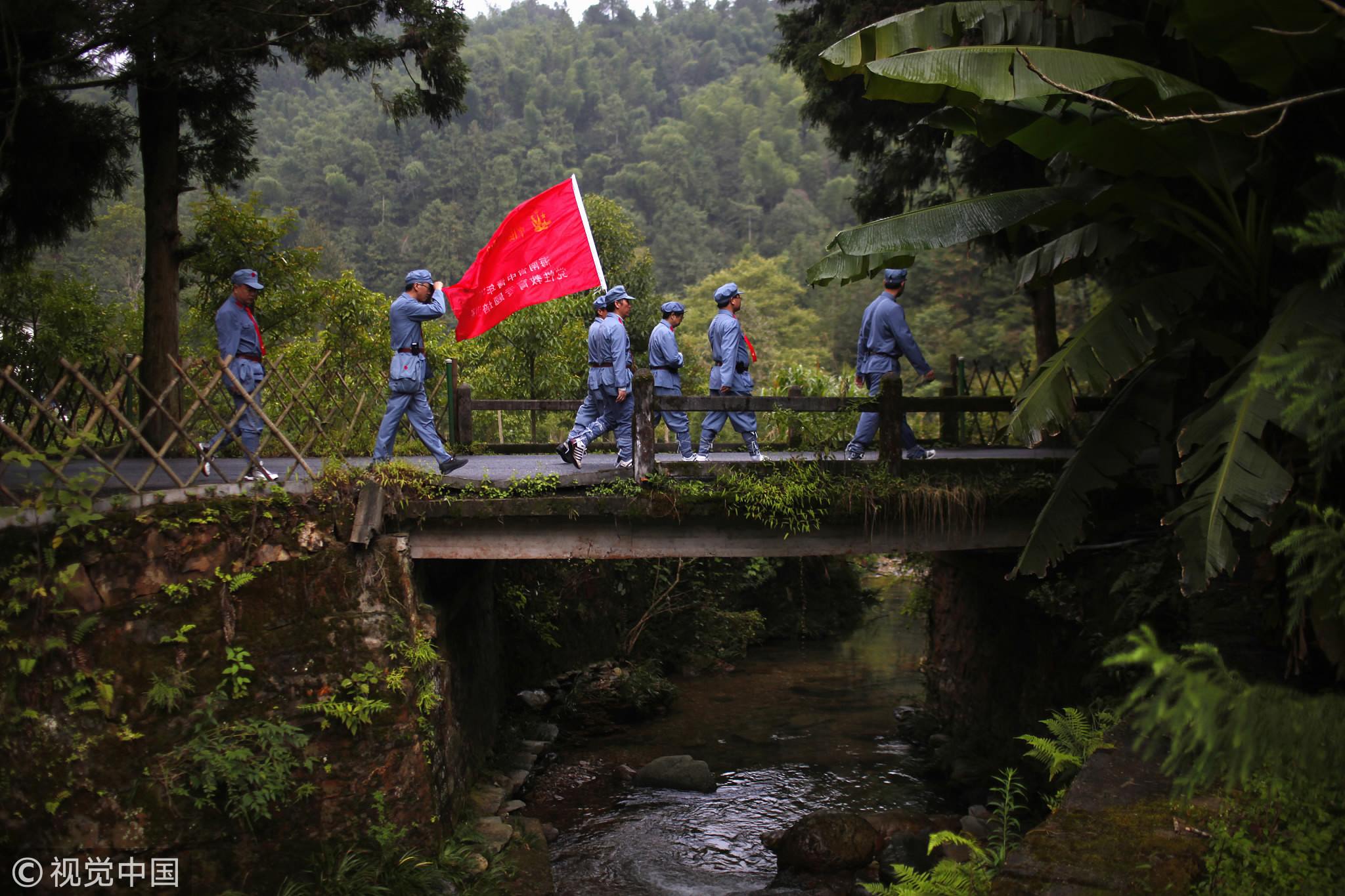
Sept. 21, 2012: Government officials in Red Army uniforms take part in a 5-day training course at the China Executive Leadership Academy of Jinggangshan, Jiangxi Province. /VCG Photo
Sept. 21, 2012: Government officials in Red Army uniforms take part in a 5-day training course at the China Executive Leadership Academy of Jinggangshan, Jiangxi Province. /VCG Photo
Besides providing a "safety net" for those who were unable to elevate above, or would drop back down to, the poverty line, the Jinggangshan government also helped locals to start businesses or find jobs, specifically in those more successful industries like tea, bamboo and fruit plantations and processing, as well as aquaculture.
Zhong Wanyin was one of those who benefited from getting into the fishing industry, according to Xinhua. Zhong now earns more than 20,000 yuan a year, which is roughly equivalent to 3,155 US dollars.
In addition, Jinggangshan smartly utilized its rich cultural heritage developed during the revolutionary era. For example, Bashang Village offers an experience camp that allows tourists to be in the "Red Army" for a day, which attracted over 40,000 participants in 2016 alone.
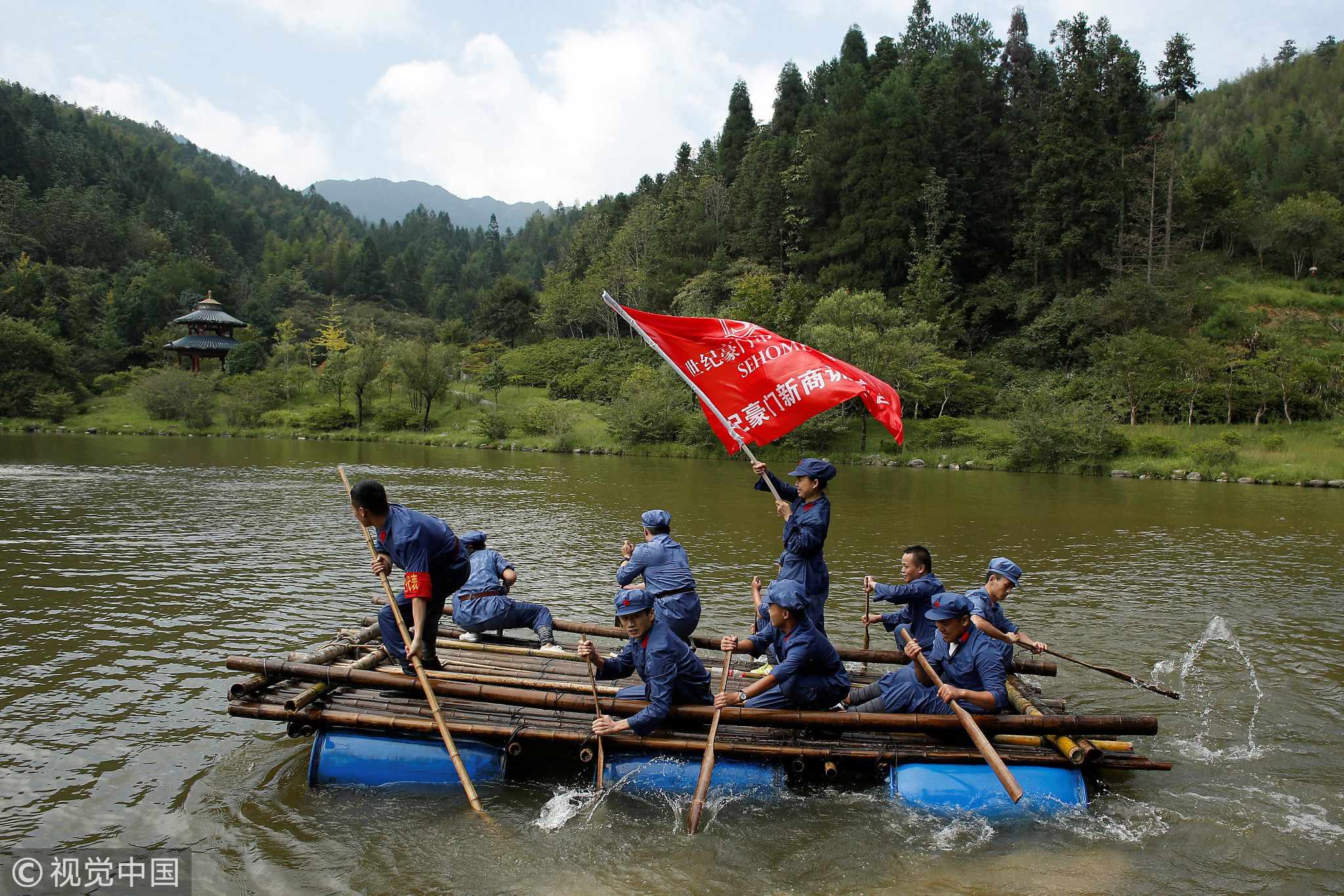
Sept. 14, 2017: Participants dressed in Red Army uniforms row a raft across a lake in the mountains outside Jinggangshan, Jiangxi. /VCG Photo
Sept. 14, 2017: Participants dressed in Red Army uniforms row a raft across a lake in the mountains outside Jinggangshan, Jiangxi. /VCG Photo
The booming tourism industry brings the site a revenue of 13.89 billion yuan (2.19 million US dollars) in 2017, with a 14.7-percent increase year-on-year.
The adoption of e-commerce is another method of shortening the distance between Jinggangshan and the people outside the mountains. With over 2,400 locals from 18 of Jinggangshan's townships benefiting from this, online platforms have helped sellers in the region send out some 1.6 million yuan worth of packages, according to 2017 data.
Just like Jinggangshan, 27 other counties also cast off poverty in 2017. For the first time in 30 years, China shortened its list of poorest counties and made a concrete step towards delivering the country's goal of completely eliminating poverty by 2020.
(With input from Xinhua News Agency)

 ["china"]