
Opinions
23:10, 19-May-2018
Expert: More internationalized financial market badly needed
 ["china"]
Share







Copied
“China’s financial market still has a long way of opening-up,” says Zhu Min, chair of Tsinghua National Institution for Finance and Development and former deputy managing director of International Monetary Fund.
In a speech at the Tsinghua PBCSF Global Finance Forum Saturday morning, he argues that the key to China’s financial sector reform is to build a more internationalized domestic financial market.
In 1996, Zhu Min was working for the Bank of China. At that time, China’s banking industry had just started to take off. Over the past 40 years since China’s reform and opening-up policy, he has witnessed the remarkable achievements made with China’s financial industry.
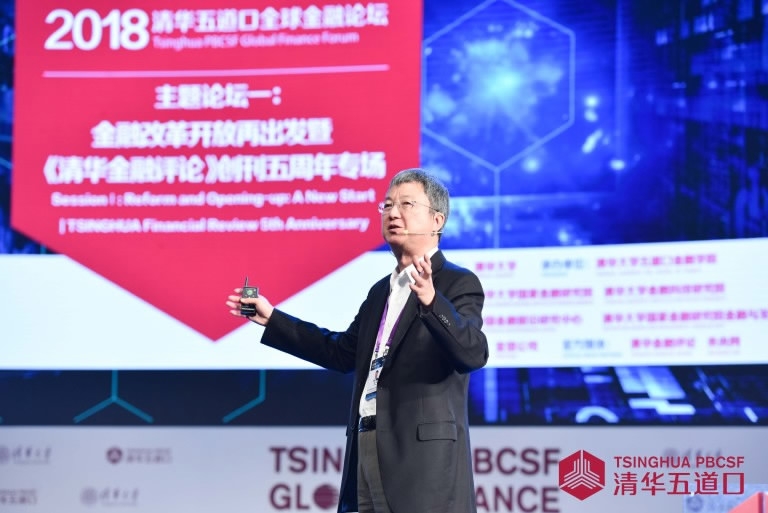
Zhu Min speaks at the Tsinghua PBCSF Global Finance Forum. Beijing, China, May 19, 2018. /Tsinghua PBCSF Photo
Zhu Min speaks at the Tsinghua PBCSF Global Finance Forum. Beijing, China, May 19, 2018. /Tsinghua PBCSF Photo
The top 5 largest banks in the world are from China now. China’s global capital market rate has increased from zero to 11.3%. China is the second largest stock market and third largest bond market in the world. And China also has an insurance industry with great potential.
All those achievements are miracles without doubts. But in the meantime, Zhu Min points out that as the second largest economy in the world, also with the third largest financial market, China still has a long way to go for more internationalization and opening-up with its financial market.
He confessed that he “made a mistake” by predicting that assets of foreign banks may account for 15% of China’s domestic banking industry after 2015. But instead, it has decreased from 2.32% in 2007 to 1.26% today. Foreign investment accounted for only 1.15% of China’s stock market and 2.44% of the National Treasury bond market.
“This number is much lower than the world average,” Zhu says, “China’s banking industry is developing fast. But we set too many terms regarding admission to markets, shares, products, range, and supervision. It is not a fully competitive market and far from being internationalized.”
He argues that the current financial structure is not in pace with the requirements for China’s economic development in the new era, the growing need of middle class and aging population for financial services.
Against the background of high leverage and high saving rate, China faces new challenges of high debt and low resource efficiency.
“Only about 13 or 14 years ago, a loan of one yuan could produce 1 yuan new GDP. But now we need four yuan to produce the same amount. The efficiency of loans has decreased by 75%. Low efficiency means the incomplete financial market structure and system,” Zhu says.
It is high time for China to provide a sound financial structure in the structural transition period when the per capita income is rising, service industry booming and manufacturing decreasing.
He raises the question of how the financial system can better support the economic development in the future.
And he already has his answer: “the internationalization of domestic financial market.”
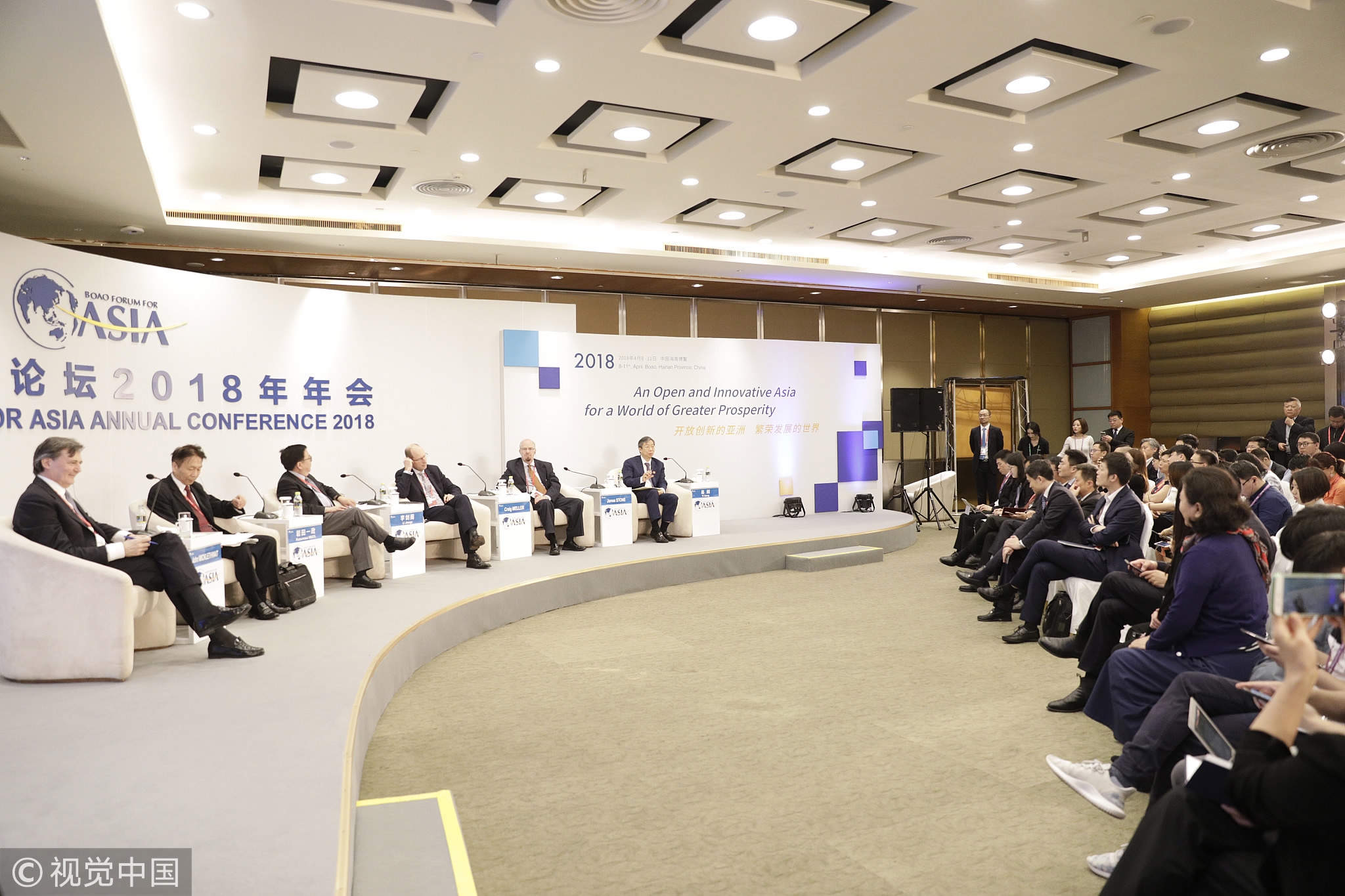
A panel discussion on monetary policy at the Boao Forum for Asia Annual Conference in Boao, China, April 11, 2018. /VCG Photo
A panel discussion on monetary policy at the Boao Forum for Asia Annual Conference in Boao, China, April 11, 2018. /VCG Photo
“The domestic market has the edge of the client network and local resources; the international organizations advance in their high-quality financial products. It is really a question of time: which force can go faster.” Zhu thinks that the competition between the two could really change the pattern of China’s financial market and improves its efficiency.
And it is with a more internationalized financial market that China can build a modern supervision system and sound financial system.
To build such a financial structure, Zhu Min offers three ways: loosen the admission to the market, expand financial business and further open up the foundational service of the financial industry; but above all, to improve the competitiveness and internationalization of the domestic financial market.
As Yi Gang, governor of the People's Bank of China, already announced new reform measures regarding China’s financial reform, Zhu Min is very excited about the future development of China’s financial sector, and to build a “Financial Pattern with Chinese Characteristics.”
And this time, it seems that he should not make an inaccurate prediction again.
(This article is based on Zhu Min's speech at the Tsinghua PBCSF Global Finance Forum on May 19, 2018.)