
Tech & Sci
14:32, 26-Apr-2018
Record amount of microplastic in Arctic sea ice: study
 ["europe"]
Share







Copied
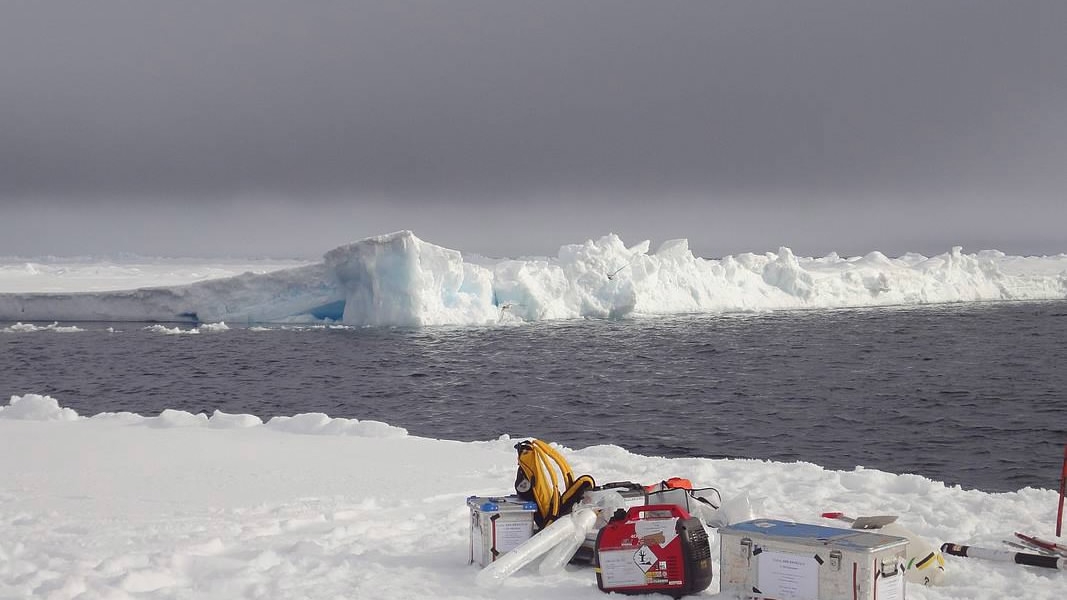
Scientists have discovered an unprecedented volume of microplastic contaminating the Arctic sea ice sheets. The alarming rate of pollution has raised concern over the health of marine creatures and humans.
Microplastics are extremely tiny chunks of polymers, nearly one-sixth the diameter of human hair. These small plastic particles are easily ingested by marine creatures and birds, and also enter the food chain of humans.
The quantitative analysis found more than 12,000 plastic particles per liter of sea ice. The study reveals plastic contamination in the region is more than three times what was previously thought.
“During our work, we realized that more than half of the microplastic particles trapped in the ice were less than a twentieth of a millimeter wide, which means they could easily be ingested by Arctic microorganisms like ciliates, but also by copepods,” says Alfred Wegener Institute (AWI) biologist and first author Ilka Peeken.
The study titled, "Arctic sea ice is an important temporal sink and means of transport for microplastic," published in a journal, Nature Communications, also measures the type of plastics found in the ice samples gathered from the Arctic Ocean. The research team found 17 kinds of plastic embedded in the ice samples collected from the Arctic Ocean.
A further investigation revealed that the six most common wastes were from packaging waste, cigarette filters, paints, and nylon. Tracking the path through which microplastics entered the Arctic, researchers found that a portion of the material was brought in by currents from the infamous Great Pacific Garbage Patch.
The Great Pacific Garbage Patch spans over 1.6 million square km is estimated to be three times the size of France. The patch is located halfway between Hawaii and California. It’s the largest accumulation zone for ocean plastics on Earth.
Researchers pointed out findings suggest that both the expanding shipping and fishing activities in the Arctic are leaving their mark. "The high microplastic concentrations in the sea ice can thus not only be attributed to sources outside the Arctic Ocean. Instead, they also point to local pollution in the Arctic,” Ilka Peeken maintained.
Waste is likely to come from fishing nets and other materials related to boats fishing for Arctic cod. As climate change causes sea ice in the Arctic to become more navigable, fishing activity has increased.
The study furthers states that it’s likely that parts of the microplastics, which are embedded into the sea ice, were transported by currents into these regions and that different oceanic realms (Pacific versus Atlantic) currently still have specific microplastic imprints. “However, these imprints are altered by localized dispersal of microplastic in the Arctic," researchers maintained.
Scientists collected data from the ice core samples procured during a polar expedition in 2014 and 2015.
[Top Image: AWI scientists collecting Arctic sea-ice for a microplastic analysis. /AWI Photo]