
Opinions
14:59, 13-Oct-2018
Opinion: The long waves of Turkey's international relations: West vs. China, Russia and Iran
Updated
14:29, 16-Oct-2018
 ["china"]
Share







Copied
Editor's note: Dr Harun Ozturkler is a professor at Kirikkale University in Ankara, Turkey. The article reflects the author's opinion, and not necessarily the views of CGTN.
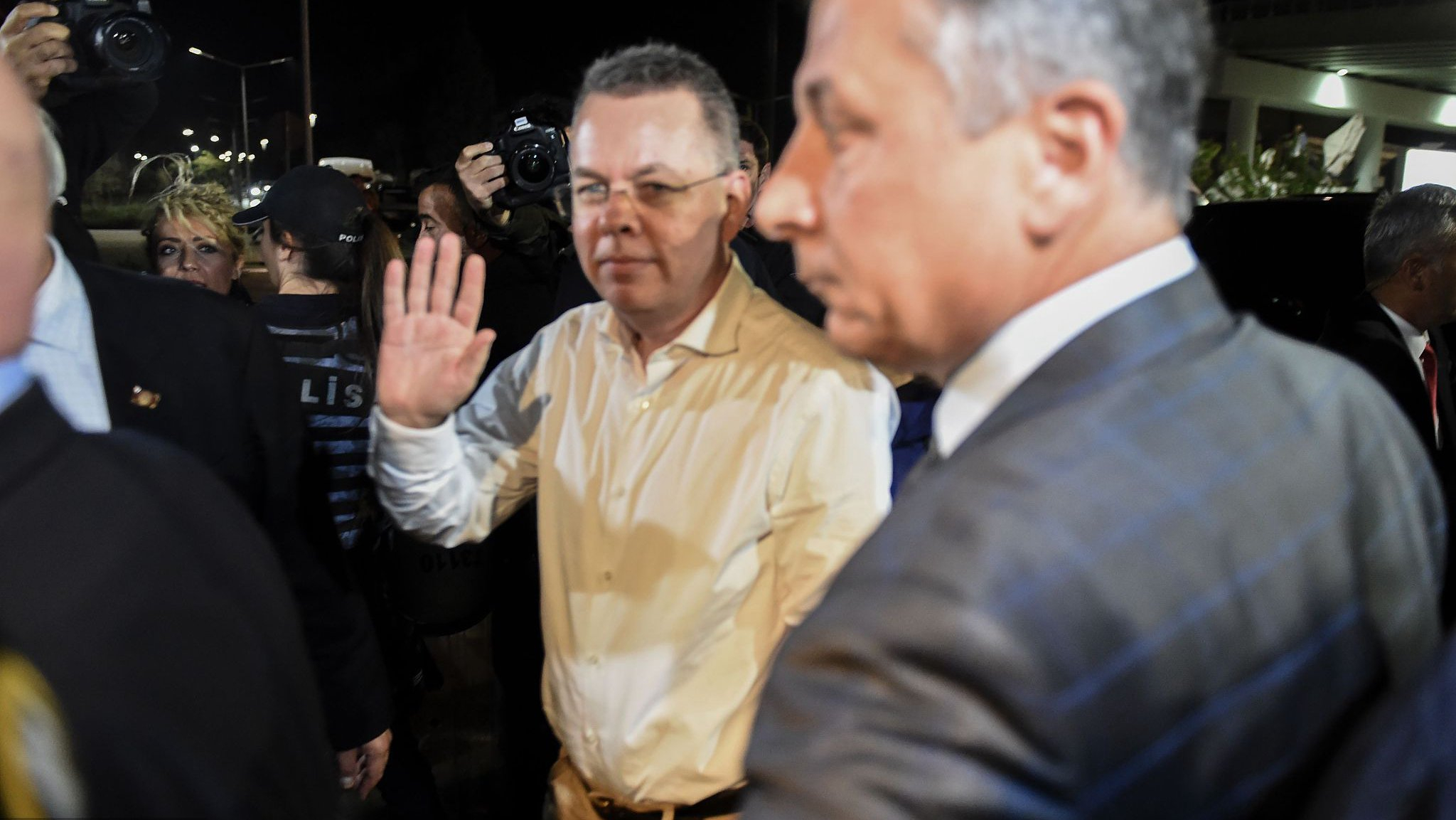
On October 12, 2018, the US pastor Andrew Brunson, who had been detained in Turkey for 3 years on terror charges, was finally freed by the Turkish court. Turkey had previously refused to release him, which had once triggered US sanctions on two top Turkish government officials.
Given the current world situation and Turkey's complicated relations with various countries, one may wonder how the Turkish President Recep Tayyip Erdogan should handle its relationships with major international players – including the US, the European Union (EU), Russia, Iran and China – at the moment.
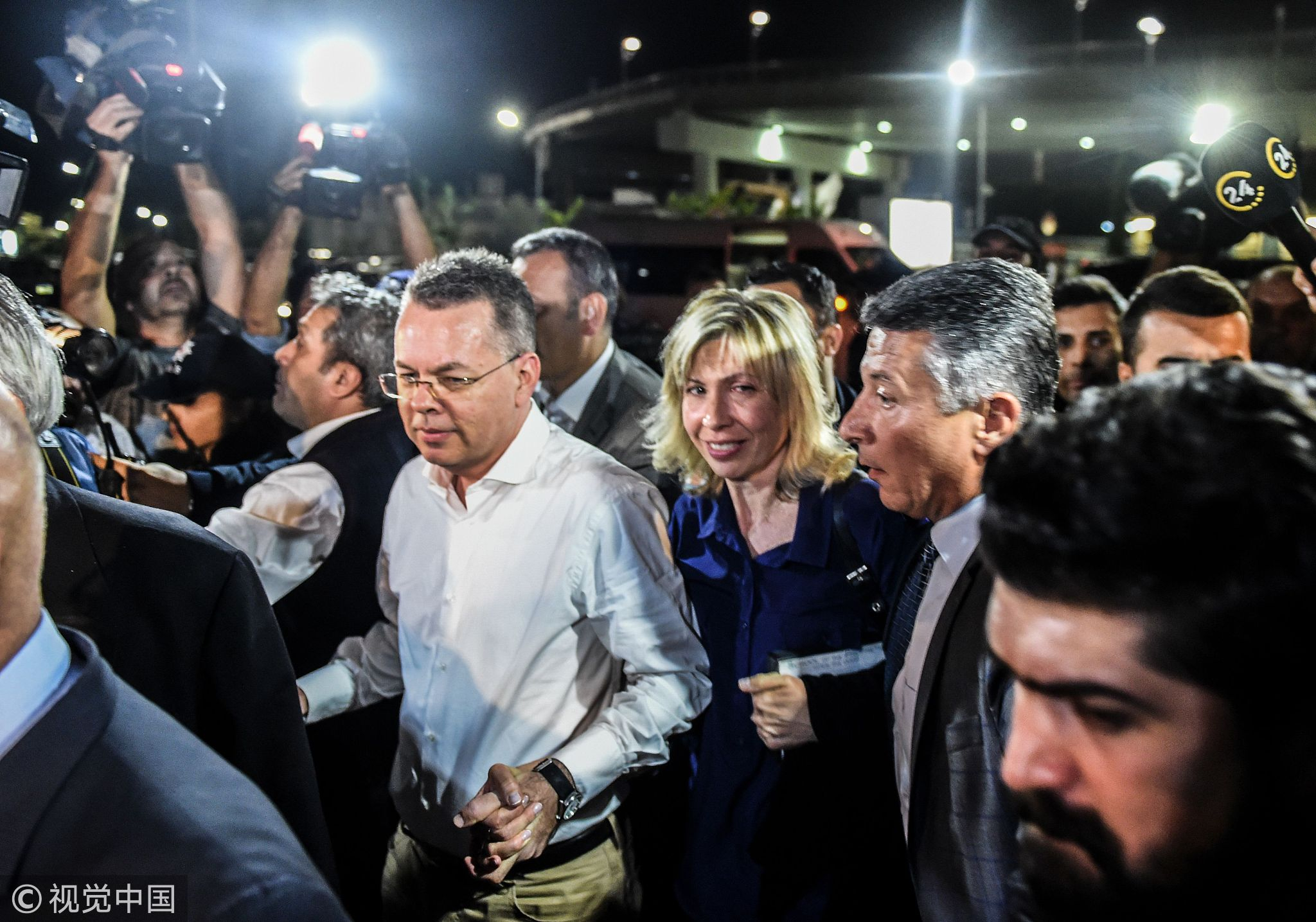
US pastor Andrew Craig Brunson (C,L) arrives at Adnan Menderes airport in Izmir after being freed following a trial in a court in Aliaga in western Izmir province, Turkey, October 12, 2018. /VCG Photo
US pastor Andrew Craig Brunson (C,L) arrives at Adnan Menderes airport in Izmir after being freed following a trial in a court in Aliaga in western Izmir province, Turkey, October 12, 2018. /VCG Photo
It is a fact that Turkey's relationship with the West is complex.
With the European Union (EU), Turkey has been struggling for a full membership for more than half a century.
And with the US, Turkey had had a more stable relationship with it, compared to now, until the failed coup attempt that happened in Turkey in 2016. The US has not answered Turkey's demand for the extradition of the terrorist leader Fethullah Gulen. He was accused of orchestrating the coup.
The US' support for the terrorist groups in Syria is also adding fuel to the flame in the bilateral relations. As a result, US-Turkey relations have deteriorated dramatically.
In terms of Turkey's relations with Russia, Iran and China – the country's ties with Russia are cozier than ever; it is acting together with Iran in Syria and is against US sanctions on Iran; and Turkey-China relations are thriving in economic terms.
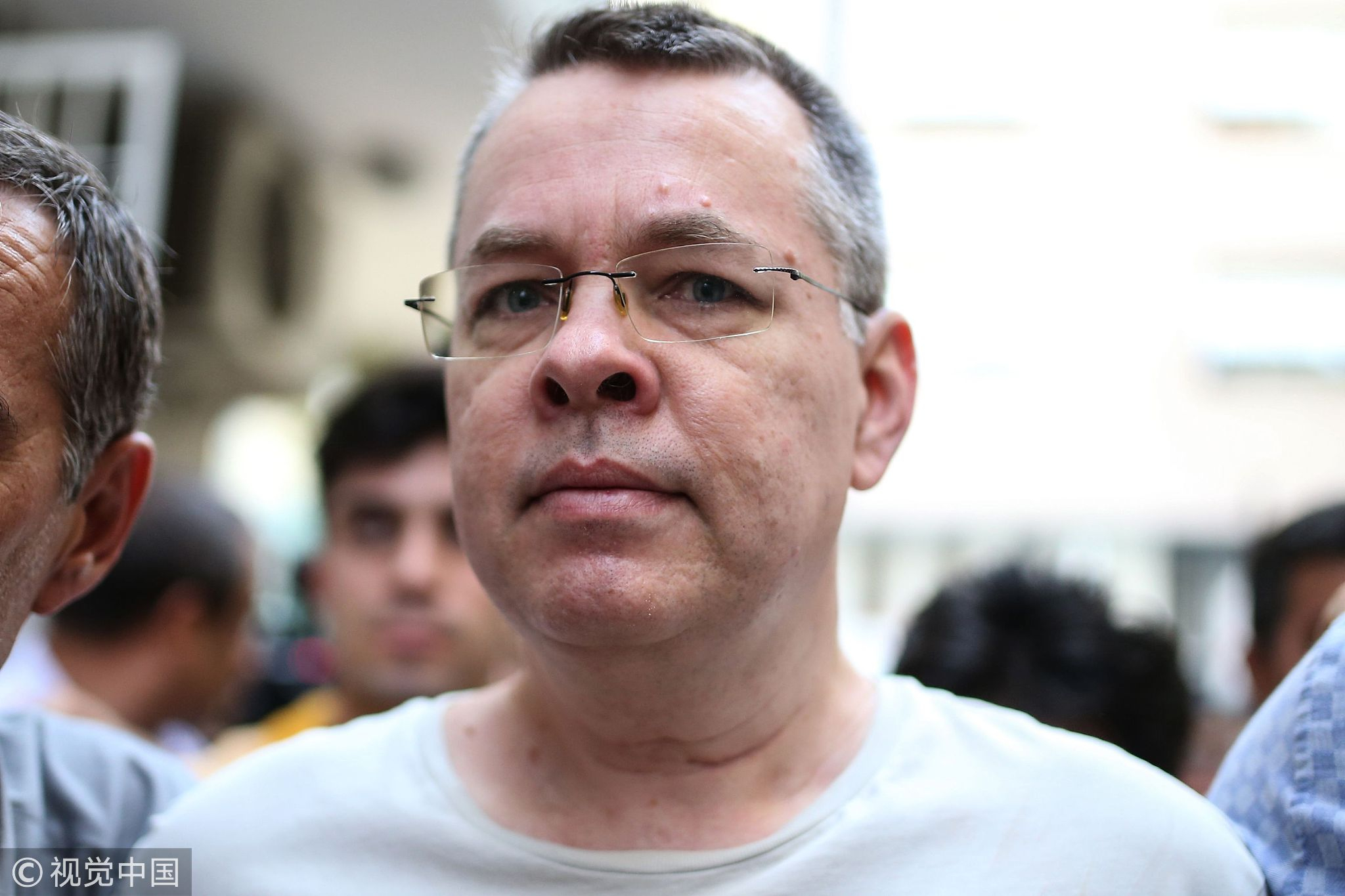
US pastor Andrew Craig Brunson is escorted by Turkish plain clothes police officers to his house in Izmir, Turkey, July 25, 2018. /VCG Photo
US pastor Andrew Craig Brunson is escorted by Turkish plain clothes police officers to his house in Izmir, Turkey, July 25, 2018. /VCG Photo
An important question is whether the current status of Turkey's international relations will play into the Turkish President Erdogan's hands or harm his party's performance in the local elections that will take place early next year.
Turkey has been experiencing economic problems since the June presidential election with sinking value of TL, fast-rising inflation, and slowing economic growth. High current account deficit, heavy indebtedness of the Turkish private sector, and Turkey's need for foreign capital for its investment and mega infrastructure projects have aggravated its economic problems.
Increasing concerns over the trade war between the US and China, the US sanctions on Iran, tensions between the US and Russia and rising interest rates in the US hit international financial markets both in terms of the amount of funds and of cost of funds available for the emerging market countries, specifically those that are experiencing hard economic times, such as Turkey and Argentina.
IMF's downward revision of the global economic growth performance for this year and announcement of cloudy perspectives for the coming years will add more pressure on Turkey.

Turkish President Tayyip Erdogan speaks during the Turkey-Africa Economy and Business Forum in Istanbul, Turkey, October 10, 2018. /VCG Photo.
Turkish President Tayyip Erdogan speaks during the Turkey-Africa Economy and Business Forum in Istanbul, Turkey, October 10, 2018. /VCG Photo.
In order to be able to defy US sanctions and improve its export performance, Turkey first turned its face to Russia, China, and Iran, trying to launch a trade block using local currencies in economic transactions with each other. Turkey has also asked for financial help from China. However, Turkey is having huge trade deficits with both Russia and China, and the US sanctions have complicated its economic relations with Iran.
President Erdogan has once again shown his ability in tactical maneuvers and turned his face to the EU. His visit to Germany last week and the steps taken towards reviving the relationship between Turkey and the EU can be considered a huge success on his part. Turkey has an over 35-billion-US-dollar trade volume with Germany and more than half of Turkey's international trade happens with the EU.
In terms of trade with the US, the total trade volume increased from about 12 billion US dollars in 2009 to over 20 billion in 2017. In addition, about 51 percent of Turkey's 119.7 billion dollars gross short-run debt and 61 percent of 337.2 billion dollar gross long-run debt are in terms of dollar.
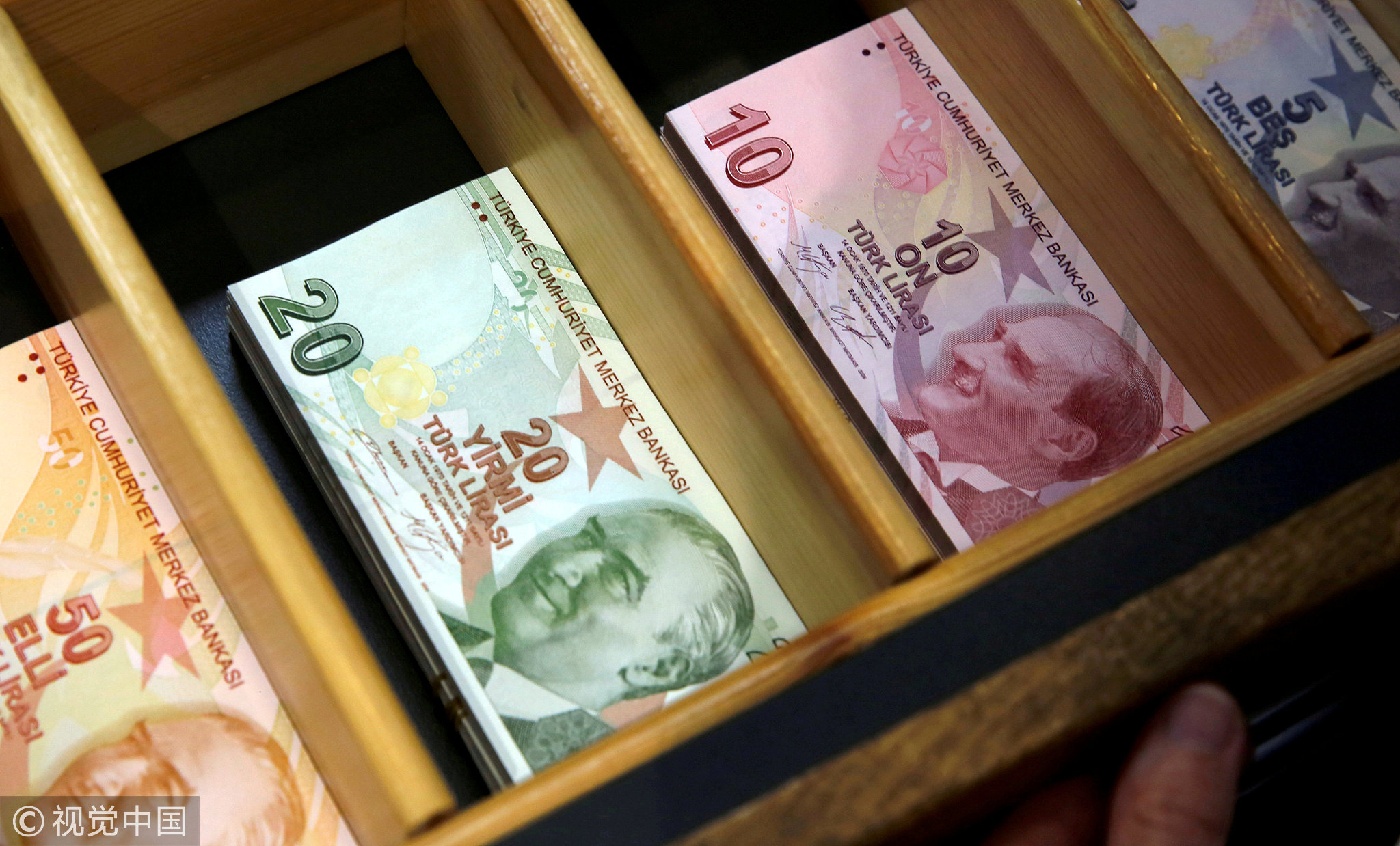
Turkish lira banknotes are pictured at a currency exchange office in Istanbul, Turkey, August 13, 2018. /VCG Photo
Turkish lira banknotes are pictured at a currency exchange office in Istanbul, Turkey, August 13, 2018. /VCG Photo
Furthermore, Turkey's long-term security interest lies in the North Atlantic Treaty Organization (NATO), of which the US and Turkey are the two most important members. Turkey, the US, and the EU will need to cooperate on energy issues in general and new energy-based developments in the Mediterranean. Therefore, it seems that the current status of the relationship between the US and the EU will change for the better in the near future.
On the other hand, considering Turkey's urgent need for energy, Turkey will need to work with Russia on the nuclear energy production projects. As mentioned above, Turkey has a large trade deficit with China, which needs to be corrected by exporting more to China. China's trade war with the US is an opportunity for Turkey to step up its economic relations with China. Iran is Turkey's neighboring country with a huge potential for deeper economic relationship.
Turkey's relations between the West and Russia, China and Iran have a multidimensional aspect, and President Erdogan's achievement in aligning these relations with his domestic political agenda will determine his and his party's performance domestically.
(If you want to contribute and have specific expertise, please contact us at opinions@cgtn.com.)