
Opinion
15:55, 06-Mar-2019
Big deal on horizon after the Hanoi summit?
 ["china"]
Share







Copied

Editor's note: Xu Fangqing is a senior editor with China News Week and a non-resident fellow with the Center for China and Globalization. The article reflects the author's opinion, and not necessarily the views of CGTN.
Although the second Kim-Trump summit ended unpredictably, we also witnessed some silver linings from this meeting which may herald an imminent history-making “big deal” for peace on the Korean Peninsula. Despite not reaching a deal, the two sides showed more positive gestures, which harbored hopes for further talks.
For example, both parties held a press conference to explain the outcome calmly and rationally without using hostile rhetoric, as we've seen before. The two leaders also expressed a willingness to keep negotiating.
Furthermore, three days after the summit, the U.S. and the ROK (Republic of Korea) announced they would halt the “Key Resolve” and “Foal Eagle” military drills which have been in place over a decade. We could, to some extent, give the credit to the Kim-Trump meeting.
We have no clue as to why the summit ended so suddenly, but in hindsight, they might have reached an impasse once the two found they could not agree on the deal to dismantle the nuclear facility in Yongbyon in return for the lifting of sanctions. Apart from that, both parties apparently had no trust and synergy when it comes to the pace of implementation.
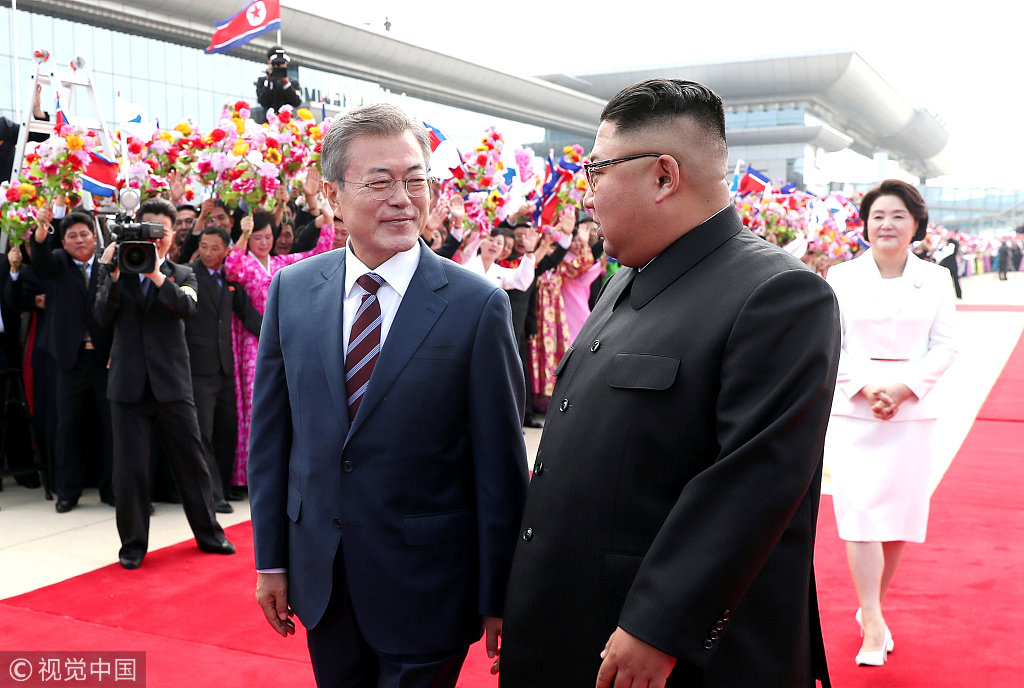
ROK President Moon Jae-in and DPRK leader Kim Jong Un attend an official welcome ceremony at Pyongyang Sunan International Airport, in Pyongyang, DPRK, September 18, 2018. /VCG Photo
ROK President Moon Jae-in and DPRK leader Kim Jong Un attend an official welcome ceremony at Pyongyang Sunan International Airport, in Pyongyang, DPRK, September 18, 2018. /VCG Photo
The comprehensive plan needs more parties to be involved if it is to really take force. China and the ROK are two specific stakeholders and Japan, Russia and even the EU would also be involved in order to carry out the ambitious peace plan.
A package plan which was taken as mission impossible now seems already on the table by the U.S. and the DPRK. In retrospect, it's de facto a great breakthrough as such a coordinated and comprehensive plan was never an option for the peace talks in the region. Besides the package plan and two Kim-Trump summits, we also have other advantages in hand now to contribute to an upbeat future.
The environment in Northeastern Asia is arguably in its best period in the last decade. Sino-Japanese relations are now back on track and probably would welcome a new peak this year. Let us not forget the ties between the DPRK and the ROK. Kim Jong Un and Moon Jae-in would probably accomplish summits in Pyongyang and Seoul.
Despite the tense Sino-U.S. trade relations in 2018, talks now seem to be making substantial progress as the U.S. side has announced a delay in raising tariffs as planned. The U.S. and China may soon reach a deal on the trade, which will also add more certainty to the region. Besides, the stable tenures of the presidents of the ROK and the U.S. for the next two years would benefit the Peninsula peace cause.
A security mechanism involving more parties is badly needed to keep a collapse at bay, as risks in misjudgment are prone to causing damage to the whole peace course. It may sound over-optimistic to hope for an overall deal between the U.S. and DPRK in view of the past history of negotiations. But the parties have made many historic breakthroughs, like the four times Kim Jong Un has visited China, the three meetings between the leaders of the DPRK and the ROK, and the two summits between Trump and Kim.
A peaceful solution for the region has become a consensus nowadays and what we need to do next is figure out how to fulfill it cautiously and skillfully.
(If you want to contribute and have specific expertise, please contact us opinions@cgtn.com.)