
Politics
08:36, 09-Aug-2018
Russia to work on retaliatory measures after new US sanctions
Updated
08:03, 12-Aug-2018
 ["china"]
Share






Copied
Russian Foreign Ministry spokeswoman Maria Zakharova said on Thursday that Moscow was starting to work on retaliatory measures after the United States announced a new round of sanctions against Moscow.
Zakharova told reporters at a briefing that no evidence had been presented to prove Russia's blame, and that the pretext for the new round of sanctions had been made up.
The Kremlin on Thursday also said a new batch of sanctions on Moscow announced by the United States was illegal under international law and that Russia’s financial system was stable.
Washington said on Wednesday it would impose fresh sanctions on Russia by the end of August after it determined that Moscow had used a nerve agent against a former Russian agent and his daughter in Britain.
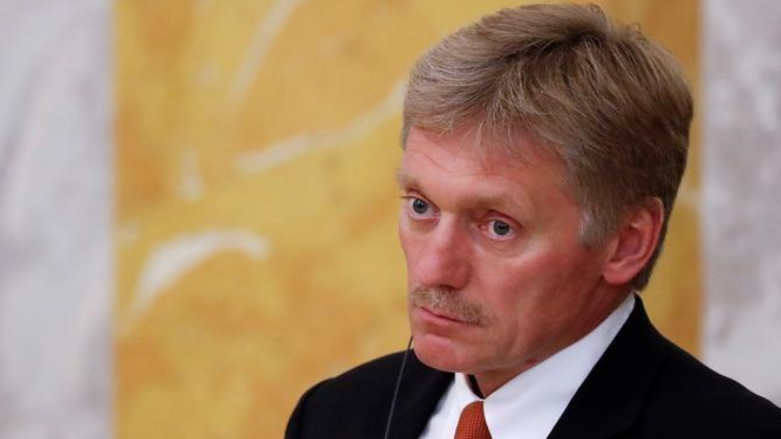
Kremlin spokesman Dmitry Peskov attends a news conference of Russian President Vladimir Putin and his French counterpart Emmanuel Macron in St. Petersburg, Russia May 24, 2018. /Reuters Photo
Kremlin spokesman Dmitry Peskov attends a news conference of Russian President Vladimir Putin and his French counterpart Emmanuel Macron in St. Petersburg, Russia May 24, 2018. /Reuters Photo
Kremlin spokesman Dmitry Peskov, speaking to reporters on a conference call, said the US move was “absolutely unfriendly,” but said Moscow continued to hope that for an improvement in battered US-Russia relations.
“Making a linking to these events (the British poisoning) is for us unacceptable and such restrictions like those passed by the American side earlier ... are absolutely illegal and do not correspond to international law,” said Peskov.
News of the US measures sent the rouble tumbling to two-year lows at one point and sparked a wider asset sell-off over fears that Moscow was locked in a spiral of never-ending sanctions.
Sergei Skripal, a former colonel in Russia's GRU military intelligence service, and his 33-year-old daughter, Yulia, were found slumped unconscious on a bench in the southern English city of Salisbury in March after a liquid form of the Novichok type of nerve agent was applied to his home's front door. Moscow has denied any involvement in the attack.
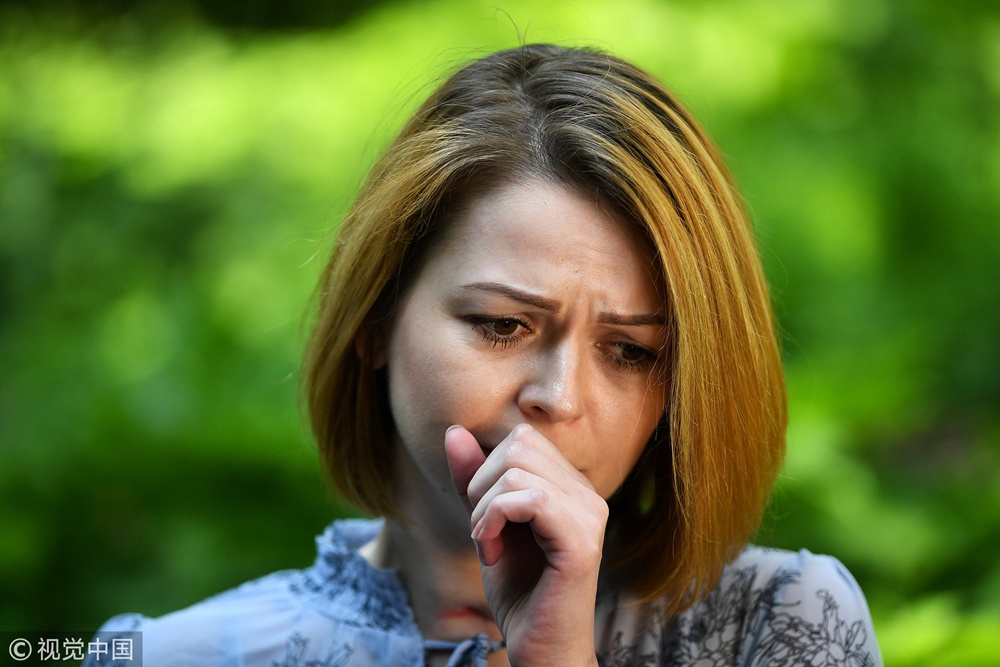
Yulia Skripal, the daughter of former Russian spy Sergei Skripal, makes her first public appearance during an interview in London since being discharged from hospital on May 23, 2018. /VCG Photo
Yulia Skripal, the daughter of former Russian spy Sergei Skripal, makes her first public appearance during an interview in London since being discharged from hospital on May 23, 2018. /VCG Photo
European countries and the United States expelled over 100 Russian diplomats in the strongest action by President Donald Trump against Russia since he came to office.
State Department spokeswoman Heather Nauert said it had been determined that Russia "has used chemical or biological weapons in violation of international law, or has used lethal chemical or biological weapons against its own nationals."
The sanctions would cover sensitive national-security controlled goods, a senior State Department official told reporters on a conference call, citing the 1991 Chemical and Biological Weapons and Warfare Elimination Act.
There would, however, be exemptions for space flight activities, government space cooperation, and areas covering commercial passenger aviation safety, which would be reviewed on a case-by-case basis, the official added.
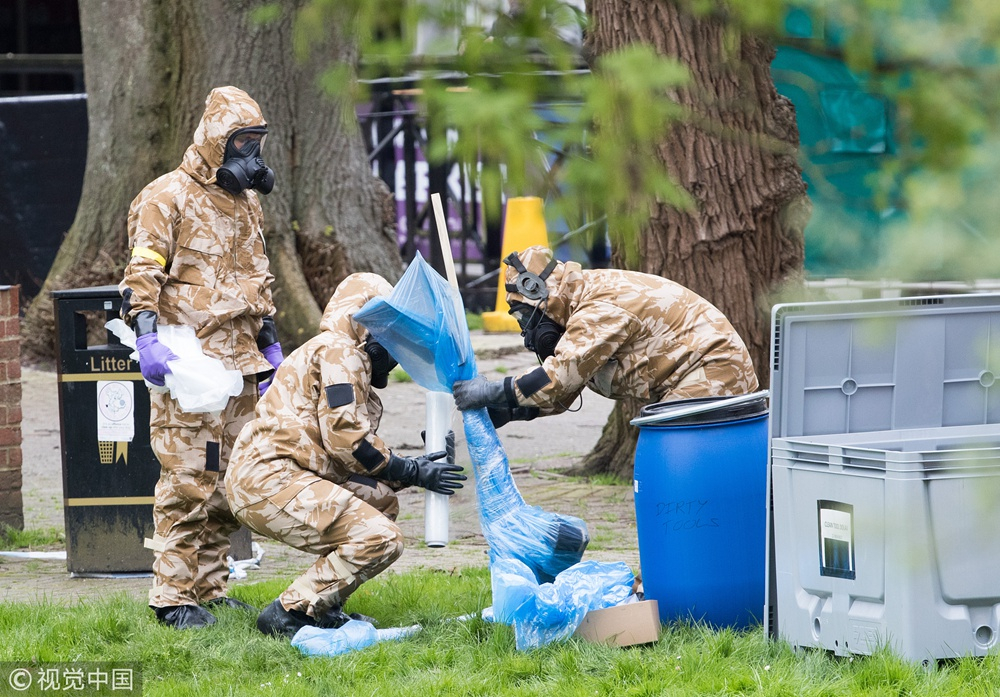
UK military officers work in the Maltings shopping area, close to the bench where Sergei Skripal and his daughter Yulia were found critically ill, in Salisbury, England, April 24, 2018. /VCG Photo
UK military officers work in the Maltings shopping area, close to the bench where Sergei Skripal and his daughter Yulia were found critically ill, in Salisbury, England, April 24, 2018. /VCG Photo
"It is possible that trade affected could potentially reach hundreds of millions of dollars," the official added. "It's up to Russia how dramatic the impact is."
The official said a second batch of "more draconian" sanctions would be imposed after 90 days unless Russia gives "reliable assurances" that it will no longer use chemical weapons and allow on-site inspections by the United Nations or other international observer groups.
A British government spokesman welcomed Washington's announcement, saying: "The strong international response to the use of a chemical weapon on the streets of Salisbury sends an unequivocal message to Russia that its provocative, reckless behavior will not go unchallenged."
The news came as Republican US Senator Rand Paul said on Wednesday he had delivered a letter from Trump to Russian President Vladimir Putin proposing cooperation.
(Top image, August 9, 2006: Former Russian military intelligence colonel Sergei Skripal attends a hearing at the Moscow District Military Court, Russia. /VCG Photo)
Source(s): Reuters