
Opinion
09:05, 16-May-2019
U.S. Middle East peace plan: Deliberate disclosure or accidental leak
 ["china"]
Share







Copied
Editor's note: Ren Zheng is a Ph.D. student, majoring in American politics and international strategy, at the China Institute of Contemporary International Relations. The article reflects the author's views, and not necessarily those of CGTN.
For decades, U.S. presidents have made great efforts to resolve the Israeli-Palestinian conflict, but with little success. The deal-maker President Donald Trump would like to accomplish what his predecessors failed to achieve in this area.
Ever since he took office, he planned to launch a “Deal of the Century” for peace in the Middle East. The deal is developed by Senior Adviser Jared Kushner, special envoy for Mideast peace Jason Greenblatt and David Friedman (now U.S. ambassador to Israel) and aimed at brokering a long-term settlement between Israel and Palestine.
To get enough support, the release of such a peace plan for the Middleast has been repeatedly postponed.
However, with a leaked document published on May 7, 2019 by Israeli newspaper Israel Hayom, the “main points” of the peace plan are being widely discussed. Whether the report is a result of an ordered disclosure or accidental leak, it can ultimately serve as a warm-up for peace plan release.
Main points and details of the plan
As shown in the leaked document, the peace plan is based on a two-state solution that includes the creation of a demilitarized state of “New Palestine,” the Israeli annexation of all illegal settlements in the West Bank, a land deal with Egypt, and shared capitals in Jerusalem.
The draft is also comprised of specific details such as the final status of borders and Jerusalem, the economic relationship between the proposed Palestinian state and Israel, the new Palestinian state's obligation to pay Israel for providing security and financial support (30 billion U.S. dollars over five years) from the U.S., Europe and the Gulf states.
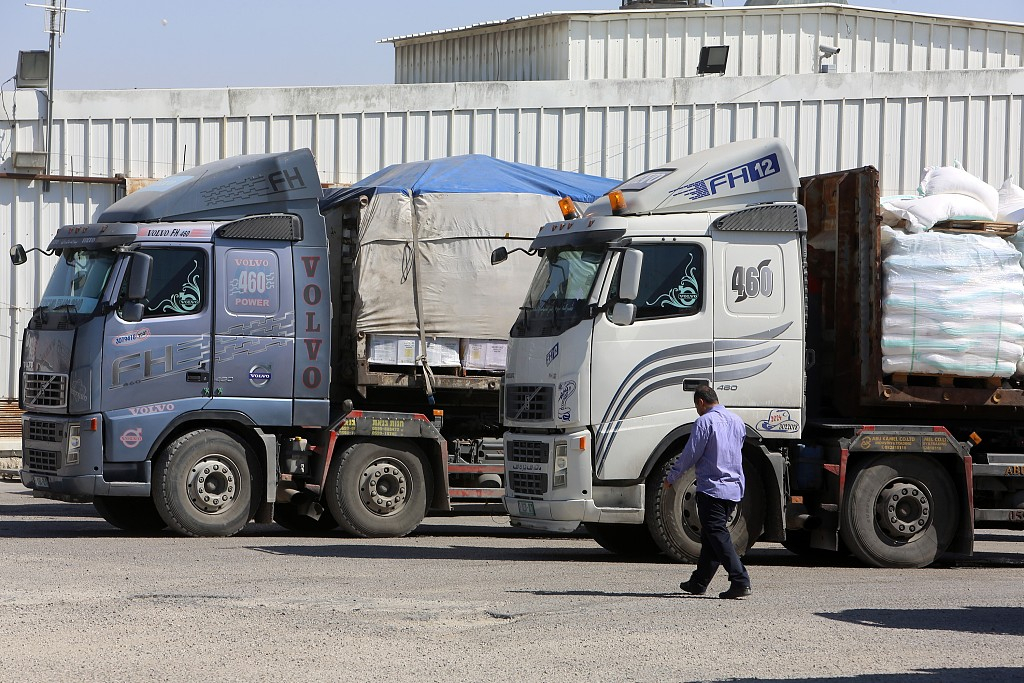
Trucks are seen at the commercial border crossing Karam Abu Salem after Israel re-opened Karam Abu Salem and Beit Hanoun (Erez) crossings, in Gaza City, Gaza, May 12, 2019. /VCG Photo
Trucks are seen at the commercial border crossing Karam Abu Salem after Israel re-opened Karam Abu Salem and Beit Hanoun (Erez) crossings, in Gaza City, Gaza, May 12, 2019. /VCG Photo
What's more, there are also punitive clauses in the draft, for example, if either Israel or the Palestinians (Hamas and the Palestine Liberation Organization), reject the deal, the U.S. will cut off all aid to Israel and ensure “no country in the world transfers money” to the Palestinians, whose economy is reliant on foreign donors.
U.S. hopes for this deal
The essential idea of the draft can be seen as an exchange between Israel keeping many key settlements in the West Bank and some version of an independent Palestinian state.
Through the exchange, Trump wanted to coordinate the strategic interests of all parties, including Israel and key Arab states and then push Palestinians into a credible, if unfavorable, deal.
Possible vision refers to the economic benefits for both Israel and Palestine of increased regional cooperation. That would happen if the barrier caused by the Palestinian problem were removed.
Comprehensive approaches include humanitarian aid for Gaza and national status for Palestinians, which are backed by generous financial communications by the Saudi and other Gulf and Western states to the new state.
Basic obstacles to peace
There have always been numerous obstacles, however, to reaching an agreement between the two sides, taking into account the concerns and needs of Israel and Palestinian.
Overall, Israel is more concerned about land, especially that in the West Bank and Jordan Valley, the loss of which will make Israel's military and security position entirely different.
On Palestinians' part, however, they would focus more on national sovereignty, pursuing the dream of “creation of a Palestinian state” for a long time.
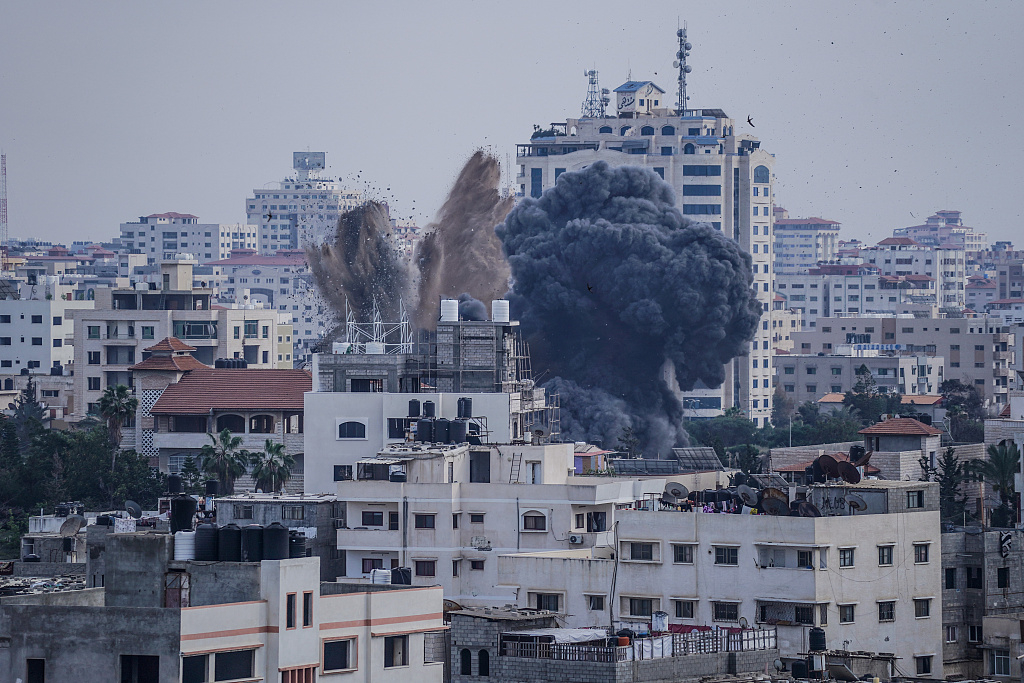
Smoke is rising after an Israeli air raid on homes in Gaza City, May 5, 2019. /VCG Photo
Smoke is rising after an Israeli air raid on homes in Gaza City, May 5, 2019. /VCG Photo
On the surface, this leaked plan satisfies both Palestinian's call for the creation of a Palestinian state in the West Bank and Gaza and Israeli's call for all territory held by Israeli settlements and settlement blocs at the same time.
However, the balance between Israel and Palestine is almost impossible to achieve. After carefully analyzing the content of the plan, a bias toward Israel and U.S. allies will be found; naturally, the primary obstacles to peace mainly come from the Palestinian side as follows.
First of all, the Palestinians cut off contact with the Trump administration after it recognized Jerusalem as the capital of Israel in December 2017 and officially moved the U.S. embassy to the city in May 2018. Moreover, Palestinians have accused the U.S. of taking a staunchly pro-Israel stance and completely denied U.S. role as a peace mediator between Palestinians and Israelis.
What's more, even before the Trump administration, the U.S. was viewed as a dishonest broker. Some Palestinians believe that the U.S.-led negotiating process can deliver a fair agreement. Thus, Palestinian leaders have little reason to support a plan which stands for a pro-Israel stance and seems stacked against them, which is also used to increase their international bargaining power.
Finally, Palestinians have been living with a lack of economic opportunities, considering economic aid as an important factor. As Palestinian Authority Foreign Minister Riyad al-Maliki voiced opposition to the plan: “There is no amount of money that can make it acceptable.”
So, it is evident that the economic value for Palestinians influences the decision whether the proposal can be counted as a peace effort.
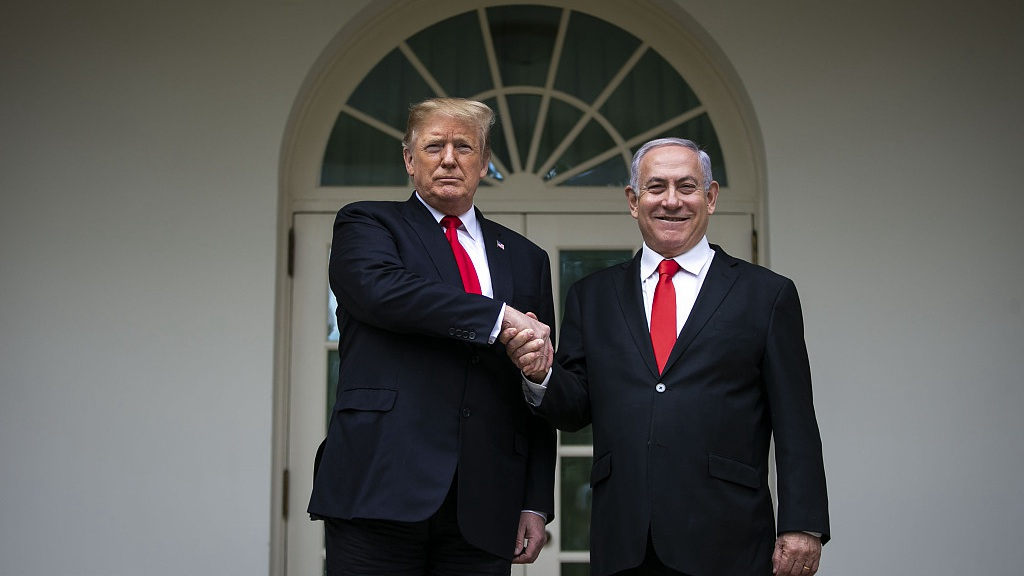
(Cover: U.S. President Donald Trump (L) shakes hands with Benjamin Netanyahu, Israel's prime minister, in the Rose Garden of the White House in Washington, DC, U.S., March 25, 2019. /VCG Photo)
(If you want to contribute and have specific expertise, please contact us at opinions@cgtn.com.)