
Culture
22:08, 20-May-2018
Unlocking the charm of the Chinese language
 ["china"]
Share







Copied
02:36

Spoken by the largest number of people in the world, the Chinese language is also gaining popularity among people outside China.
According to statistics released by the Ministry of Education, in 2017, the number of foreign students studying Chinese as part of their higher education reached 489,200, growing over 10 percent in two years. This has also led to an increased number of people coming to China to study the language and continue exploring the culture.

October 28, 2017: Candidates take selfies at the closing ceremony of the 10th "Chinese Bridge" Competition in Kunming, Yunnan Province. /VCG Photo
October 28, 2017: Candidates take selfies at the closing ceremony of the 10th "Chinese Bridge" Competition in Kunming, Yunnan Province. /VCG Photo
CGTN hit the streets to interview foreigners living in Beijing, and to learn more about why they decided to learn Chinese.
Francis George Woodcock is from the Seychelles and is a student at Beijing International Studies University (BISU). He talked to us about how the language could open up opportunities for him. For Woodcock, China provides a bigger stage and the Chinese language brings more possibilities.
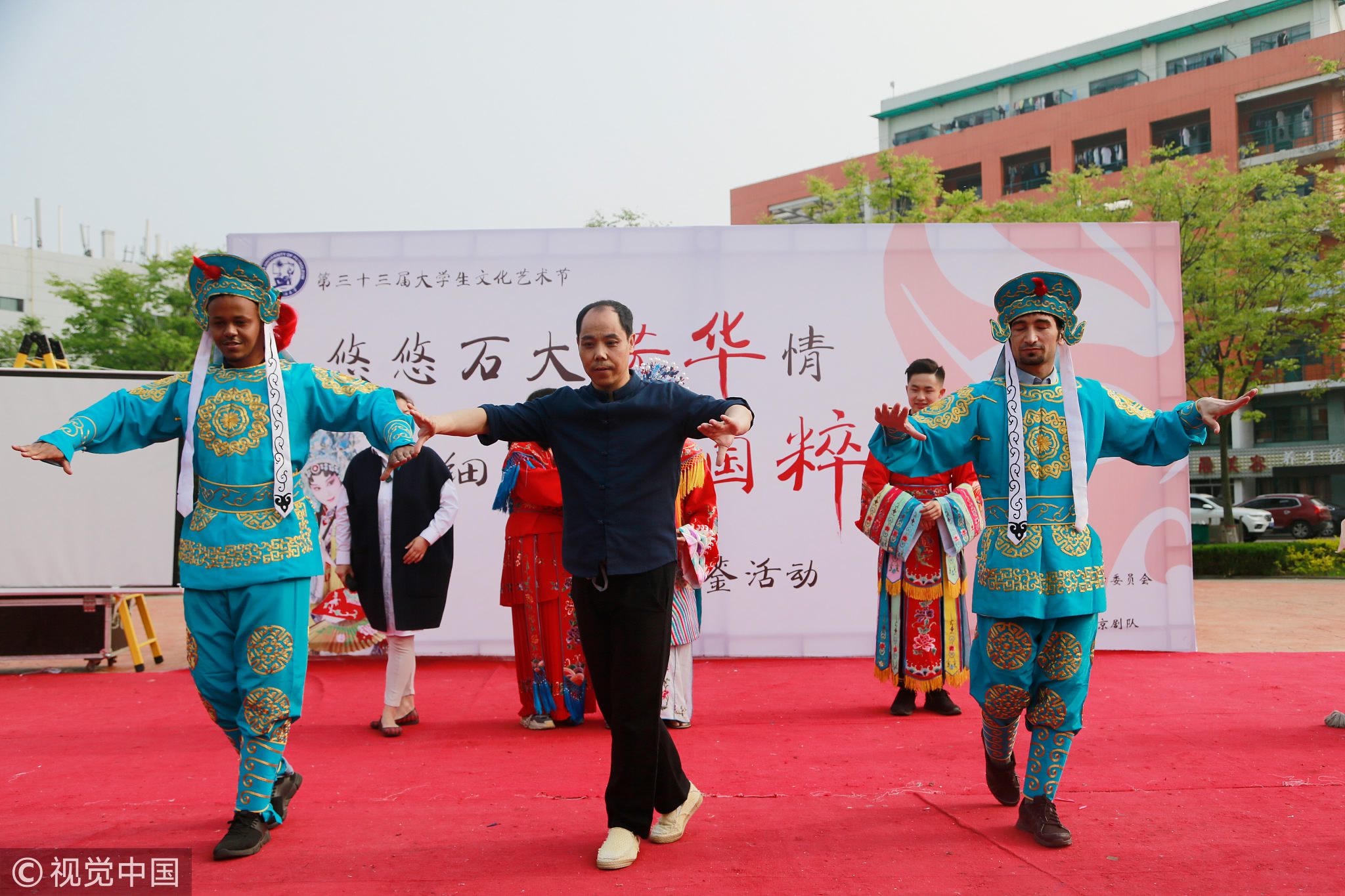
May 13, 2017: Overseas students learn Peking Opera in China University of Petroleum in Qingdao, Shandong Province. /VCG Photo
May 13, 2017: Overseas students learn Peking Opera in China University of Petroleum in Qingdao, Shandong Province. /VCG Photo
“Learning Chinese is not just learning a language. It’s a language of one of the biggest populations in the world,” says M. Yousaf, a Pakistani PhD student in the Communication University of China (CUC). “If you know this language, you know the culture, the values, civilization, and mind of the people.”
Based on statistics released at the 12th Confucius Institute Conference, in 2017, a total of 2.32 million students studied at Confucius Institutes and Confucius classrooms with 12.72 million people attending various cultural events.

July 24, 2017: British students from the Confucius Institute of Goldsmiths University learn to paint the round fan, in Zhenjiang, Jiangsu Province. /VCG Photo
July 24, 2017: British students from the Confucius Institute of Goldsmiths University learn to paint the round fan, in Zhenjiang, Jiangsu Province. /VCG Photo
However, for people learning the language as an adult, they face a tall order in mastering a language that garnered the title of “hardest language to learn” from the United Nations Educational Scientific and Cultural Organization (UNESCO).
For the foreign teachers and students that CGTN spoke to on campuses in Beijing, the toughest obstacle in Chinese is its pronunciation and unique tones.
“All the languages don’t have any tones, but Chinese has tones. It’s kind of a big difference from the others,” Woodcock told CGTN.
“The biggest difficulty in Chinese is tones. I think that is the most difficult part of the Chinese language, because it’s very difficult to remember how to pronounce all vowels,” said Bogdan, Woodcock’s classmate. From Bosnia and Herzegovina, he has been studying in BISU for 8 months. “It’s very difficult to remember how to pronounce all vowels. Here we study very fast, so it’s very difficult,” the beginner admitted.
Flying thousands of miles to China, however, cannot guarantee a perfect linguistic “environment.”
As a freshman at the CUC, Hajnal Nonna has spent more than half of her teenage years studying in China. Able to speak standard Chinese like the native, Nonna still thinks that accents are the biggest problem for her to understand others. “Every person’s accent is very different, like Beijing people, or maybe Sichuan… It’s very different. I have learned (Chinese) in Beijing, so I have the Beijing accent,” she told CGTN.
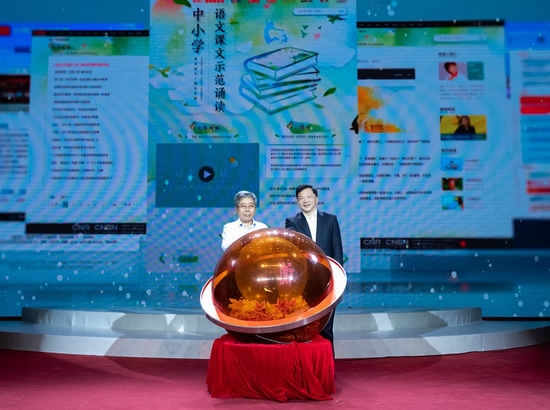
Shen Haixiong (R), president of the CMG, and Chen Baosheng (L), Minister of Education, launch the “Chinese language textbook audio demonstration materials”, May 19, 2018, in Beijing. /Xinhua Photo
Shen Haixiong (R), president of the CMG, and Chen Baosheng (L), Minister of Education, launch the “Chinese language textbook audio demonstration materials”, May 19, 2018, in Beijing. /Xinhua Photo
On May 19, 2018, the China Media Group (CMG) and Chinese Ministry of Education co-hosted the “Chinese language textbook audio demonstration materials” conference, launching 100 pieces of work recorded by more than 70 anchors and hosts from the CMG.
The audio materials involving more than 3,000 compulsory articles in textbooks are expected to benefit over 150 million students and nine million teachers in primary and secondary school. These materials to a certain extent are useful tools for foreign learners to tackle the most solid wall on their way to better Chinese, especially listening and speaking.
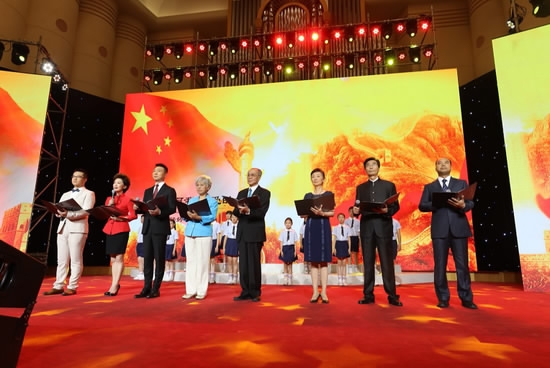
Anchors and hosts from the CMG perform classic articles included in textbooks at the conference. /Xinhua Photo
Anchors and hosts from the CMG perform classic articles included in textbooks at the conference. /Xinhua Photo
Recent years have seen TV programs such as "The Reciter" and "Letters Alive," which introduce classic pieces of Chinese literature read by professional anchors, hosts or actors, soar in popularity. An increasing number of audiences want beautiful voices to represent the classics.
(Videographer: Jiang Yuting and Qi Jianqiang; Video editor: Jiang Yuting. Ai Yan also contributed to the story.)