
Company
08:38, 08-May-2019
Lyft forecasts 2019 peak year for losses, sees path to profit with ride sharing
 ["north america"]
Share







Copied
Lyft Inc on Tuesday forecast that 2019 would be the peak year for losses after the ride service company lost 1.1 billion U.S. dollars in its first quarter, just days ahead of rival Uber's IPO.
"We are encouraged by our strength of our core business and see a clear path to profitability in ridesharing," said Chief Financial Officer Brian Roberts, sending shares up three percent in after-hours trading.
Revenues nearly doubled in the quarter ended in March, but Lyft forecast growth would slow in its first results as a public company. Lyft is watched as a bellwether for its larger rival Uber Technologies Inc, which will price its offering on Thursday.
Lyft, which says it has nearly 40 percent of the U.S. ride-hailing market, said increased demand helped push revenue to 776 million U.S. dollars in the quarter, up 95 percent from a year earlier and above analysts' average estimate of 739.4 million U.S. dollars, according to IBES data from Refinitiv.
An outlook for second-quarter revenue of 800 million U.S. dollars to 810 million U.S. dollars was ahead of analysts' expectations. The low end of that forecast would amount to revenue growth of 58 percent; however, far short of the growth Lyft has enjoyed recently.
For the full year, Lyft forecast revenue growth between 52 percent and 53 percent.
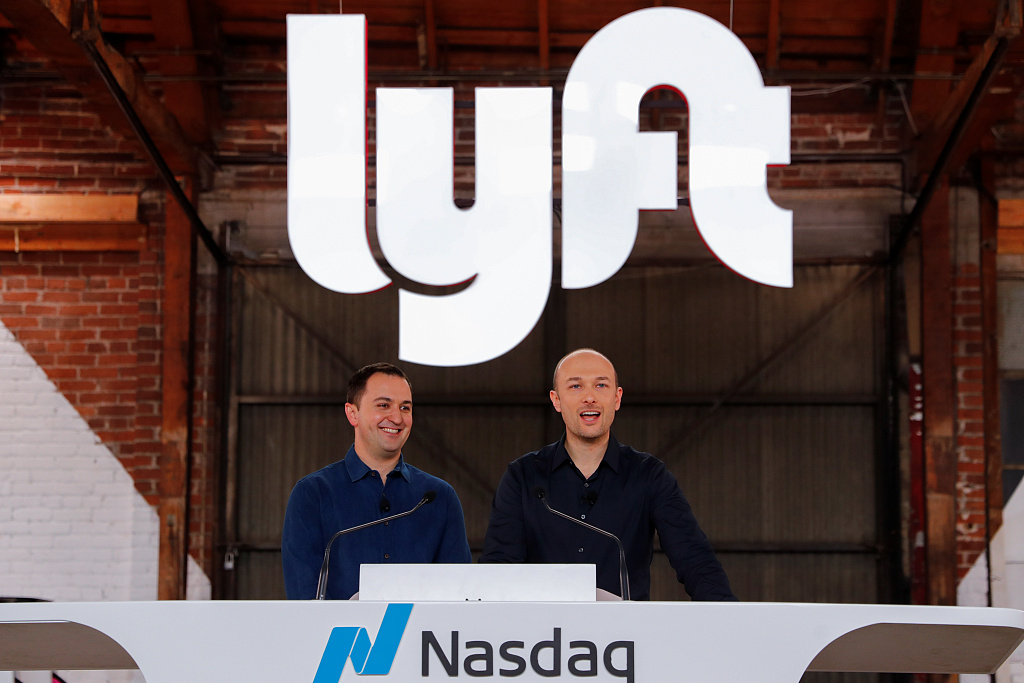
Lyft President John Zimmer and CEO Logan Green speak at a Lyft IPO event in Los Angeles, California, U.S., March 29, 2019. /VCG Photo
Lyft President John Zimmer and CEO Logan Green speak at a Lyft IPO event in Los Angeles, California, U.S., March 29, 2019. /VCG Photo
Since Lyft's IPO on March 29, shares had fallen 23 percent.
Atlantic Equities analyst James Cordwell called the results "pretty strong," with hints that Lyft was continuing to take market share from Uber. He cautioned, however, that Lyft's outlook did suggest "a meaningful slowdown in revenue."
In a snub to Uber, Lyft also announced a partnership with Alphabet Inc's Waymo in which Lyft will deploy 10 self-driving vehicles around the Arizona city of Phoenix. Uber has welcomed Waymo cars on its network.
Lyft posted revenue of 37.86 U.S. dollars from each of its 20.5 million active riders during the first quarter, a 34 percent increase in revenue and a 46 percent increase in riders over the same period in 2018.
Total costs and expenses rose more than 200 percent in the quarter as it stepped up its promotional activities to compete with rival Uber, although a contribution margin improvement to 49.6 percent from 35.4 percent pointed to greater efficiency.
A net loss widened to 1.14 billion U.S. dollars, in the first quarter ended March 31 from 234.3 million U.S. dollars a year earlier.
Last year, Lyft had 30.7 million riders and 1.9 million drivers in more than 300 cities in the United States and Canada. In comparison, Uber – which could be valued at about 90 billion U.S. dollars – had 75 million riders and 3.9 million drivers in 65 countries.
Source(s): Reuters