
Politics
19:19, 03-Jul-2018
Austria says ready to protect borders if Germany moves on migrants
Updated
19:19, 06-Jul-2018
 ["china"]
Share






Copied
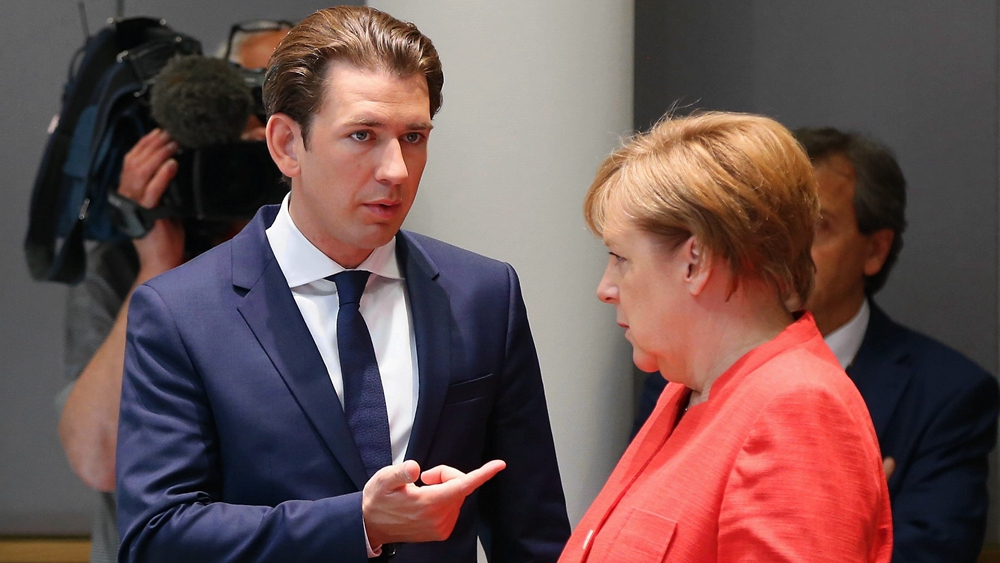
Austria is prepared to take measures to protect its southern borders if an immigration deal within Germany’s coalition goes into effect, the government in Vienna said on Tuesday.
"Should this agreement become the German government’s position, we see that as prompting us to take action to prevent negative consequences for Austria and its population," Austrian Chancellor Sebastian Kurz said in a joint statement with two far-right members of his cabinet.
The Austrian stance
Austria was responding to a deal reached late on Monday between German Chancellor Angela Merkel’s Christian Democrats (CDU) and her partners in Bavaria’s Christian Social Union (CSU), settling a row over immigration that had threatened to topple the German government.
Under the deal, migrants who have already applied for asylum in other European Union countries will be held in transit centers on the border while Germany negotiates bilateral deals for their return.
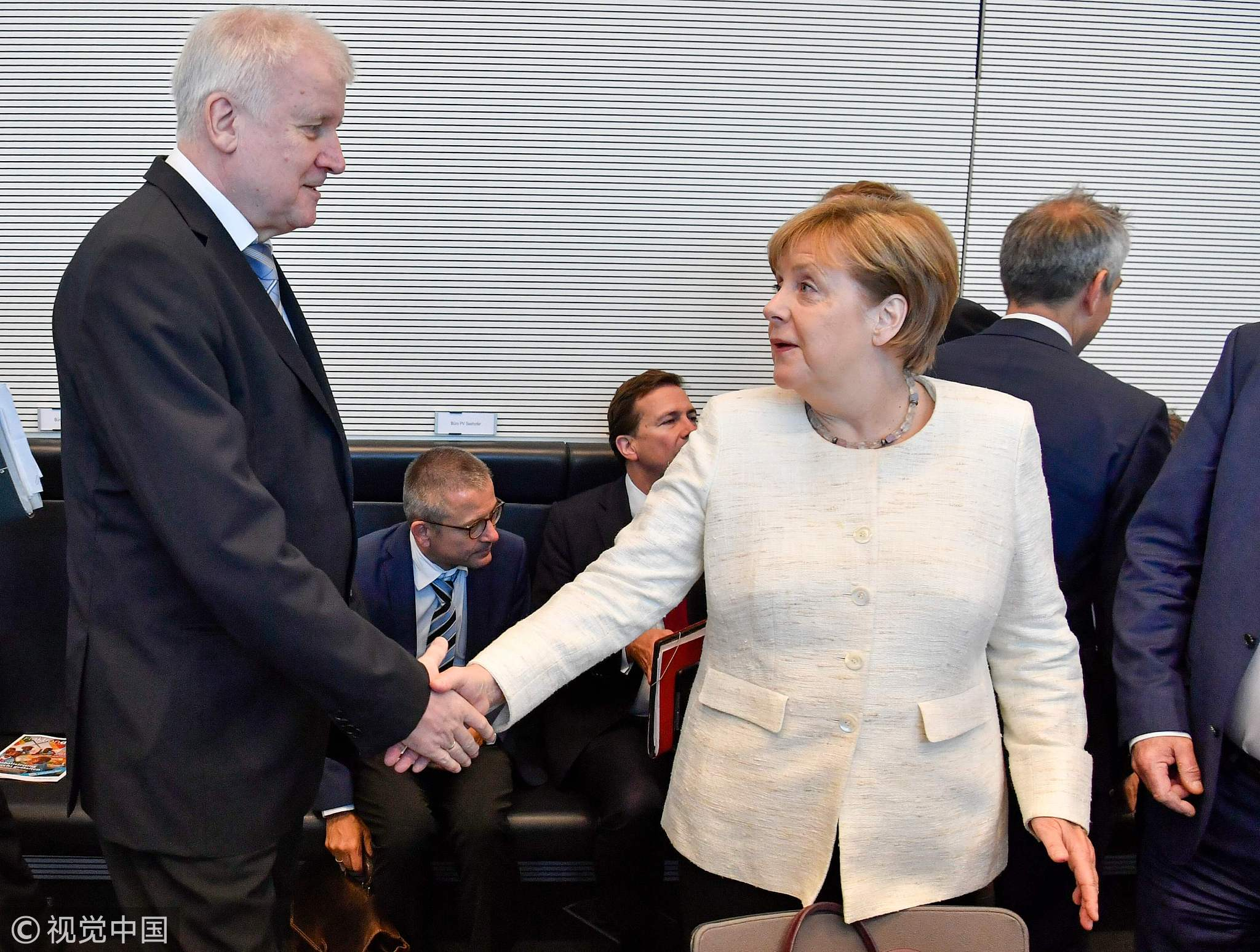
German Chancellor and leader of the Christian Democratic Union (CDU) Angela Merkel and German Interior Minister and leader of the Bavarian Christian Social Union (CSU) Horst Seehofer shake hands at the start of a CDU/CSU parliamentary group meeting in Berlin, Germany, July 3, 2018. /VCG Photo
German Chancellor and leader of the Christian Democratic Union (CDU) Angela Merkel and German Interior Minister and leader of the Bavarian Christian Social Union (CSU) Horst Seehofer shake hands at the start of a CDU/CSU parliamentary group meeting in Berlin, Germany, July 3, 2018. /VCG Photo
Austria, which has Germany on its northern border, has repeatedly said it will at least match any German measures on its own frontiers further down migrant routes, such as those it shares with Italy and Slovenia.
"The government is therefore prepared in particular to take measures for the protection of our southern borders," the statement by Kurz, Vice Chancellor Heinz-Christian Strache and Interior Minister Herbert Kickl said, without elaborating.
Austria’s southernmost borders are with Slovenia and Italy.
Scrutiny by the SPD
Meanwhile, within the German government, Angela Merkel's Social Democrats (SPD) coalition partners said on Tuesday they need to scrutinize the deal between the CDU and the CSU.
The head of the SPD’s Jusos youth wing, Kevin Kuehnert, told rbb radio that the SPD has spoken out against closed institutions for asylum seekers "and therefore I do not expect us to simply nod this through."
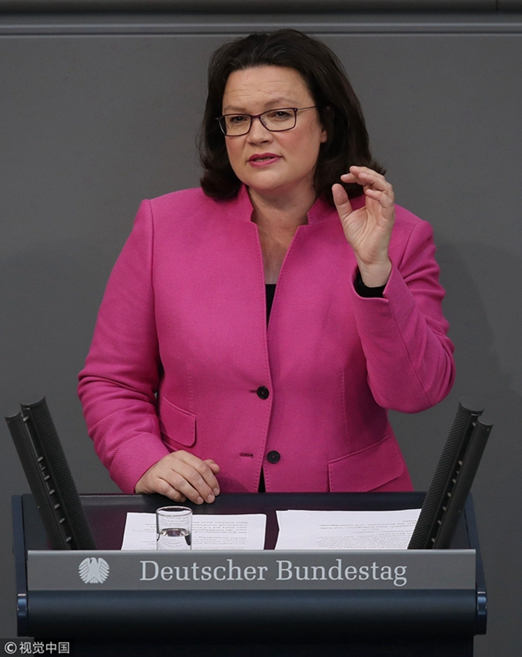
Andrea Nahles, head of the Bundestag faction of the German Social Democrats (SPD), speaks during debates after German Chancellor Angela Merkel gave a government declaration at the Bundestag ahead of the upcoming EU and NATO summits in Berlin, Germany, June 28, 2018. /VCG Photo
Andrea Nahles, head of the Bundestag faction of the German Social Democrats (SPD), speaks during debates after German Chancellor Angela Merkel gave a government declaration at the Bundestag ahead of the upcoming EU and NATO summits in Berlin, Germany, June 28, 2018. /VCG Photo
Ultimately, however, it seems unlikely that the SPD will torpedo the deal and trigger another political crisis.
CDU General-Secretary Annegret Kramp-Karrenbauer told German television she believed the SPD would back the deal.
"The SPD has said they want to speed up the process," she said. "I think this is a realistic solution that the Social Democrats can agree to," she said.
(Cover: German Chancellor Angela Merkel (R) chats with Austrian Prime Minister Sebastian Kurz (L) during the second day of the European Union Leaders' Summit in Brussels, Belgium, June 29, 2018. /VCG Photo)
Source(s): Reuters