
Space
22:49, 14-Aug-2018
Chinese scientists intend to chase solar eclipse in space
Updated
22:48, 17-Aug-2018
 ["china"]
Share







Copied
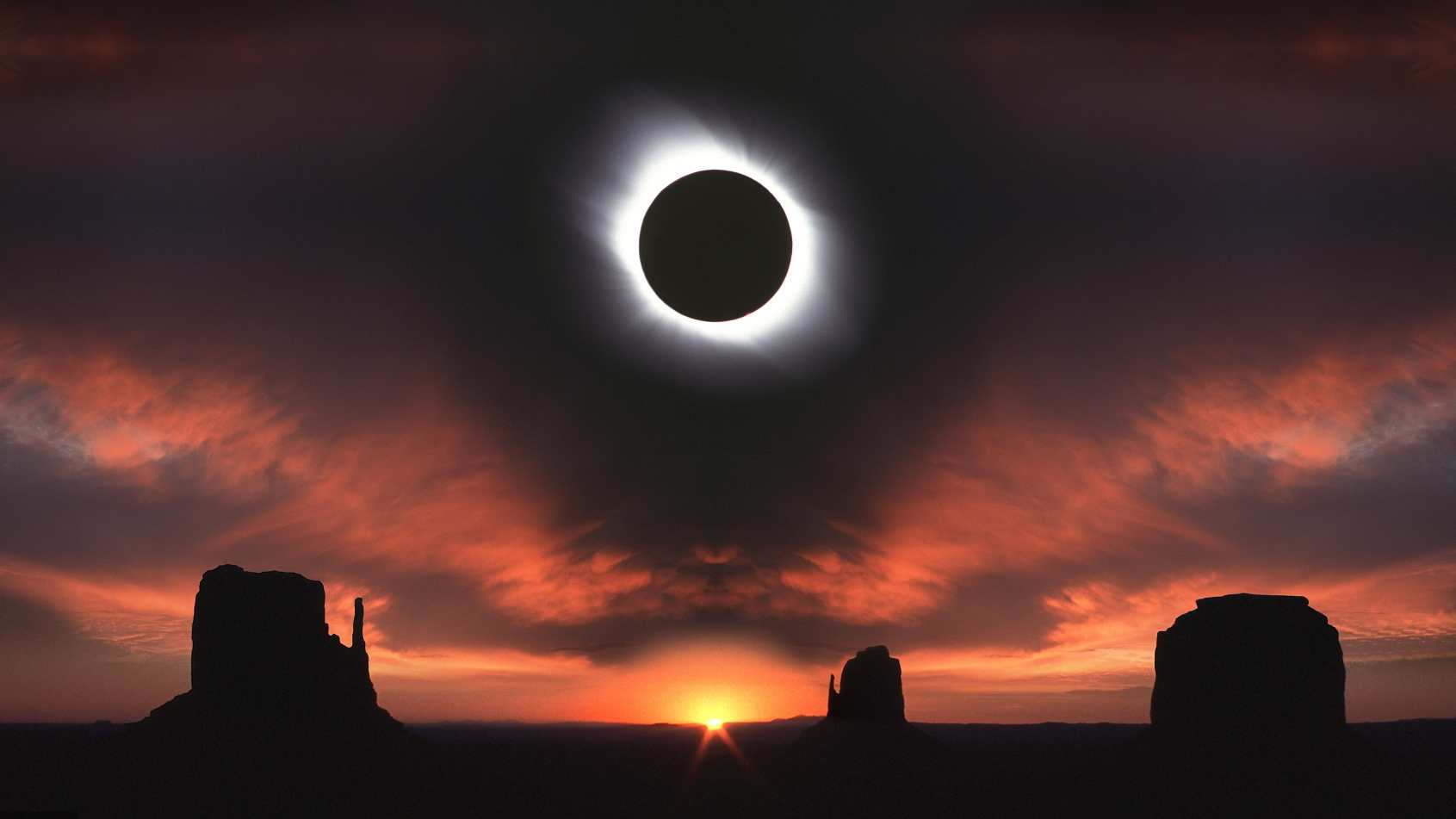
Total solar eclipses formed by the Moon shadowing the Sun are spectacular opportunities for scientists to observe the Sun's corona, but the chance is too short and rare to capture.
Nevertheless, Chinese scientists have proposed an idea to view a total solar eclipse in space by using the Earth to cover the Sun – different from NASA’s approach to enter the star’s atmosphere and take a close look.
The corona – the Sun's rarefied gaseous envelope – is more than a million degrees Celsius and often generates solar storms that interfere with satellites, navigation and communication systems, said Luo Bingxian, a researcher at the National Space Center of the Chinese Academy of Sciences (CAS).
"The heating process of the corona is one of astronomy's biggest mysteries, but our understanding of it is still lacking due to our inability to observe it," Luo said.
"It's very difficult to see the corona clearly from Earth, since its brightness is less than a millionth of that of the Sun's disk," Luo said.
The corona is normally visible only during a total solar eclipse, when it is seen as an irregularly shaped glow around the darkened disk of the Moon.
However, total solar eclipses are rare and usually last only minutes, not to mention sometimes the best observation location is from the ocean, or the weather is unfavorable.
Even a coronagraph, a special instrument designed to observe the corona, is easily affected by factors such as stray light, vignetting and atmospheric scattering.
"Since we can see the Moon between the Sun and Earth during a total solar eclipse, I thought we could put a telescope, the Earth and Sun in a straight line," said Luo.
His team calculated the best place for the telescope was close to the second Lagrange point (L2) of the Sun-Earth system, about 1.4 million kilometers from the Earth.
There, the relative positions of the Sun, Earth and telescope would remain unchanged with the gravity of the Sun, Earth and a little propulsion, Luo said.
Cooperating with scientists from the University of Science and Technology of China and the Innovation Academy of Microsatellites of the CAS, Luo recently took the idea to a contest of innovative future technologies in Shenzhen, south China's Guangdong Province, and it was selected as one of the 30 winning projects. The contest encouraged young Chinese scientists to conceive groundbreaking technologies and trigger innovation.
(Top image: Total solar eclipse in Utah, US /VCG Photo)
Source(s): Xinhua News Agency