
Opinions
08:24, 11-Jul-2018
Opinion: Population aging challenge needs structural reform
Updated
08:09, 14-Jul-2018
 ["china"]
Share







Copied

Editor's note: Lin Bao is a research fellow at the Institute of Population and Labor Economics at the Chinese Academy of Social Sciences. The article reflects the author's opinion, and not necessarily the views of CGTN.
China is experiencing rapid population aging. At the end of 2017, according to the National Bureau of Statistics, the population aged 60 and over was 240.90 million, accounting for 17.3 percent of the total population, which had increased by about 62 million compared to 2010.
In addition to prolonged life expectancy, the long-term low fertility rate is the main reason for the rapid population aging. Since the total fertility rate in China in the early 1990s has been below the replacement level of 2.1, with the risk of slipping into a low fertility trap.
Population aging has deeply and widely affected all aspects of social and economic development in China and will continue in the future. The most direct impact will be in terms of economic development, social security and elderly services etc.
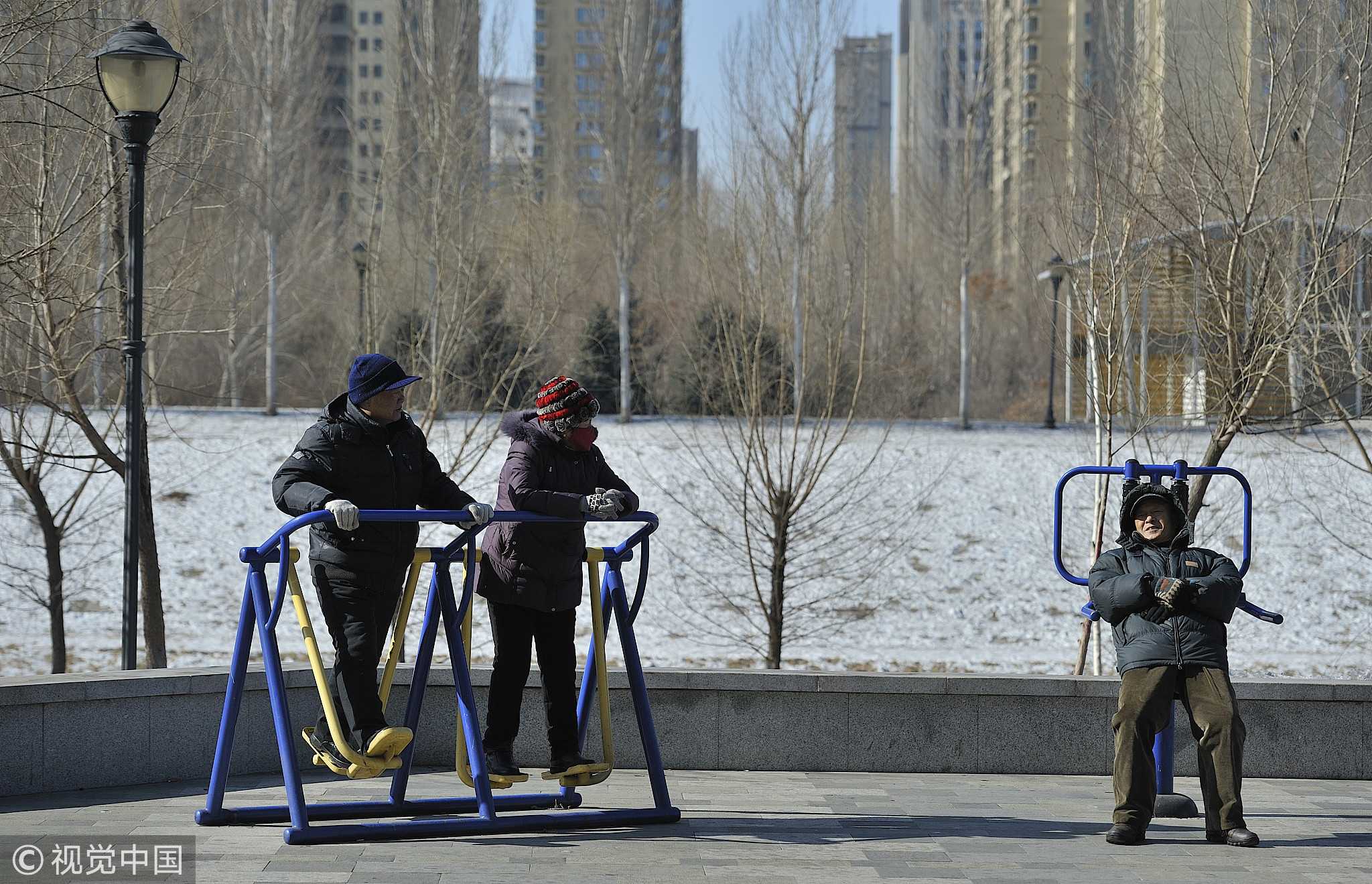
Elderly people exercise at An Yang Park in Harbin, China, February 27, 2018. /VCG Photo
Elderly people exercise at An Yang Park in Harbin, China, February 27, 2018. /VCG Photo
First, the population aging has led to a rapid decline in the demographic dividend, so that the traditional economic development pattern is unsustainable. Since 2012, China’s working-age population aged 15-59 has been declining with the decrease of a demographic dividend too, which has led to a rapid rise in labor costs. Thus the traditional comparative advantage of lower labor costs has gradually been lost. Some experts believe that this has led to the slowing down of China's economy.
Second, the pressure on old-age income security has increased, and the social security system is facing more challenges. The burden of supporting the elderly will rise sharply with population aging, and the pressure on pension payments will continue to increase. In recent years, the pension system seems to have been already under pressure in some local provinces and they have to rely on debt.
Third, the demand for elderly services has increased dramatically and the construction of the social service system for the elderly, such as nursing and medical care services, needs to be accelerated.

Assistive devices for the elderly on show at the Beijing International Rehabilitation Aids Products Expo at Beijing International Exhibition Center, June 7, 2018 /VCG Photo
Assistive devices for the elderly on show at the Beijing International Rehabilitation Aids Products Expo at Beijing International Exhibition Center, June 7, 2018 /VCG Photo
In response to the challenges of population aging, the Chinese government has also taken a series of measures in recent years, which include adjustment of the fertility policy, reform of the pension system, and promotion of the construction of the social elderly service system.
In terms of adjusting the fertility policy, China has implemented a two-child policy for couples of whom either the husband or the wife is from a single-child family and then adjusted to the universal two-child policy. However, the effect of these policies has been very limited as the birth population has only slightly rebounded. In the long run, the impact of the two-child policy on delaying population aging is small. How to effectively improve the fertility level is still a major problem in China.
In terms of the pension system, several measures have been introduced, such as integrating the original multiple systems into two central systems: the basic old-age insurance system for urban and rural residents and the basic old-age insurance system for urban workers. The government has also established a central regulation fund system, adjusted the pension indexation method, changed the enterprise annuity method and introduced tax-deferred commercial insurance. However, these measures are still insufficient to cope with the challenge of population aging and further reforms are needed.
In regards to the construction of the social pension service system, a series of measures have also been introduced, including promoting the combination of medical and elderly care, vigorously developing the elderly service industry and carrying out long-term care insurance pilots, etc. However, the problem of imbalance in the supply and demand structure of elderly services remains unresolved and further structural reform on the supply side of elderly services is badly needed.
In short, population aging is a long-term challenge for China, and there is still a long way to go to meet this challenge.