
Science
08:23, 17-Aug-2018
Study: Kids more susceptible to robots than adults
Updated
08:17, 20-Aug-2018
 ["china"]
Share







Copied
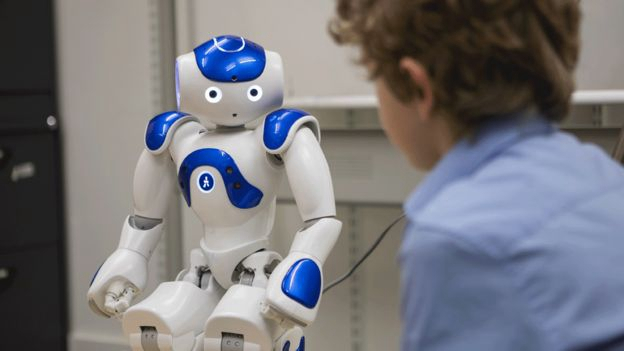
A study published on Wednesday in the journal Science Robotics showed that children were more likely to be influenced by robots compared with adults.
The research conducted at the University of Plymouth compared how adults and children responded to an identical task when in the presence of both their peers and humanoid robots.
It showed that adults regularly had their opinions influenced by peers but they were largely able to resist being persuaded by robots.
However, children aged between seven and nine were more tempting to give the same responses as the robots, even if they were obviously incorrect.
The study used the Asch paradigm, first developed in the 1950s, which asked people to look at a screen showing four lines and decided which two matched in length.
When alone, people almost never made a mistake but when doing the experiment with others, they tend to follow what others were saying.
In the new study, when children were alone in the room, they scored 87 percent on the test, but when the robots join in their score drops to 75 percent.
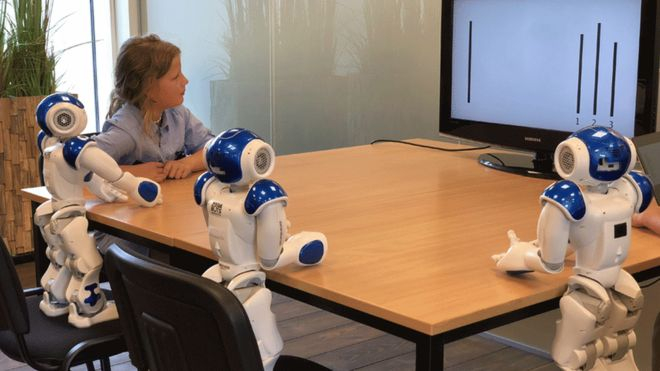
A girl in the test with robots /Photo courtesy of University of Plymouth
A girl in the test with robots /Photo courtesy of University of Plymouth
Among their wrong answers, 74 percent matched those of the robot, according to the study.
"Adults do not conform to what the robots are saying. But when we did the experiment with children, they did. It shows children can perhaps have more of an affinity with robots than adults,” said the study leader Tony Belpaeme, professor in robotics at the University of Plymouth and Ghent University.
Experts warned about possible commercial exploitation of robots’ influence – what if robots were to suggest, for example, what products to buy or what to think.
While the researchers said further discussions on how to protect children from that influence are needed, the chairman of the Foundation for Responsible Robotics Noel Sharkey thought the studies missed one component to distinguish whether the influence comes from the robots or just the sound played by them.
(Top image: Photo courtesy of University of Plymouth)
Source(s): Xinhua News Agency