
Opinions
12:18, 06-Jul-2018
Reality check: US trade war is self-defeating
Updated
11:28, 09-Jul-2018
 ["china"]
Share







Copied
Editor's note: Bi Jianlu is the chief opinion editor of CGTN Digital. The article reflects the author's opinions, and not necessarily the views of CGTN.
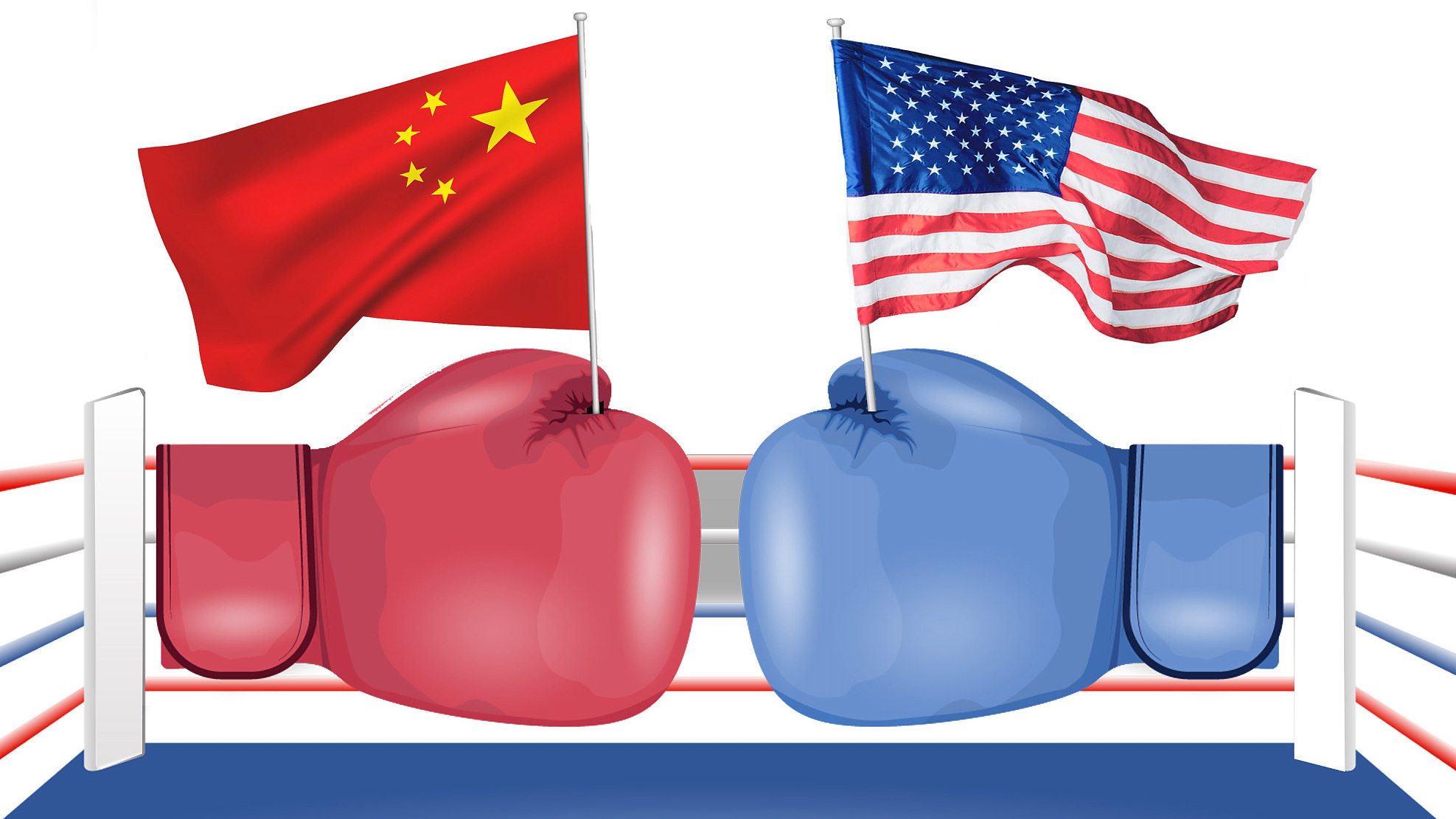
The US has placed an additional 25-percent tariff on imports from China worth 34 billion US dollars, prompting a swift response from China. Beijing announced on Friday noon it will take countermeasures to safeguard the interests of the country and its people. The Sino-US trade conflict has entered a new phase.
Trade Deficit – US self-punishment
Launching a trade war against China is tantamount to the US punishing itself.
The root cause of the Sino-US trade deficit is the lack of savings and overconsumption in the US, and is also closely related to the global industrial chain. The truth is that America has benefitted hugely through its dealings with China, yet blames it for its trade deficit.
On the one hand, the United States, through the issuance of the US dollar, clearly enjoys the cheap goods produced by the Chinese workforce. On the other, it accuses China of taking job opportunities from Americans. That is typical insatiable hegemonic logic.
And it is clear that China will not be the only party hurt by a trade war. Analysis shows that more than 20 billion of the 34 billion US dollars, amounting to 59 percent, in goods the US has placed tariffs on are the products of foreign-invested enterprises in China. Among them, American companies take up a considerable proportion.

Farmer John Duffy loads soybeans from his grain bin onto a truck before taking them to a grain elevator on June 13, 2018 in Dwight, Illinois. /VCG Photo
Farmer John Duffy loads soybeans from his grain bin onto a truck before taking them to a grain elevator on June 13, 2018 in Dwight, Illinois. /VCG Photo
Mary Lovely, an economist from Peterson Institute for International Economics, says the first round of tariff impositions will do more harm to US and foreign multinationals than Chinese domestic companies. Some 87 percent of the computers and electronic products affected by the July 6 tariffs are produced by Chinese subsidiaries of multinationals, not Chinese-owned companies.
By placing levies on Chinese and foreign companies, including US-funded enterprises, Washington will be attacking the global industrial and value chain. In short, the US is firing at the world and itself.
America’s practice is tantamount to pushing the world back to the Cold War era of thinking. This kind of mentality, against peaceful development, is a disaster, especially for developing countries, and the US will suffer from its own behavior.
US, not a victim, but selfish hegemonist
Given that globalization has provided the world economy and individual countries with transformative development opportunities, why does the US portray itself as a victim?
Carmen M. Reinhart, a professor of the international financial system at John F. Kennedy School of Government at Harvard Kennedy School, rejected the argument that the US is the victim of world trade in the French newspaper Le Monde last year.
In Reinhart's opinion, the image of America as a victim is simply an excuse for US governance issues and income inequality. She adds that countries that are developing faster through globalization have been made scapegoats.
President Trump continues to take shots at the existing rules of the global trading system. In his eyes, trade is a zero-sum game, and a deficit means losing money.
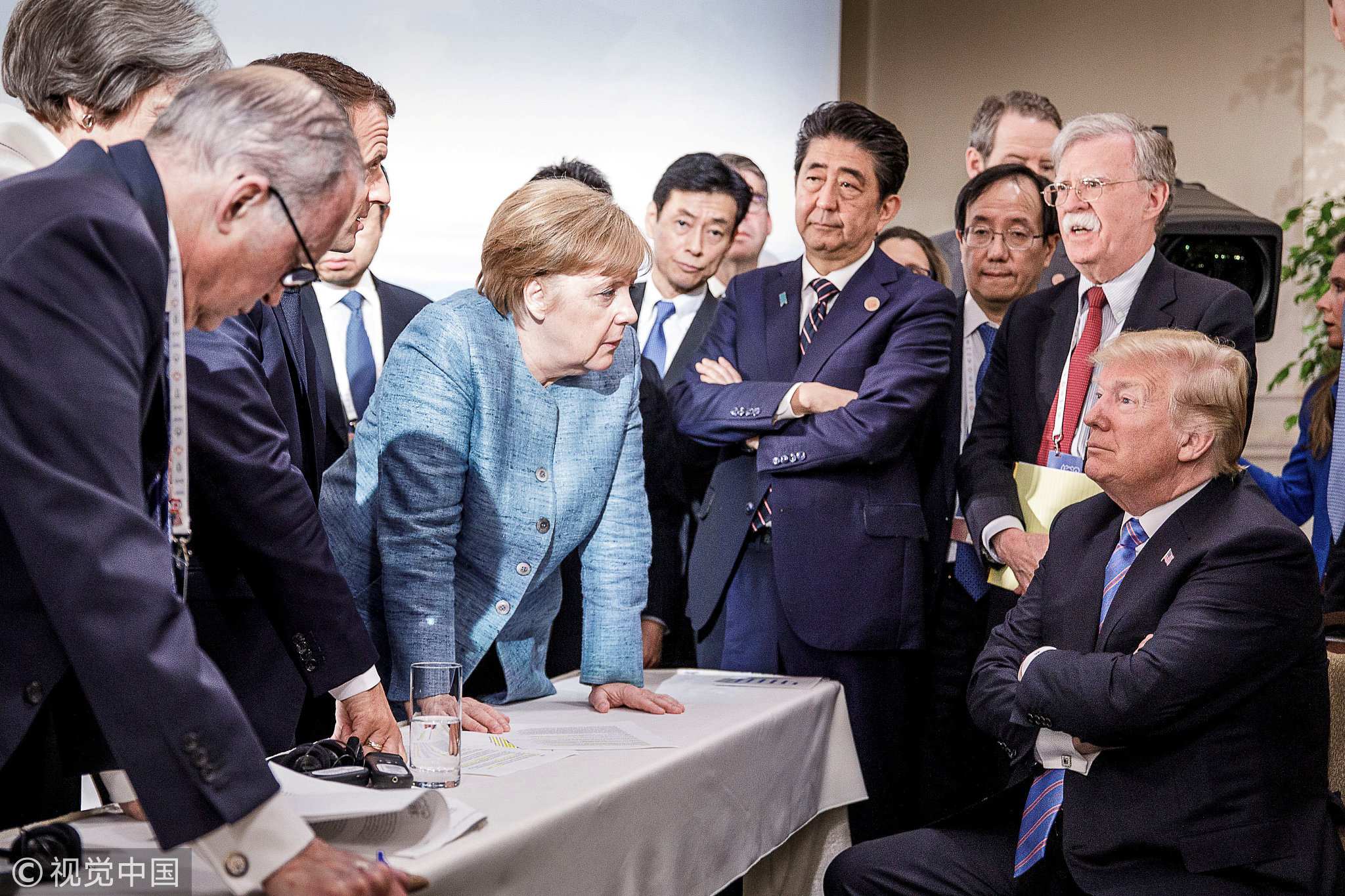
German Chancellor Angela Merkel speaks to US President Donald Trump during the second day of the G7 meeting in Charlevoix city of La Malbaie, Quebec, Canada, June 9, 2018. /VCG Photo
German Chancellor Angela Merkel speaks to US President Donald Trump during the second day of the G7 meeting in Charlevoix city of La Malbaie, Quebec, Canada, June 9, 2018. /VCG Photo
The US president advocates the economic integration of G7 countries, zero tariffs, zero subsidies, and zero barriers. This proposal is tantamount to establishing a new international economic order. Such behavior will bring China and the United States into a shadow zone, from a favorable situation of reciprocal trade.
Trump utilizes the power of the United States in the existing international order in an attempt to further maximize the interests of his country. This is an explicit example of selfish hegemony.
'Death by China' – populism's delusion
Trump's arguments on trade issues, and many of the measures taken since he took office, can be found in the book Death by China. The writer is Peter Navarro, an American economist who currently serves as the Director of the White House National Trade Council.
About 95 percent of top economics expressed disapproval in a survey by the University of Chicago Booth School of Business in 2012 of Navarro’s rejection of the argument that “free trade improves productivity and provides consumers with better choices. In the long run, the positive impact of these benefits is better than the negative impacts of employment.”
Daniel J. Ikenson, head of trade policy research at the Cato Institute, criticized Navarro as hawkish and populist, saying his view of trade is "a dangerous and misleading global zero-sum perspective with no approval of any economist."
In addition, Dan Steinbock, research director of international business at the India, China & America Institute (United States), argued that Navarro’s "China threat theory" lacks factual basis and is more like a political persuasion tool.
Bloomberg News criticizes Death by China as full of emotional attacks, completely ignoring the positive side of China's reform and opening up, and the contribution of the Chinese economy to global economic recovery and growth.
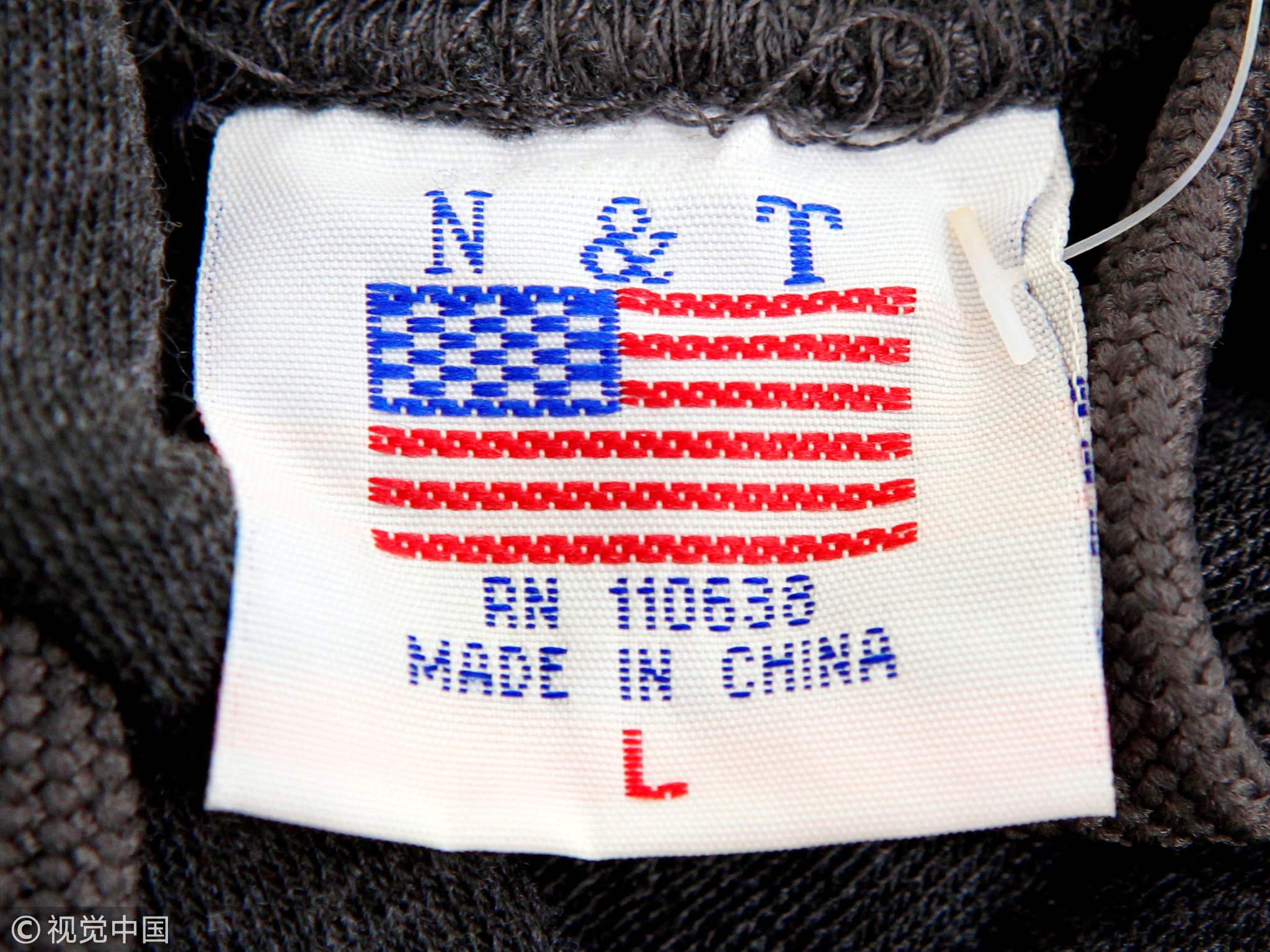
The label of a Washington DC sweatshirt bears a US flag but says "Made in China" at a souvenir stand in Washington, DC, January 14, 2011. /VCG Photo
The label of a Washington DC sweatshirt bears a US flag but says "Made in China" at a souvenir stand in Washington, DC, January 14, 2011. /VCG Photo
The Los Angeles Times agrees with Bloomberg News by saying that the book is filled with xenophobic hysteria and exaggerated facts, and fails to accurately identify cause and effect.
It is hard to believe that the arguments in Death by China, which are incompatible with mainstream American economics and mainstream public opinion, are guiding US policy.
This situation is puzzling, and a concern for the world. People of insight in the US should fight to end this hawkish Cold War thinking, and abandon the zero-sum mindset.