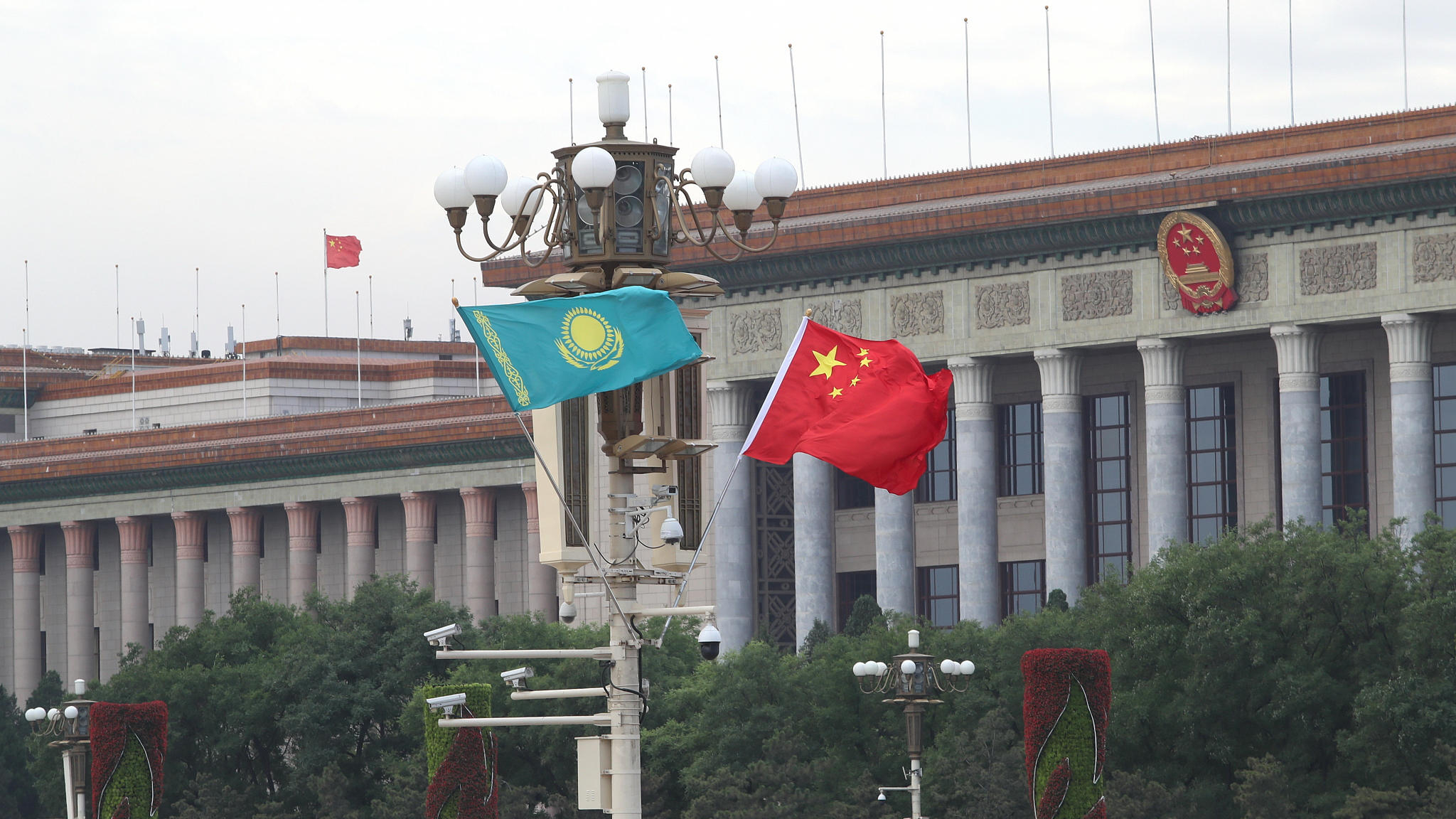
Editor's note: Massalimova Aliyа is the dean of the Faculty of Philosophy and Political Science at Al-Farabi Kazakh National University, Kazakhstan (Almaty). The article reflects the author's opinion, and not necessarily the views of CGTN.
It is a geopolitical reality that Kazakhstan sits at the crossroads of Eurasia. And its foreign policy and national security concepts are based on two centrally defining features of Kazakhstan’s geographic location.
Firstly, it is a landlocked state with a long border with two regional powers, China and Russia; secondly, the interests of the US, China, Russia, and the EU converge here.
China's contribution pushes Kazakhstan's economic development
China’s direct investment has changed Kazakhstan's privatization programs. Under its investment strategy, Kazakhstan has prioritized reforms to make its energy industry attractive to all types of cooperation.
The transition from extraction of raw materials to a path of services and technology is helping provide new channels and platforms to enhance trade and economic ties with key partners and beyond.
Kazakhstan has been developing new routes to transport energy to the Asian and European markets.
The modernization of refineries, of which China has recently become an active participant and investor, has been designed to expand the product slate by producing petrochemicals.
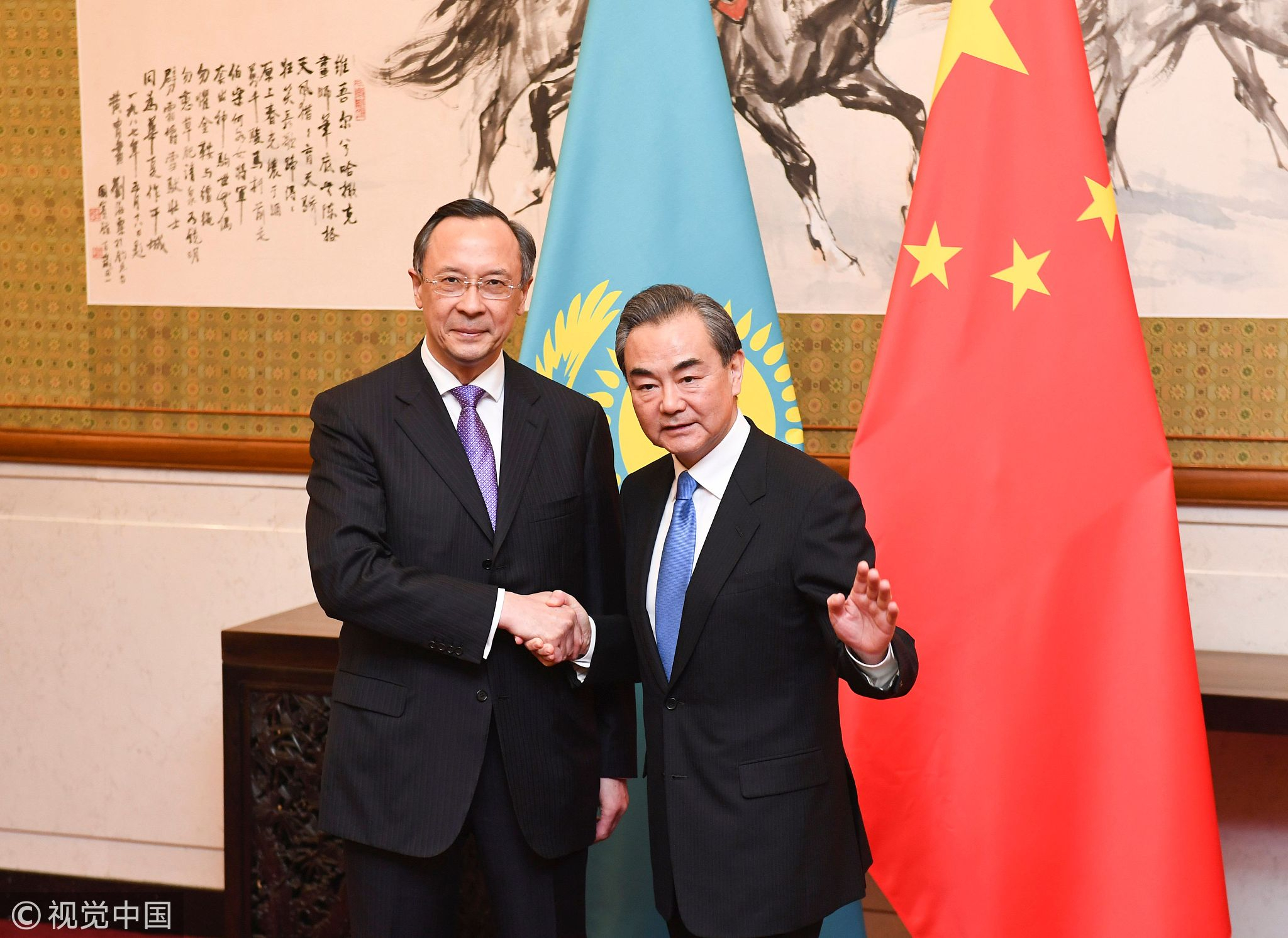
April 24, 2018: Kazakh Foreign Minister Kairat Abdrakhmanov (L) shakes hands with Chinese State Councilor and Foreign Minister Wang Yi before their meeting at the Diaoyutai State Guest House. / VCG Photo
April 24, 2018: Kazakh Foreign Minister Kairat Abdrakhmanov (L) shakes hands with Chinese State Councilor and Foreign Minister Wang Yi before their meeting at the Diaoyutai State Guest House. / VCG Photo
The gas market has improved, leading to a continuous supply, elimination of regional imbalances and reduction of greenhouse gas emissions.
A plant, aimed at producing fuel assemblies, is currently being built by Kazakh and Chinese partners, and will be commissioned in 2019, with output expected in 2020.
Another area of successful China-Kazakhstan cooperation is the transmission and distribution systems in the power sector, which over the past few years was reorganized, creating a new high-voltage transport network.
Astana will also welcome cooperation with Beijing in developing alternative energy sources since it needs expertise and equipment to increase its power sector.
It is important to note that, from the start, Kazakhstan has consistently followed a multi-vectored foreign policy, which has helped guarantee that no power can exercise strategic control over its broader economic future.
At the same time, Kazakhstan’s energy industry has undoubtedly benefited from greater links to other trade and economic activities with China which are speeding up structural reforms in the oil and gas sector.
Kazakhstan’s key position between China and Russia
Kazakhstan’s key geopolitical position along the Silk Road Economic Belt has proven its strategic importance for economic and security reasons.
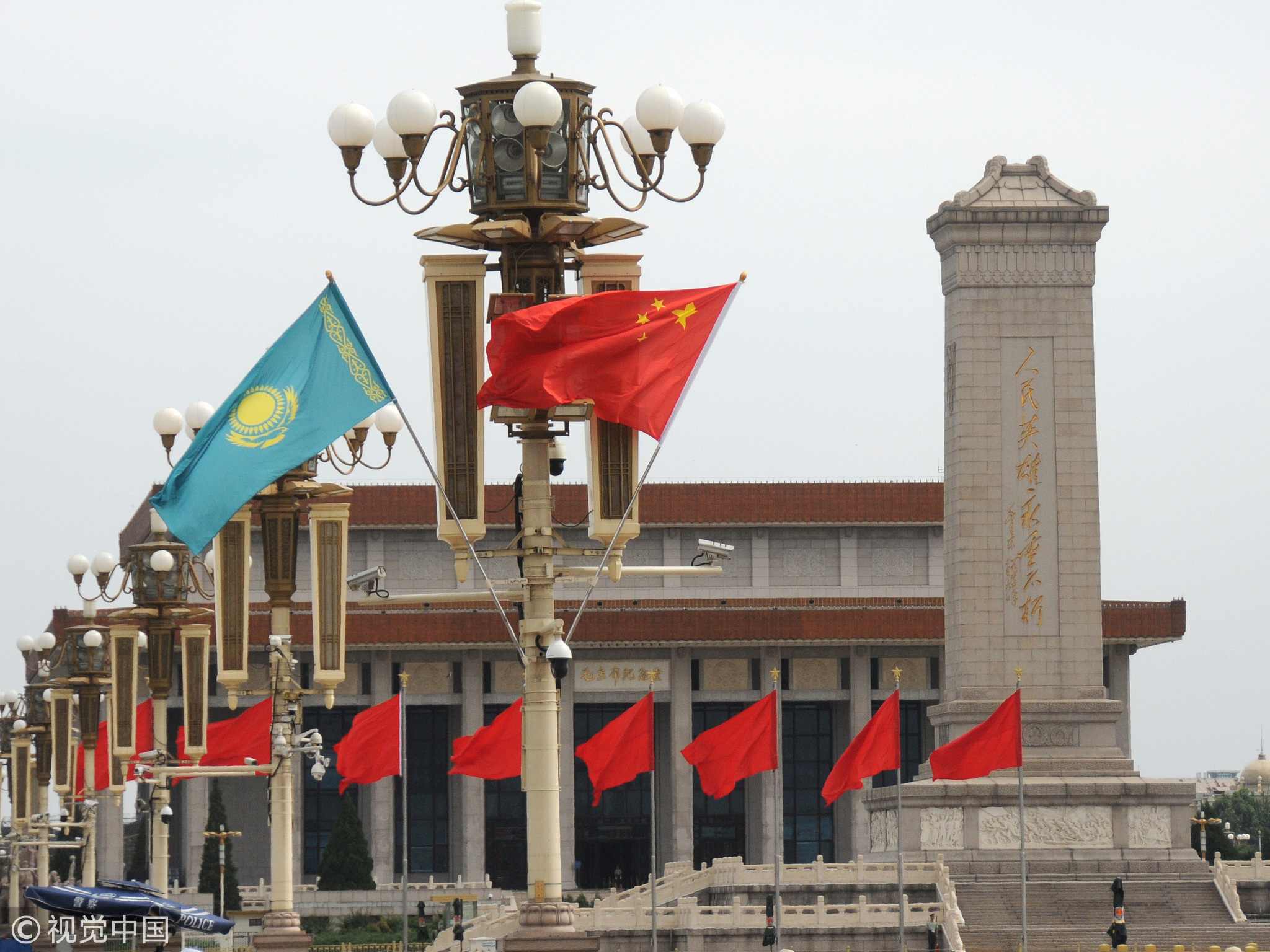
June 7, 2018: The national flags of China and Kazakhstan are hung at Beijing’s Tiananmen Square to welcome the Kazakhstan's president to visit China. / VCG Photo
June 7, 2018: The national flags of China and Kazakhstan are hung at Beijing’s Tiananmen Square to welcome the Kazakhstan's president to visit China. / VCG Photo
The country’s efforts on the international arena are first and foremost aimed at firmly defending its national interests, and creating favorable external conditions for a profound political, economic and social modernization.
In order to strengthen political trust and avoid unnecessary rivalry and confrontation, Kazakhstan has entered into several regional cooperative organizations, blocs and alliances.
Kazakhstan, for example, is one of the founding members of the Shanghai Cooperation Organization (SCO). The country’s interests there include promoting economic and regional integration and deepening multilateral relations with the organization’s members, including in the realm of security.
The creation and development of the Eurasian Economic Union with Russia, Belarus, Armenia and Kyrgyzstan since 2015 has been a way for Kazakhstan to link its market with those of the member states more securely through trade, facilitate the access of Kazakh products to those markets, create the conditions for economic growth and a favorable environment for its businesses and small and medium-sized enterprises.
Kazakhstan is also a member of the Collective Security Treaty Organization, which aims to strengthen its military capabilities through security integration.
In terms of bilateral ties, over its 27 years of independence, Kazakhstan has developed successful strategic relations with both Russia and China, ensuring the legal recognition of its state border and fully preserving its territorial integrity.
These achievements and successes are inextricably linked with the name of President Nursultan Nazarbayev and his strategic vision and trust-based rapport with the leaders of China and Russia.
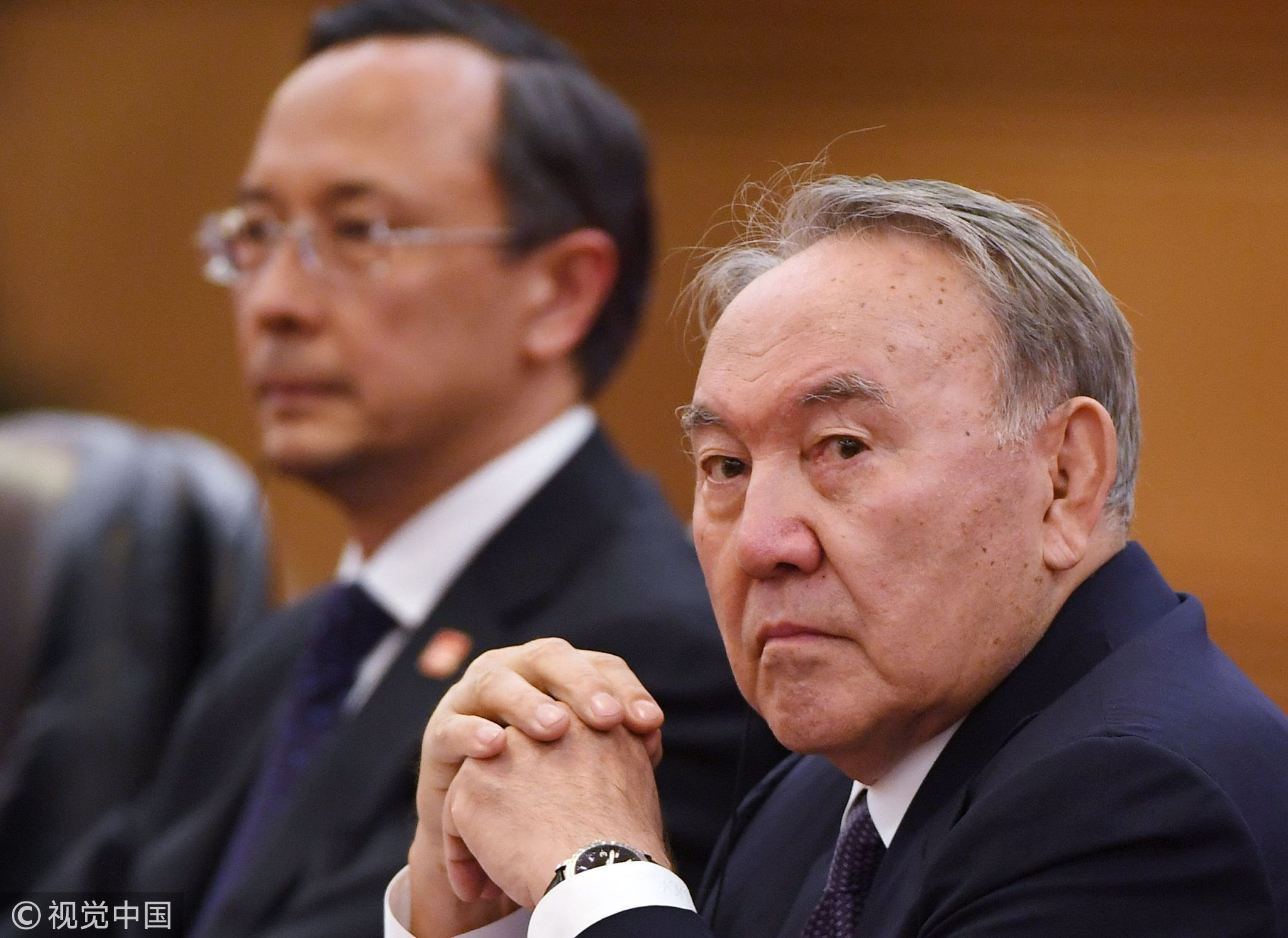
June 7, 2018: Kazakhstan's President Nursultan Nazarbayev (R) listens as Chinese President Xi Jinping (not pictured) speaks at the Great Hall of the People in Beijing. / VCG Photo
June 7, 2018: Kazakhstan's President Nursultan Nazarbayev (R) listens as Chinese President Xi Jinping (not pictured) speaks at the Great Hall of the People in Beijing. / VCG Photo
Belt and Road Initiative in sync with Kazakhstan’s economic plan
Kazakhstan is the largest landlocked country on the planet, but it strives to use this situation to its advantage, acting as a "land-linked" hub for international trading routes, to the benefit of all relevant parties.
The government has committed significant resources to streamlining and upgrading the road, rail, airport and pipeline infrastructure, and ensuring an effective overlap between our Nurly Zhol Program and the China-proposed Belt and Road Initiative (BRI), which runs through Central Asia, with Kazakhstan playing a key role.
Nurly Zhol – or "the Bright Path" – is a vast, region-wide project which aims to make Kazakhstan a key transport and logistics hub for Central Asia and beyond. It was announced by President Nazarbayev in November 2014.
This project is driving state and foreign direct investment into critical infrastructure and priority sectors and promoting economic growth.
Nurly Zhol targets development of international transit through the construction of main roads that link China to Western Europe. The development of industrial infrastructure includes completion of networks in existing special economic zones and construction of new industrial zones.
Logistics cooperation, for instance, has linked Kazakhstan with the Pacific and boosted bilateral trade between the two sides.
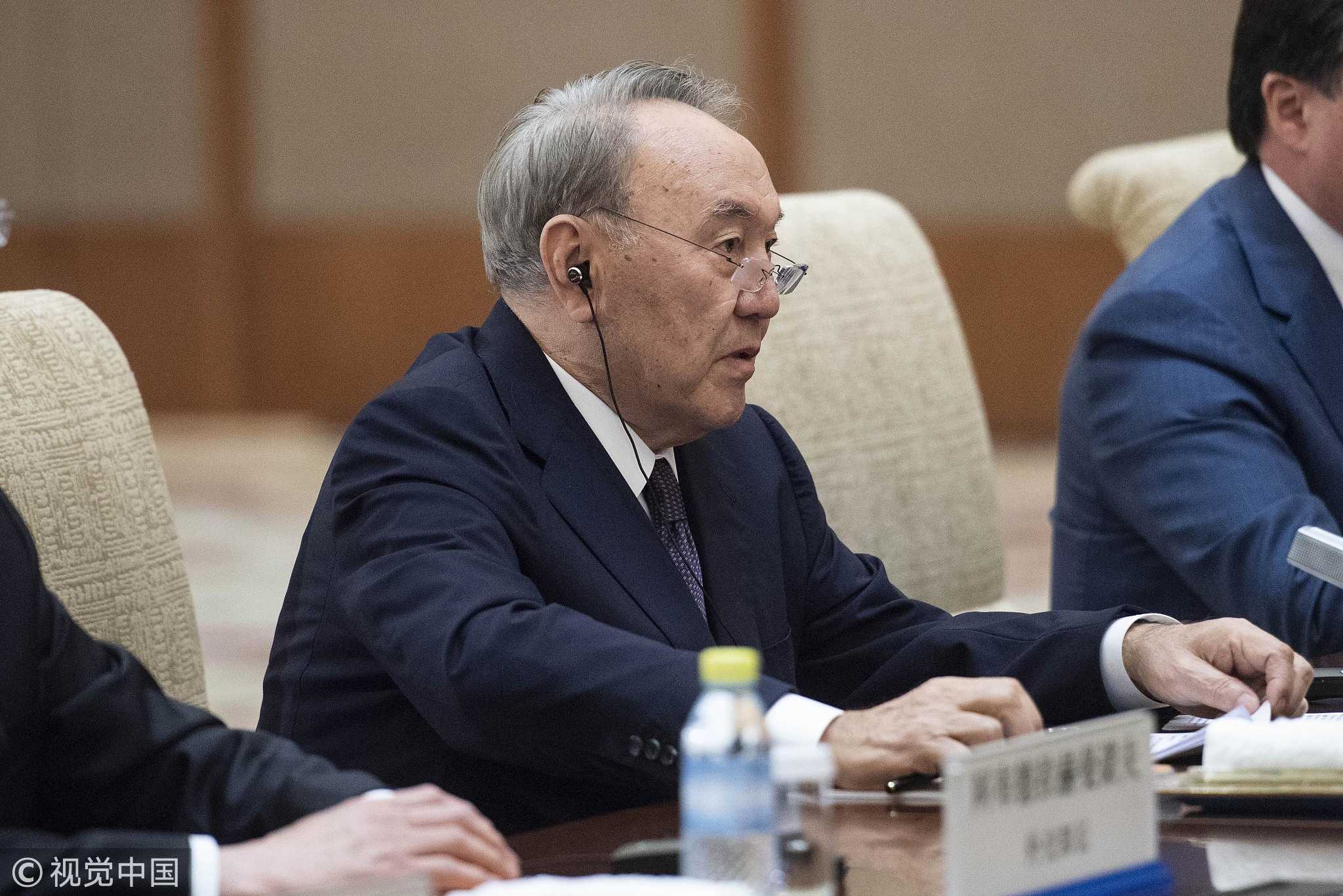
June 7, 2018: Kazakhstan's President Nursultan Nazarbayev speaks to China's Premier Li Keqiang (not pictured) during a meeting at the Diaoyutai State Guesthouse in Beijing. / VCG Photo
June 7, 2018: Kazakhstan's President Nursultan Nazarbayev speaks to China's Premier Li Keqiang (not pictured) during a meeting at the Diaoyutai State Guesthouse in Beijing. / VCG Photo
In addition, digitalization has increased the speed of decision-making and revenues from providing services.
Importantly, both massive projects, Nurly Zhol and BRI, aim to strengthen the two countries’ capabilities and shift productivity of domestic businesses and exporters towards trade and logistics, manufacturing, tourism, information technology and finance.
The joint implementation of the projects has benefited both China and Kazakhstan in significant ways.
As the ancient Silk Road is being rebuilt and modernized with exciting potential for growth under the aegis of the Chinese government and its major Central Asian partner – Kazakhstan – both projects are earning the trust and catching the attention of international investors and decision makers.

 ["china"]