
Opinions
15:19, 10-Sep-2018
Opinion: Leveraging market mechanisms to increase workers' income
Updated
14:32, 13-Sep-2018
 ["china"]
Share







Copied

Editor's note: Hou Ruoshi was an executive member of the Council of the WTO Rules Research Institute at China Law Society, and also a former research fellow of the Institute of International Studies of Tsinghua University. The article reflects the author's opinions, and not necessarily the views of CGTN.
To look at the role of consumption in the market economy in a new way is necessary for an enhanced initiative to increase workers' income. Traditionally, scholars studying economic development focused on supply, producers focused on sales, profits and the development of production, while the government attached particular importance to investment as the main driving force of economic growth.
None of them have paid attention to consumption demand. However, economic development would be impossible without the fundamental role of consumption. After the products leave the factory, they are made available through commercial channels for consumers to purchase and consume.

A woman selects melon at a supermarket in Shijiazhuang, capital of North China's Hebei province, May 9, 2016. /Xinhua News Agency
A woman selects melon at a supermarket in Shijiazhuang, capital of North China's Hebei province, May 9, 2016. /Xinhua News Agency
Producers then need to maintain their production in order to continuously replenish the consumer market to meet the demand of consumers, which also results in the increased income of the workers. In this way, a virtuous circle is formed: from production to consumption and then to income generation, with consumption as the hub. In this process, consumption plays a fundamental role in economic development.
In the history of world economic development, economic powers are all big consumers. The strength of national power depends on both the generation and consumption of wealth. It is a common pattern in the development of major economic powers that production serves consumption and consumption drives production.
Citizens' individual consumption in some major countries accounts for about 60 percent of the global GDP. In order to sustain individual consumption, workers' income contributes about 70 percent of the GDP in these countries. Therefore, consumption, rather than investment, is the main component of wealth spending.
Market mechanisms should be fully leveraged to increase workers' income.

A worker at a plant in Xingtai, North China's Hebei province, January 25, 2017 /Xinhua News Agency
A worker at a plant in Xingtai, North China's Hebei province, January 25, 2017 /Xinhua News Agency
Increased income for workers is critical to sustaining consumption. Some people deem workers' income as a burden for the macroeconomy and part of producers' costs. However, in macroeconomics, workers' income represents the contribution of workers to wealth generation and determines individual consumption power.
It is, therefore, a driving force of national economic growth. For producers, it is an important factor to incentivize workers to improve productivity. If the growth rate of workers' income remains lower than that of productivity all the time, and their income does not match their contribution, can they still work earnestly?
Moreover, workers' income is a major contributing force to social stability and healthy economic development. If the incomes of the vast majority of people are stagnant, can there be cohesion in a society?
The basic idea of increasing workers' income is that the benefits of economic growth should be shared by the vast number of workers. Since consumption is the main content of market economy, market mechanisms should also be leveraged in increasing workers' income. Workers' income consists of two parts.
One is what they get paid from producers, which is called market income, for it is the income gained through the market transaction. The other is what they get from the government, i.e., all kinds of financial subsidies through government fiscal and tax policies for the purpose of re-distributing national income. The two parts combine to form workers' disposable income.
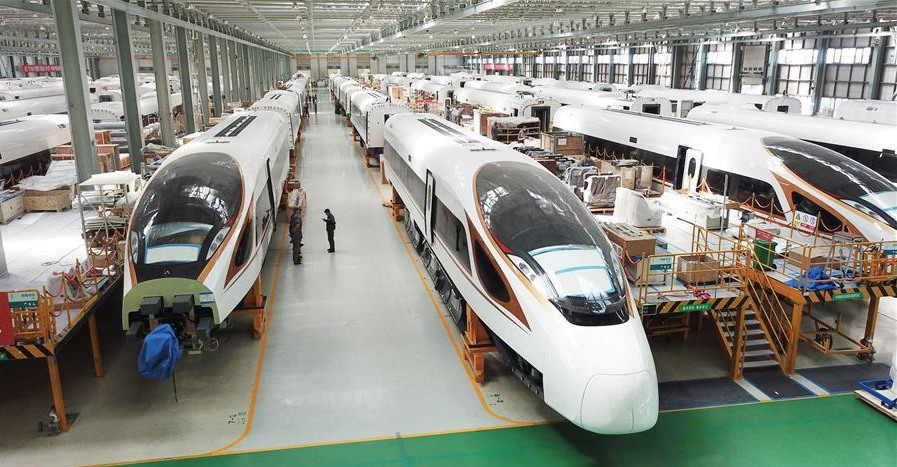
Fuxing bullet trains at the assembly workshop at CRRC Changchun Railway Vehicles Co. Ltd. in Changchun, northeast China's Jilin Province. September 14, 2017 /Xinhua News Agency
Fuxing bullet trains at the assembly workshop at CRRC Changchun Railway Vehicles Co. Ltd. in Changchun, northeast China's Jilin Province. September 14, 2017 /Xinhua News Agency
To increase workers' income with market mechanisms, it is necessary to strictly implement the principle of fair trade and establish and improve the market pricing system.
Within the framework of the labor market, the fair trade principle is embodied in the bargaining between labor and capital, i.e., the pricing of labor value by producers and workers, as well as the pricing of products that affect workers' income. Agricultural products are a good case in point. Because the power of capital is greater than that of workers, the income distribution between capital and workers may be unfair.
In order to ensure workers receive reasonable incomes, we should secure the leading role of workers in the market so that they can effectively exercise their right to pricing. In industries and services, collective wage bargaining and minimum wage mechanisms should be implemented.
For agriculture, farmers' income is determined by the price of agricultural products. In order to ensure fair prices, on top of the mechanism of minimum price protection of agricultural products, we should also implement a collective bargaining mechanism between farmers and wholesalers to determine fair prices.
As the defender of a fair market, the government has at least two things to do to increase workers' income. The first is to establish a system to safeguard workers' income. In the process of implementing labor laws and policies, competent authorities must ensure the smooth operation of the labor market pricing system.
The second is to fix market failures with fiscal and tax policies. The main measures include raising taxes on the rich and providing subsidies for low and middle income workers, expanding government spending on social welfare to increase workers' disposable income, and implementing tax reforms that involve tax cuts for businesses, part of which must be used to increase workers' income.
(If you want to contribute and have a specific expertise, please contact us at opinions@cgtn.com)