
Opinions
09:08, 30-Jul-2018
Opinion: Trump’s 'zero tariffs' deal targets domestic goals
Updated
08:39, 02-Aug-2018
 ["china"]
Share







Copied
Editor’s note: Xu Fangqing is a senior editor at China News Week and a non-resident fellow at the Center for China and Globalization. The article reflects the author's opinion, and not necessarily the views of CGTN.
It’s now a familiar episode when it comes to President Donald Trump that one day he may voice threats and even accusations towards an adversary but speak highly of the same subject the next day.
The US-European “zero tariffs” agreement follows the exact roadmap of Trump’s “art of the deal” given the primary trade tensions between the two sides of the Atlantic.
The “madman” and “little rocket man” scolding still echoed when the US president and DPRK leader Kim Jong Un sat for a historic meeting and agreement in June.
Likewise, Trump expressed his willingness to sign a “real” nuclear deal with Iran as he insisted on quitting the multilateral atomic solution. It has become the classic rule for his style.
Undoubtedly Trump has achieved impressive scores, especially on the promises he made to his voters. It also reflects on his current high approval rate among his supporters despite so many adverse developments, from the Helsinki summit to his long-term former lawyer Cohen’s damaging testimony.
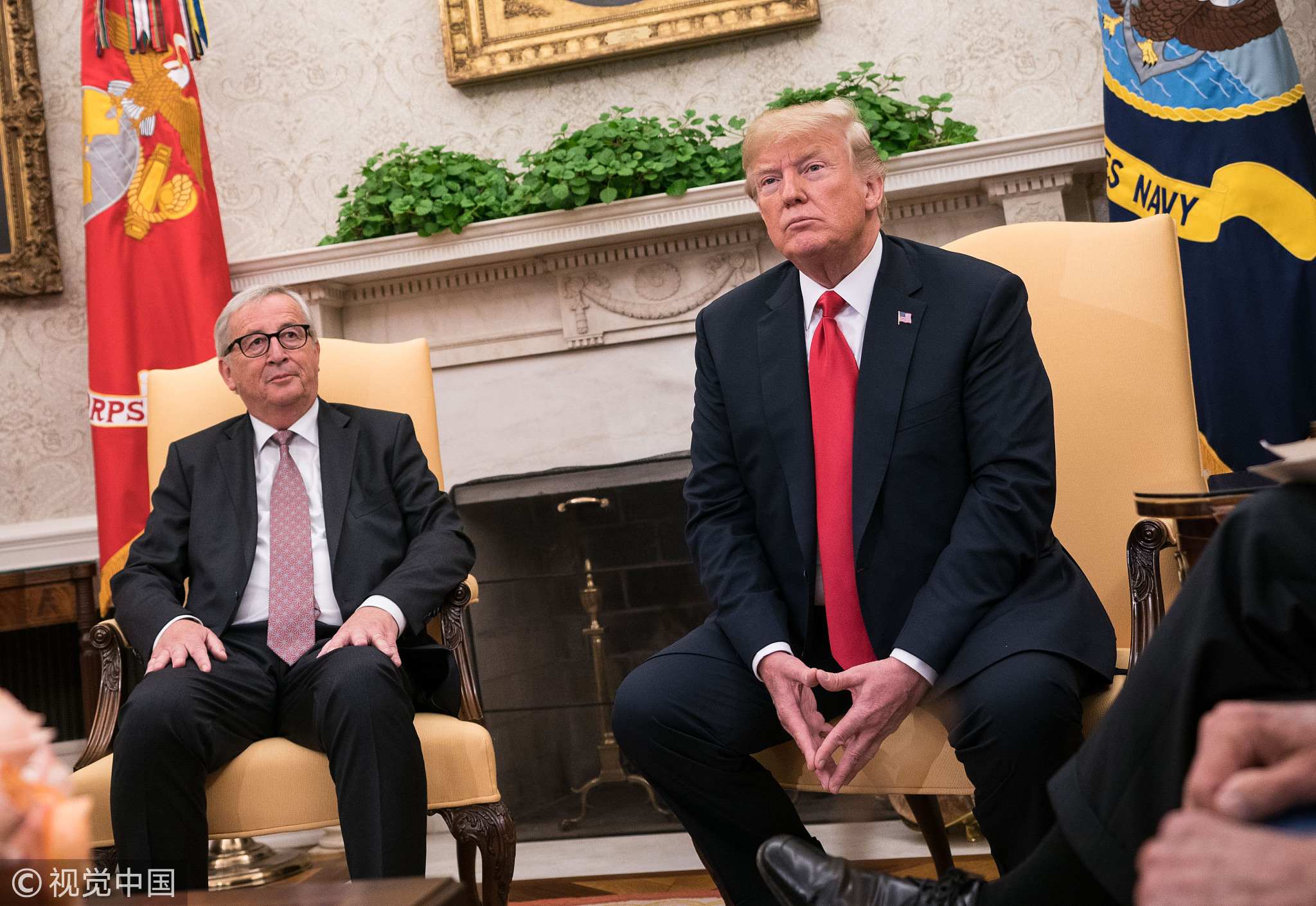
US President Donald Trump sits with President of the European Commission Jean-Claude Juncker, in the Oval Office at the White House, July 25, 2018. /VCG Photo.
US President Donald Trump sits with President of the European Commission Jean-Claude Juncker, in the Oval Office at the White House, July 25, 2018. /VCG Photo.
However, we could also conclude that it’s a little bit different from the inside to outside. With regard to domestic issues, Trump pays more attention to the real effects or the essential goals.
While on the foreign policy, he tries to cater to American voters and cares less about what he could really make in the end.
The joint statement on trade issued by the US and EU last Wednesday could apply to this format. The “zero tariffs deal” both sides claimed is too great to be realized within a short-term as we see no timetable or any specific plan.
The agreement itself is a landmark, for the EU and US have now resorted to talking instead of fighting over their trade issues.
We believe that Trump is well aware of the prospects for “zero tariffs” considering the discord and tremendous gap among European countries. French President Macron has already expressed his direct disagreement over the “vast new trade deal” between Trump and Juncker.
It’s too early to say a US-European trade alliance has been formed due to the complexity and disharmony of economic interests among different entities.
In other words, a security and shared-values union could be more practical for them rather than a trade league.
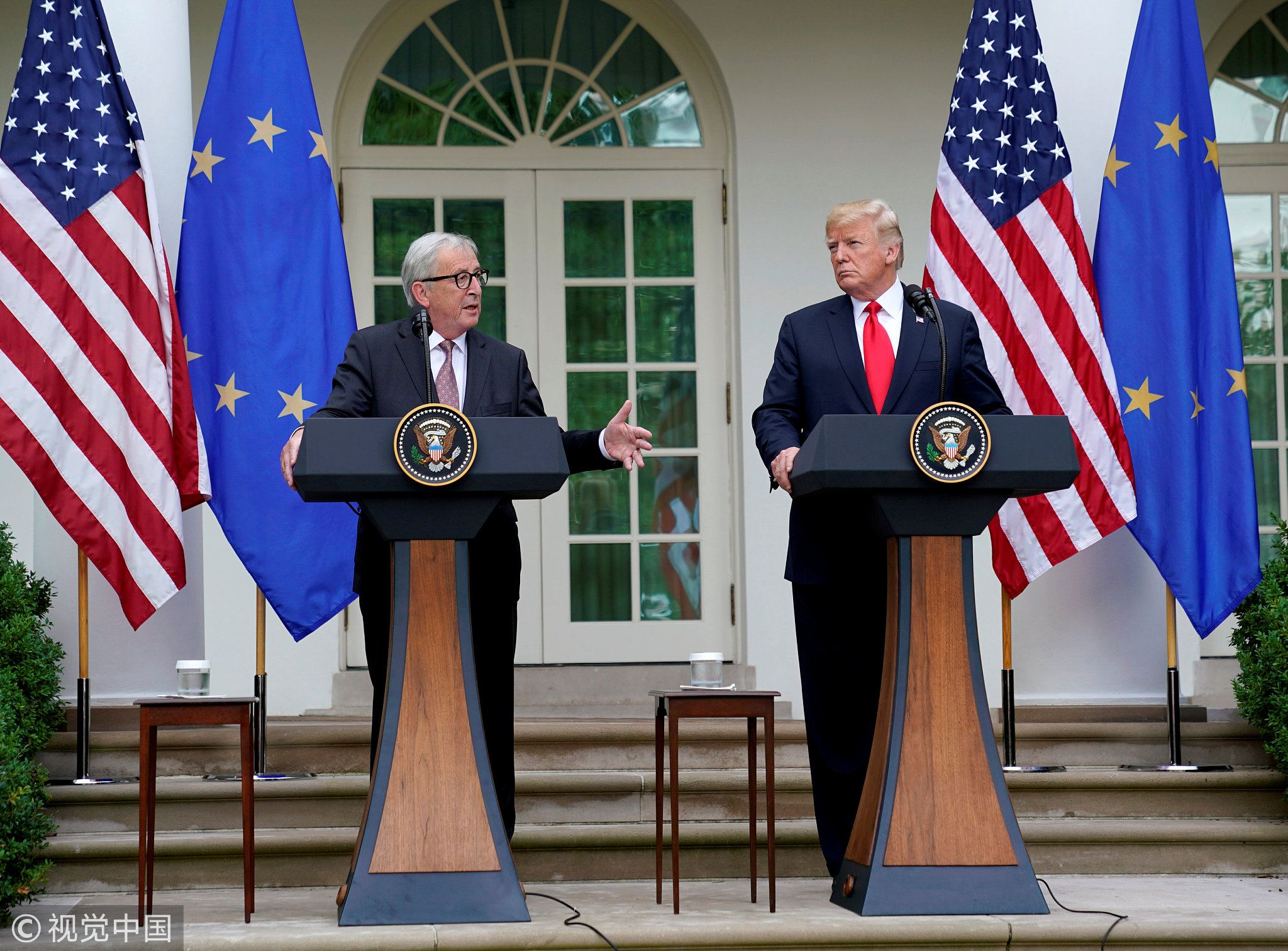
US President Donald Trump and President of the European Commission Jean-Claude Juncker speak about trade relations in the Rose Garden of the White House, July 25, 2018. /VCG Photo.
US President Donald Trump and President of the European Commission Jean-Claude Juncker speak about trade relations in the Rose Garden of the White House, July 25, 2018. /VCG Photo.
Moreover, a zero tariffs agreement with a timetable was inked firstly between Japan and the EU and the two have no military and security bonds, unlike Japan and the US.
A “trade union” is hard to forge but the trade agreements indeed have their rules in dealing with specific issues like anti-subsidies and protection of intellectual property rights.
At the end of May, representatives of the US, Europe, and Japan issued a joint statement in Paris to support the free trade spirit. The subsequent “zero tariffs” deals between the EU and Japan, and the EU and US just undertake the principles set by that statement.
As a developing economy, China would be under pressure to reach a zero tariffs deal because of the fragility and shortage of competitiveness of some our industries like agriculture and finance.
However, we also hold some strong advantages achieved from the reform and opening-up over the past 40 years as our government and enterprises have learned ample lessons and experiences to tackle the risks and challenges from inside and outside.
In the long run, “zero tariffs” would be in line with our strategic targets of enlarging our opening-up horizon and deepening our reform in order to realize our “double-century goals.”
Therefore, we would rather raise our economic strength to compete with the top players of the world than assume the real aim of the possible “tariff union.”
The priority for now is that we should promote and actively take part in the economic globalization with an open-minded attitude and wider global eyesight.