
World
17:02, 24-Apr-2018
Royal baby #3: Why not everyone is happy about it
 ["europe"]
Share







Copied
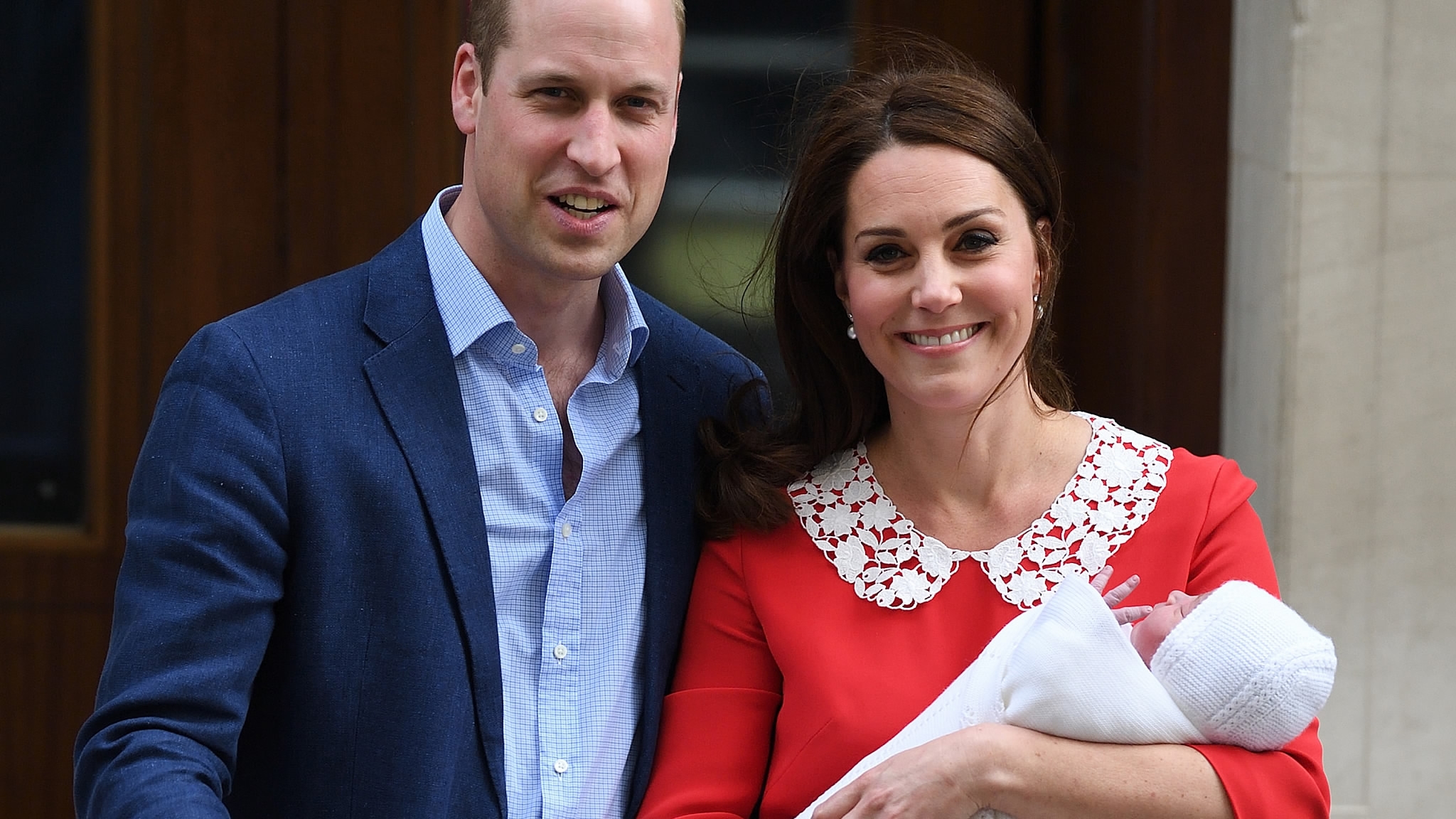
To the delight of royalists and well-wishers, Prince William and Kate Middleton emerged from the Lindo Wing of St. Mary’s Hospital all smiles carrying their newborn son.
Born at 11:01 a.m. on Monday, the new prince is now the fifth in line to the British throne and is Queen Elizabeth II’s sixth great-grandchild.

Royal well-wishers watch from above as the Duke and Duchess of Cambridge and their newborn son depart the Lindo Wing, St Mary's Hospital in Paddington, London,UK, on April 23, 2018. /VCG Photo
Royal well-wishers watch from above as the Duke and Duchess of Cambridge and their newborn son depart the Lindo Wing, St Mary's Hospital in Paddington, London,UK, on April 23, 2018. /VCG Photo
It is a joyous occasion welcomed by many and threw the media into frenzy. But amid all congratulations – #RoyalBaby instantly became the trending topic on Twitter since Kensington Palace’s announcement of the birth Monday morning – others find it a bitter pill to swallow.
‘Inhumane and barbaric’
The announcement of the third royal baby last year coincided, rather unfortunately, with the government’s reformed child tax credits, introducing what is now referred to as the “rape clause.” This means, among other things, parents are no longer entitled to support for a third child, or any subsequent children, unless the mother can prove that the baby is born “as a result of non-consensual conception” or “at a time when [she was] in an abusive relationship.” Other exceptions include adoption, multiple births, kinship care and those conceived before April 2017 when the announcement was made.
As if to make matters worse, mothers claiming this exemption must complete an eight-page “rape assessment” form, basically forcing them to disclose and relive their rape and abuse to third party professionals who need to countersign their claims. Living with the father of the child will disqualify the claimant. In an earlier interview, Scottish National Party MP Alison Thewliss called it "one of the most inhumane and barbaric policies ever to emanate from Whitehall".
This controversial two-child tax credit limit is said to impact around 515,000 families by 2020, hitting lower-income families the most who rely on the 2,780-pound tax credit per year for a child to supplement low wages. Such limits, however, will not affect the Cambridges.
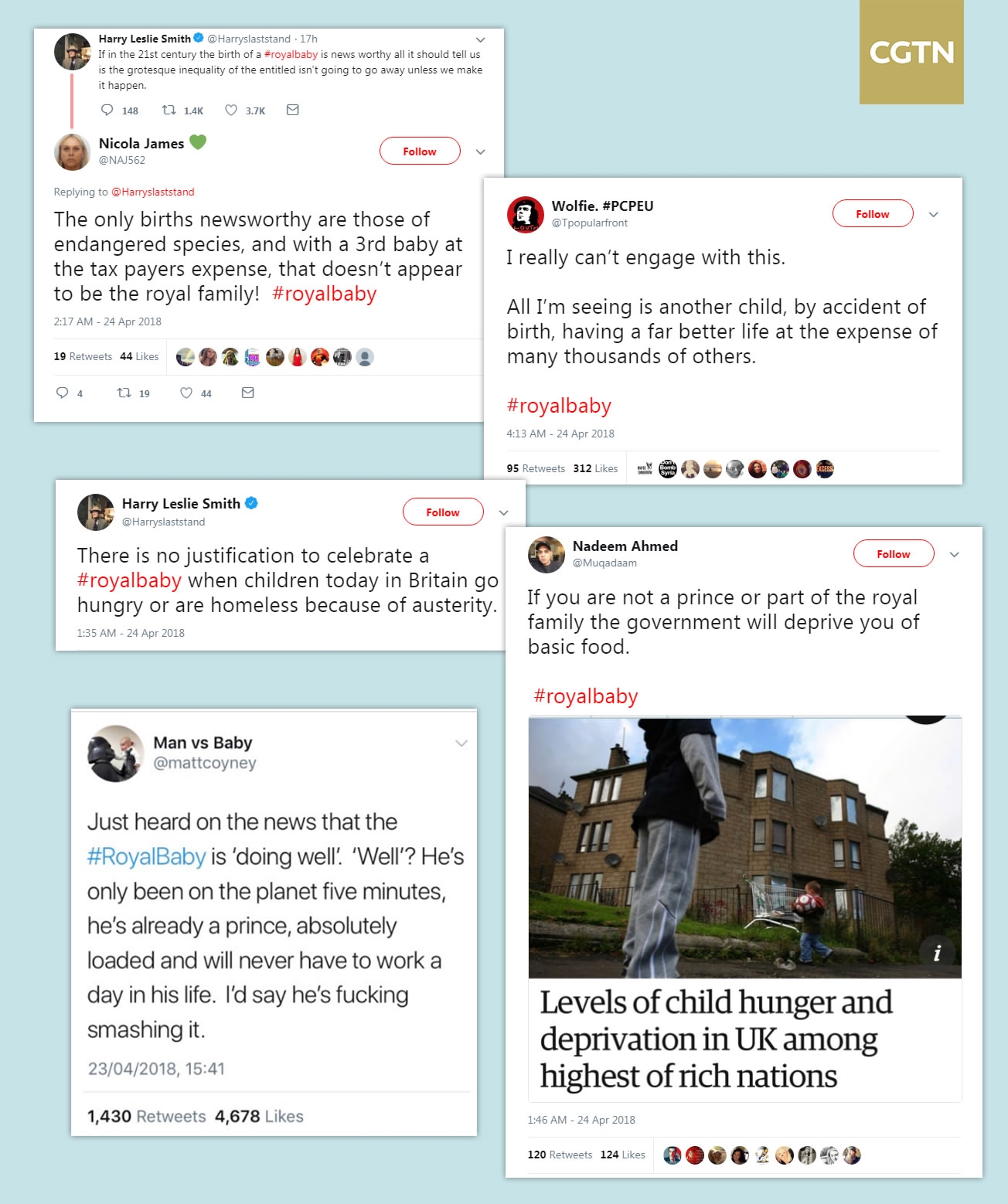
The controversial policy sparked a wave of anger on social media. The hashtag #RoyalBaby has been the trending topic on Twitter since Kensington Palace announced the royal birth on Monday morning.
The controversial policy sparked a wave of anger on social media. The hashtag #RoyalBaby has been the trending topic on Twitter since Kensington Palace announced the royal birth on Monday morning.
The callous policy was brought back into the public consciousness, sparking a wave of anger on social media questioning the fairness of a third royal baby. According to author and journalist Patti Armstrong, “The contrast of William and Kate’s baby news reveals that the government considers some more worthy of reproduction. It bespeaks of the notion that the wealthy are gifts to society that deserve to procreate while the poor are parasites.”
The government argued that the reform was to "ensure that people in receipt of benefits should face the same choices as those who supported themselves solely through work and to ensure that the system created incentives to work and to make progress and work as the best route out of poverty."
‘Unfairness of UK’
Among the excited crowd that greeted the Duke and Duchess of Cambridge outside the hospital on Monday, a Republican campaign group also voiced their sentiments that the third royal baby highlighted the “unfairness of UK.” Republican activists campaigning for the full abolishment of the Queen as head of state said the new prince should “signal an end to the Royal family.”
“The arrival of a new prince or princess highlights the unfairness of the hereditary principle – for the millions of children told they’ll never be good enough and for the baby whose life has been predetermined,” Republic group said in a statement. “Here is a new baby whose career, religion, even personal relationships, have already been mapped out.”
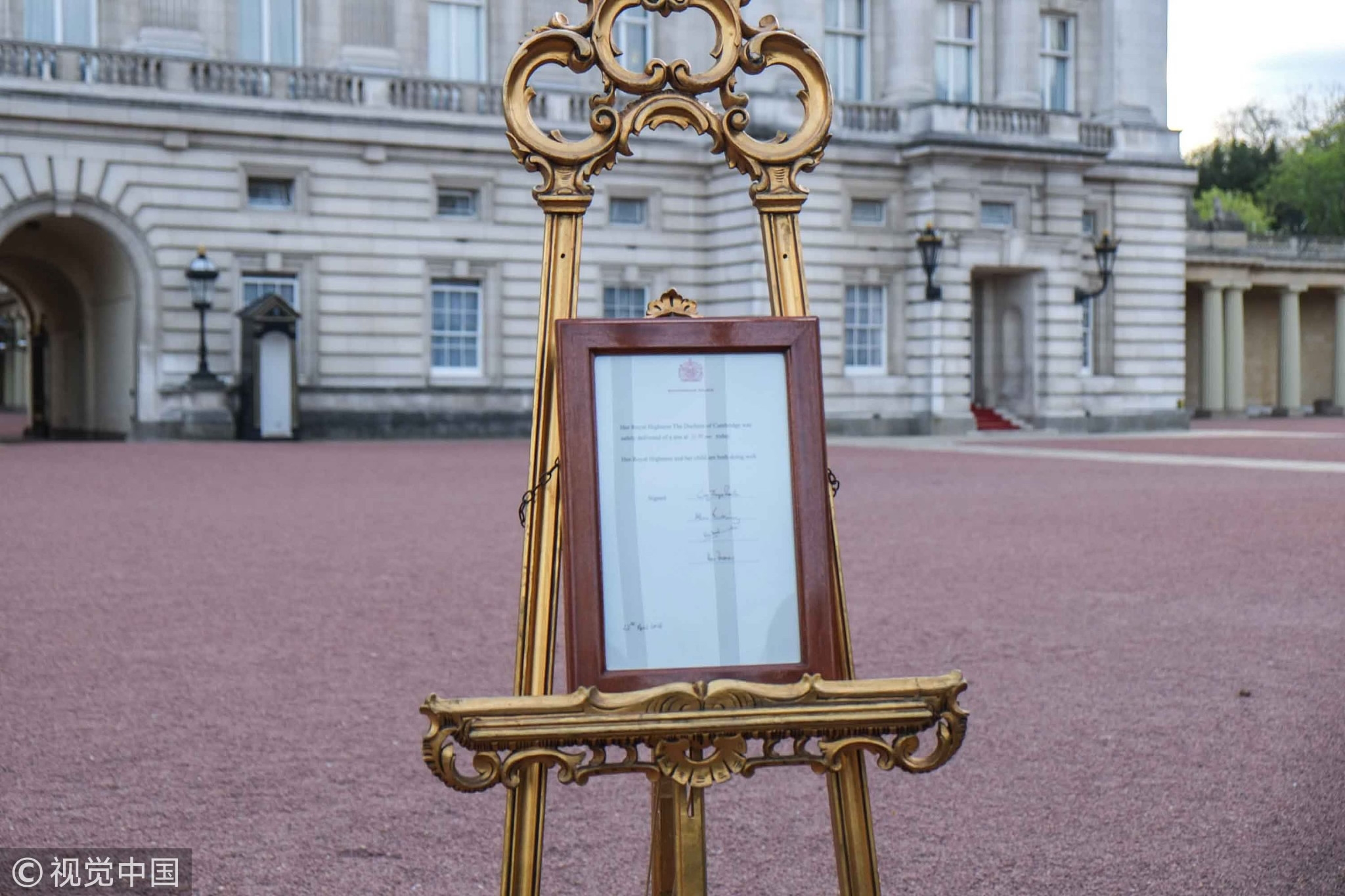
The formal notice announcing the birth of Prince William and Kate Middleton's third child, Buckingham Palace, London, UK, April 23, 2018. /VCG Photo
The formal notice announcing the birth of Prince William and Kate Middleton's third child, Buckingham Palace, London, UK, April 23, 2018. /VCG Photo
Two-child policy in China
Meanwhile, on the other side of the world, China just scrapped the commission responsible for administering its two-child policy as birth rates in the country continue to drop. Despite the lifting of the decades-old one-child policy in 2015, about 630,000 fewer babies were born in 2017 compared to 2016.
During the annual legislative meeting in March, the National Health and Family Planning, in charge of managing the country’s birth rates, is one of the 15 ministries and agencies that Chinese President Xi Jinping announced to be scrapped as part of a large restructuring of the ministries.
According to Xinhua, the country intends to set up a national health commission instead that “will be responsible for formulating national health policies, coordinating and advancing medical and healthcare reform, establishing a national basic medicine system, supervising and administering public health, medicare and health emergencies, as well as family planning services.”
However, Wang Pei'an, the deputy director of the family planning commission told financial news agency Caixin that the two-child policy still needs to be reviewed and that China does not intend to loosen family planning policies.
For the first time since 1981, “family planning” will not appear in the name of any government department in China.